Supervised vs Unsupervised Learning: Key Differences
Published: 7 Jul 2026
Machine learning is everywhere today, from Google search results to Netflix recommendations. But have you ever wondered how machines actually learn from data? This question becomes even more interesting when we compare supervised vs. unsupervised learning.
Many beginners get confused between these two concepts because both are used to train AI models. However, the way they learn and the type of data they use is completely different.
In this article, we will explain supervised vs. unsupervised learning in detail. You will also learn key differences, real-world examples, and how both methods are used in modern AI systems.
What is Supervised Learning?
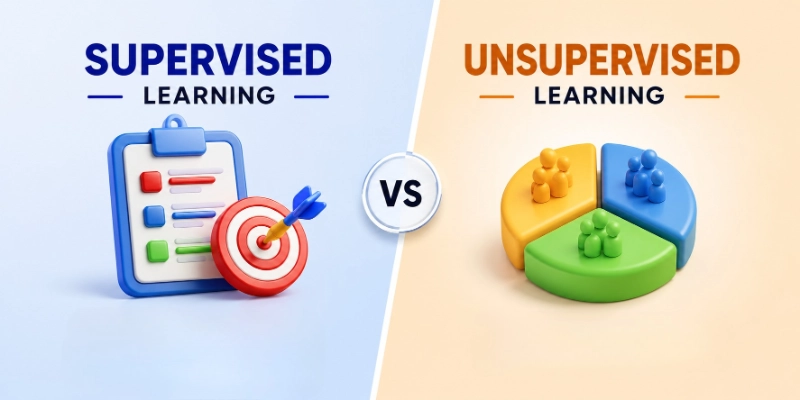
Supervised learning is a machine learning approach where a model learns from labeled data and predicts outputs based on past examples.
It works by mapping input data to the correct output using training examples.
Popular examples include:
- Email spam detection
- Image classification
- Language translation
- Credit score prediction
- Weather forecasting
What is Unsupervised Learning?
Unsupervised learning is a machine learning method where a model analyzes data without labels and discovers patterns, structures, or relationships.
It groups similar data together or finds hidden insights.
Popular examples include:
- Customer segmentation
- Market basket analysis
- Anomaly detection
- Recommendation systems
- Data clustering
Key Characteristics of Supervised Learning
The following are the main characteristics of supervised learning that explain how it learns from labeled data and makes predictions.
1. Uses labeled datasets
- Supervised learning works with labeled datasets where both input data and correct outputs are already provided.
- The model learns patterns by comparing inputs with the expected results during training.
2. Requires training and testing data
- Supervised learning uses training data to learn patterns and testing data to measure accuracy.
- This process helps the model perform better on new and unseen data.
3. Predicts outcomes
- The main purpose of supervised learning is to predict outcomes based on learned patterns.
- It can identify categories, make decisions, or estimate future results from input data.
Key Characteristics of Unsupervised Learning
The following are the main characteristics of unsupervised learning that explain how it works with data and identifies hidden relationships.
1. Works with unlabeled data
- Unsupervised learning uses unlabeled data where no correct answers or categories are provided.
- The system analyzes the data independently to identify structures and relationships.
2. No predefined output
- In unsupervised learning, there is no fixed output or target result during training.
- The model explores the data and generates insights based on similarities and differences.
3. Finds hidden patterns
- The main goal of unsupervised learning is to discover hidden patterns and group related data.
- It helps identify trends, clusters, and data relationships that may not be immediately visible.
Side-by-Side Comparison Table
The table below provides a comparison of supervised and unsupervised learning based on their features, working methods, and real-world applications.
| Feature | Supervised Learning | Unsupervised Learning |
| Data | Uses labeled data | Uses unlabeled data |
| Purpose | Predicts outcomes and classifications | Finds hidden patterns and relationships |
| Algorithms | Linear Regression, SVM, Decision Trees | K-Means, PCA, Apriori Algorithm |
| Use cases | Spam detection, price prediction, classification | Customer segmentation, recommendation systems |
| Complexity | Easier to evaluate because outputs are known | More complex because outputs are not predefined |
Real-World Examples of Supervised Learning Algorithms
Supervised learning algorithms are widely used in real-world applications where labeled data helps machines make accurate predictions and decisions. These algorithms improve automation, forecasting, and classification tasks across different industries.
Some common real-world examples are given below.
- Spam Email Detection: Identifies unwanted or harmful emails automatically.
- House Price Prediction: Predicts property prices based on market and location data.
- Medical Diagnosis Systems: Helps detect diseases and medical conditions using patient data.
- Credit Score Prediction: Evaluates a person’s creditworthiness based on financial history.
- Weather Forecasting: Predicts weather conditions using historical climate data.
Real-World Examples of Unsupervised Learning Algorithms
Unsupervised learning algorithms are commonly used to discover hidden patterns, relationships, and structures in unlabeled data. These algorithms help businesses and researchers analyze large datasets more effectively.
Common real-world examples are listed below.
- Customer Segmentation: Groups customers based on behavior, interests, or purchasing patterns.
- Market Basket Analysis: Finds products that customers frequently buy together.
- Anomaly Detection: Identifies unusual patterns or suspicious activities in datasets.
- Recommendation Systems: Suggests products, movies, or music based on user behavior.
- Social Network Analysis: Detects relationships and communities within social media platforms.
Types of Supervised Learning
Supervised learning is mainly divided into different types based on the kind of output the model predicts.
Each type is used for specific tasks and helps solve different real-world problems using labeled data.
These learning methods are widely used in machine learning applications such as prediction systems, spam filtering, and data analysis.
The two main types of supervised learning are classification and regression.
The following are the major types of supervised learning.
- Classification: Used to place data into categories such as spam or not spam, true or false, or different object classes.
- Regression: Used to predict continuous values such as house prices, weather temperature, or sales revenue.
Types of Unsupervised Learning
Unsupervised learning is divided into different types based on how the system analyzes and organizes unlabeled data.
These methods help discover hidden structures, relationships, and patterns without predefined outputs.
Different unsupervised learning techniques are used in areas such as customer analysis, recommendation systems, and data compression.
Each type focuses on solving a specific kind of data problem.
The following are the major types of unsupervised learning.
- Clustering: Groups similar data points together based on shared characteristics or patterns.
- Association: Identifies relationships and connections between different data items within a dataset.
- Dimensionality Reduction: Reduces the number of variables in data while preserving important information for analysis.
Supervised Learning Algorithms
Supervised learning uses different algorithms to train AI models using labeled data. These algorithms help machines make predictions, identify patterns, and solve problems accurately based on the type of data and learning task.
The following are some common supervised learning algorithms.
- Linear Regression: Predicts continuous numerical values by finding relationships between variables.
- Logistic Regression: Used for classification tasks to predict outcomes like yes/no or true/false.
- Support Vector Machine (SVM): Separates data into categories using the best decision boundary.
- Decision Trees: Makes predictions through a tree-like structure of rules and decisions.
- Random Forest: Combines multiple decision trees to improve prediction accuracy and reduce errors.
Unsupervised Learning Algorithms
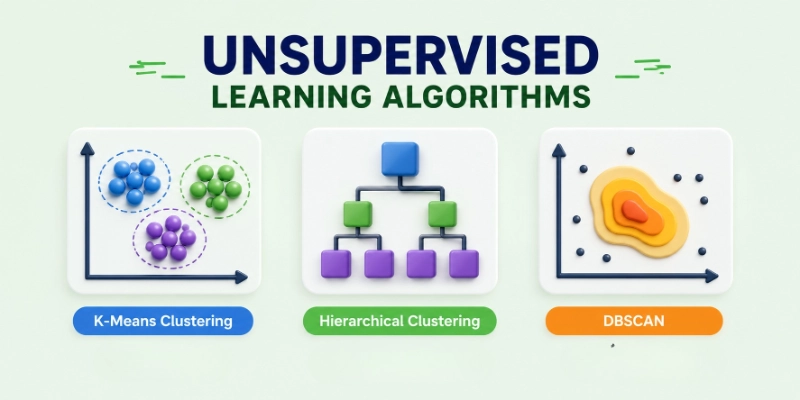
Unsupervised learning uses different algorithms to analyze unlabeled data, identify hidden patterns, and organize information into meaningful groups. These algorithms work differently depending on the type of data and the learning objective.
The following are some common unsupervised learning algorithms.
- K-Means Clustering: Groups similar data points into clusters based on patterns and similarities.
- Hierarchical Clustering: Creates a hierarchy of clusters by measuring similarities between data points.
- Apriori Algorithm: Finds frequent relationships and item combinations within large datasets.
- Principal Component Analysis (PCA): Reduces dataset complexity while preserving important information.
Advantages and Disadvantages
The following are the advantages and disadvantages of both supervised learning and unsupervised learning, highlighting their strengths and limitations in real-world AI applications.
Supervised Learning
Supervised learning is highly effective for prediction and classification tasks because it learns from labeled data. However, it also has some limitations related to data requirements and training complexity.
Pros
- Provides highly accurate predictions with labeled data
- Easy to measure model performance and accuracy
- Works well for classification and regression tasks
- Widely used in real-world business and healthcare applications
- Helps automate decision-making processes
Cons
- Requires large amounts of labeled training data
- Data labeling can be time-consuming and expensive
- Performance depends heavily on data quality
- May struggle with unseen or complex data patterns
- Training can take longer for large datasets
Unsupervised Learning
Unsupervised learning is useful for discovering hidden patterns and relationships in unlabeled data. It is commonly used for clustering, segmentation, and pattern analysis, but interpreting results can sometimes be difficult.
Pros
- Does not require labeled training data
- Helps discover hidden patterns and relationships
- Useful for clustering and data segmentation tasks
- Works well with large and complex datasets
- Reduces human effort in data preparation
Cons
- Results may be less accurate compared to supervised learning
- Difficult to evaluate model performance
- Interpretation of patterns can be challenging
- May produce irrelevant or unclear groupings
- Requires careful parameter selection for better results
When to Use Supervised vs Unsupervised Learning
The following points explain when supervised learning and unsupervised learning should be used in different machine learning situations.
- Use supervised learning when labeled data and predefined outputs are available for training and prediction tasks.
- Use unsupervised learning when data patterns, relationships, or groupings are unknown and need to be discovered automatically.
- Choose the learning method based on the business goal, data availability, and the type of problem being solved.
- Supervised learning is useful for tasks like classification, forecasting, and outcome prediction where accuracy is important.
- Unsupervised learning is helpful for customer segmentation, trend analysis, and discovering hidden insights from large datasets.
Real-World Applications in AI Industry
Artificial intelligence is widely used across different industries to improve efficiency, automate tasks, and support better decision-making. Some major real-world applications of AI are listed below.
- Healthcare: AI helps improve medical diagnosis, patient monitoring, and treatment recommendations.
- Finance: AI is used for fraud detection, risk analysis, and automated financial services.
- Marketing: AI helps businesses analyze customer behavior and deliver personalized advertising.
- E-commerce: AI improves product recommendations, customer support, and online shopping experiences.
- Cybersecurity: AI detects cyber threats and suspicious activities and protects digital systems from attacks.
Challenges in Both Learning Types
Both supervised and unsupervised learning face several challenges that can affect model performance, accuracy, and efficiency. These challenges must be addressed to build reliable AI systems.
- Data Quality Issues: Poor or incomplete data can reduce the accuracy and reliability of AI models.
- Overfitting and Underfitting: Models may either learn too much detail or fail to learn important patterns from data.
- Lack of Labeled Data: Supervised learning often struggles when sufficient labeled training data is unavailable.
- Scalability Issues: Handling and processing very large datasets can increase computational complexity and cost.
Conclusion
In this guide, we have covered supervised vs. unsupervised learning. We explored what both concepts mean, how they work, their key differences, and how they are applied in real-world AI systems. From supervised learning models that rely on labeled data to unsupervised learning methods that discover hidden patterns, both play an important role in modern machine learning. We also looked at their algorithms, advantages, disadvantages, and industry applications to give you a complete understanding.
Overall, both learning approaches are essential for building intelligent systems, and the choice between them depends on the type of data and the problem you want to solve. Understanding these fundamentals helps you choose the right technique for better accuracy and results in AI projects.
Personal Recommendation: I personally recommend starting with supervised learning first because it is easier to understand and builds a strong foundation. AIter that, exploring unsupervised learning will help you handle more complex and real-world data problems effectively.
Thank you for reading. Wishing you the best on your learning journey!
FAQs
Here are some frequently asked questions to help you better understand the differences between supervised and unsupervised learning.
The following points explain the difference between supervised and unsupervised learning in a simple and clear way:
- Data Type: Supervised learning uses labeled data, while unsupervised learning uses unlabeled data.
- Learning Style: Supervised learning learns with known outputs, while unsupervised learning finds patterns on its own.
- Main Purpose: Supervised learning predicts results, while unsupervised learning discovers hidden structures.
Common supervised learning algorithms include linear regression, logistic regression, decision trees, and support vector machines (SVM). These algorithms are used for prediction and classification tasks. They help machines learn from past data to make accurate future predictions.
Here are the real-world applications of unsupervised learning explained in simple points:
- Customer Segmentation: Groups customers based on behavior and preferences.
- Recommendation Systems: Suggests products or content based on hidden patterns.
- Market Basket Analysis: Finds items that are frequently bought together.
Supervised learning is important because it provides accurate and reliable predictions using labeled data. It is widely used in industries like healthcare, finance, and marketing. It helps automate decision-making processes with high accuracy.
Clustering is a technique in unsupervised learning where similar data points are grouped together. It helps identify patterns without predefined labels. It is commonly used in customer segmentation and data analysis.
Supervised learning requires large labeled datasets, which can be expensive and time-consuming. Unsupervised learning is harder to evaluate and may produce unclear results. Both methods can face issues like overfitting, poor data quality, and scalability problems.
Neither is better because both serve different purposes in AI and machine learning. Supervised learning is best for prediction tasks, while unsupervised learning is best for pattern discovery. The choice depends on the type of data and problem.
Dimensionality reduction is a technique used to reduce the number of variables in large datasets. It keeps only the most important information for analysis. PCA (Principal Component Analysis) is a popular method used for this purpose.
Here are the real-world uses of supervised learning explained in simple points:
- Spam Email Detection: Identifies spam and important emails using labeled training data.
- House Price Prediction: Predicts property prices based on past market data and features.
- Medical Diagnosis Systems: Helps doctors detect diseases using patient history and test results.
To learn these concepts, you need basic knowledge of mathematics, statistics, and Python programming. Understanding data analysis and machine learning basics is also important. With practice, you can easily apply both methods in real projects.




- Be Respectful
- Stay Relevant
- Stay Positive
- True Feedback
- Encourage Discussion
- Avoid Spamming
- No Fake News
- Don't Copy-Paste
- No Personal Attacks
- Be Respectful
- Stay Relevant
- Stay Positive
- True Feedback
- Encourage Discussion
- Avoid Spamming
- No Fake News
- Don't Copy-Paste
- No Personal Attacks
