AI Myths and Facts Everyone Still Believes
Published: 18 Jun 2026
Can AI really replace humans completely? Many people ask this question after watching videos or reading scary posts online. Some believe AI will control the world, while others think AI knows everything perfectly. The truth is very different from what most people hear online.
From my experience working with AI tools and studying how people use them, I have seen that most users do not fully understand how AI actually works. Movies and social media often create fear instead of sharing facts.
In this article, we will discuss AI myths and facts in detail. We will also clear common misunderstandings and explain the real impact of AI on jobs, businesses, education, and daily life.
AI Myths
Following are some common myths about AI that people often believe:
- AI will replace all human jobs
- AI is smarter than humans
- AI thinks like humans
- AI always gives correct answers
- AI is dangerous and will take over the world
- AI is only for big companies
- You need coding skills to use AI
- AI is replacing human creativity
- AI is always unbiased
- AI is just a temporary trend
- AI can read human minds
- AI learns completely on its own
- AI will eliminate the need for human skills
- AI understands emotions perfectly
- AI makes businesses successful automatically
Let’s have a look at them in detail.
1. AI Will Replace All Human Jobs
Fact: AI changes jobs more than it removes them
Many people believe AI will remove most human jobs and leave people unemployed. This idea comes from fear and headlines that show AI as a complete replacement for human workers. It sounds like machines will take over every role in the future.
In reality, AI mostly changes how work is done. It automates repetitive and time-consuming tasks, but humans are still needed for decision-making, creativity, and problem-solving. In many industries, AI actually increases productivity instead of replacing workers.
Key points:
- AI handles repetitive tasks like data entry and basic support
- New job roles are created in AI, tech, and digital industries
- Humans are still needed for strategy and communication
- AI works as a support tool, not a full replacement
Solution: Treat AI as a helper in your work. Learn how to use AI tools to improve productivity instead of fearing them. Focus on upgrading your skills so you can work with AI, not against it.
2. AI Is Smarter Than Humans
Fact: AI is task-specific, not truly intelligent
Some people think AI is smarter than humans because it can answer questions quickly and solve problems in seconds. This creates the impression that AI has superior intelligence in every area.
The truth is that AI only performs well in specific tasks where it has been trained. It does not understand meaning, context, or real-world awareness like humans do. It cannot think independently or reason across different situations.
Key points:
- AI is strong in narrow tasks like writing or image recognition
- It does not have general intelligence
- It cannot learn outside its training data on its own
- Human intelligence is still far more flexible
Solution: Use AI as a tool for specific tasks. Do not rely on it for full decision-making. Combine AI output with human thinking for better results.
3. AI Thinks Like Humans
Fact: AI predicts patterns, not emotions or thoughts
Many people believe AI thinks like a human brain because it generates human-like responses. This makes it feel like AI understands what we say.
In reality, AI does not think or understand anything. It works by analyzing patterns in data and predicting the most likely response. There is no emotion, awareness, or personal understanding behind its output.
Key points:
- AI works on probability and patterns
- It does not have emotions or consciousness
- Responses are generated, not “thought”
- It cannot understand meaning like humans
Solution: Always remember AI is a prediction system. Use it for support tasks like drafting or summarizing, but apply human judgment for final decisions.
4. AI Always Gives Correct Answers
Fact: AI can make mistakes and hallucinate information
Many users assume AI is always accurate because it sounds confident. This leads people to trust AI answers without checking them.
However, AI can produce incorrect or misleading information. This happens because it generates responses based on patterns, not verified facts. Sometimes it even creates information that looks real but is completely false.
Key points:
- AI can generate wrong or outdated information
- It does not verify facts in real time (in many cases)
- It may “hallucinate” details
- Confidence in tone does not mean accuracy
Solution: Always verify important information from trusted sources. Use AI as a starting point, not a final authority.
5. AI Is Dangerous and Will Take Over the World
Fact: Current AI has no consciousness or goals
Many fears come from movies and science fiction where AI becomes self-aware and takes control. This creates a belief that real AI systems are dangerous.
In reality, modern AI has no awareness, emotions, or intentions. It only follows instructions given by humans and processes data. It cannot act on its own or form goals.
Key points:
- AI has no self-awareness
- It cannot make independent decisions
- It works only within human instructions
- Fear mostly comes from media, not reality
Solution: Focus on responsible use of AI instead of fear. Learn how AI works so you can understand its real limits and benefits.
6. AI Is Only for Big Companies
Fact: Small businesses and freelancers use AI daily
Many people think AI tools are expensive and only used by large companies with big budgets. This is no longer true.
Today, AI tools are widely available for individuals, freelancers, and small businesses. They help with writing, marketing, design, customer support, and more.
Key points:
- Affordable AI tools are available online
- Freelancers use AI for content and design
- Small businesses use AI for marketing and automation
- No large setup is required
Solution: Start using free or low-cost AI tools. Apply them to your daily tasks to save time and improve productivity.
7. You Need Coding Skills to Use AI
Fact: Most AI tools are beginner-friendly
People often assume AI is only for programmers or technical experts. This belief stops many beginners from trying it.
Modern AI platforms are designed for simple use. You can interact with them using plain text or voice without any coding knowledge.
Key points:
- No coding required for most tools
- Simple text prompts are enough
- Designed for non-technical users
- Easy to learn within minutes
Solution: Start with simple AI tools and practice regularly. Learn basic prompting instead of coding to get results faster.
8. AI Is Replacing Human Creativity
Fact: AI supports creativity but cannot replace human emotions and originality. Some people fear that AI will take over creative fields like writing, design, and music.
AI can generate ideas and assist in creative tasks, but it does not have real emotions or personal experiences. Human creativity comes from feelings, culture, and imagination, which AI cannot replicate.
Key points:
- AI helps generate ideas and drafts
- It lacks emotional depth
- Human experience drives originality
- Creativity improves with AI support
Solution: Use AI as a creative assistant. Combine it with your own ideas to produce better and more unique work.
9. AI Is Always Unbiased
Fact: AI depends on training data and can reflect bias. Many believe AI gives neutral and fair results all the time. This is not always true.
AI systems learn from data created by humans. If that data contains bias, the AI can repeat it in its outputs.
Key points:
- AI learns from human-generated data
- Bias in data affects results
- Outputs may not always be fair
- Human review is important
Solution: Always review AI outputs critically. Use diverse sources and human judgment to reduce bias.
10. AI Is Just a Temporary Trend
Fact: AI is becoming part of modern work and life. Some people think AI is just a passing trend like many tech fads in the past.
However, AI is already deeply integrated into apps, businesses, and services. Its use is growing every year across industries.
Key points:
- Used in education, healthcare, and business
- Integrated into daily apps and tools
- Investment in AI is increasing globally
- Long-term technology shift
Solution: Learn AI skills early. Adapt to changes so you stay relevant in future job markets.
11. AI Can Read Human Minds
Fact: AI analyzes data patterns, not human thoughts. Some people believe AI can understand thoughts or predict intentions like mind reading. AI does not read minds. It only analyzes visible data such as text, behavior, or inputs.
Key points:
- No access to human thoughts
- Works only on data inputs
- Predictions are based on patterns
- No psychological awareness
Solution: Understand AI as a data tool, not a mind-reading system. Use it for analysis, not assumptions.
12. AI Learns Completely on Its Own
Fact: Humans train, monitor, and improve AI systems. Many think AI improves itself without human help.
In reality, AI systems are built, trained, and updated by humans. They require constant monitoring and improvement.
Key points:
- Human engineers train AI models
- Continuous updates are required
- AI does not evolve independently
- Human control is always needed
Solution: Trust AI as a human-built system. Understand that humans are always responsible for its behavior.
13. AI Will Eliminate the Need for Human Skills
Fact: Human creativity, judgment, and communication still matter. Some believe AI will make human skills unnecessary in the future.
AI can assist in tasks, but it cannot replace skills like decision-making, leadership, and communication.
Key points:
- Human judgment is still essential
- AI cannot replace leadership skills
- Creativity remains important
- Collaboration improves results
Solution: Focus on improving human skills alongside AI usage. The best results come from both working together.
14. AI Understands Emotions Perfectly
Fact: AI can detect patterns but cannot truly feel emotions. People think AI understands emotions like humans do because it responds in a friendly tone.
AI can detect emotional patterns in text or voice, but it does not feel anything.
Key points:
- Emotion detection is pattern-based
- No real feelings or empathy
- Responses are simulated
- Limited understanding of context
Solution: Do not rely on AI for emotional support. Use it for analysis, not human connection.
15. AI Makes Businesses Successful Automatically
Fact: Businesses still need strategy, people, and proper execution alongside AI. Some believe AI alone can make any business successful instantly. AI improves efficiency, but success still depends on strategy, planning, and human effort.
Key points:
- AI improves productivity
- Business strategy is still required
- Human decision-making is essential
- Execution determines success
Solution: Use AI as a support system in business. Combine it with strong planning and consistent execution for real growth.
AI Facts That May Surprise You
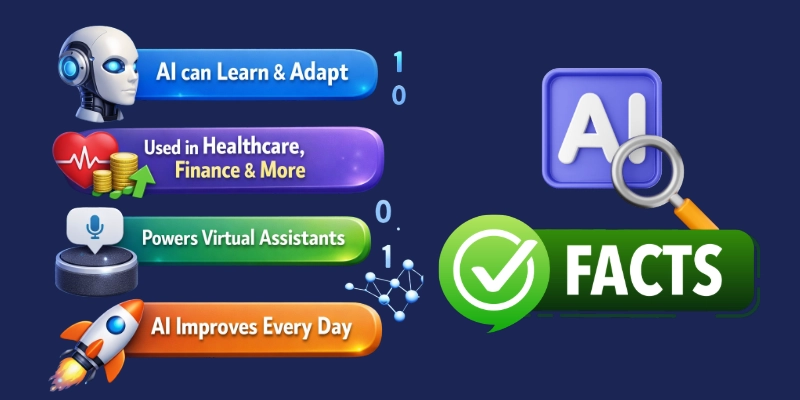
Artificial intelligence is becoming part of everyday life, but many people still misunderstand how it actually works. The following are some surprising facts about AI that everyone should know.
- AI does not actually think like humans. It works by analyzing patterns and predicting responses from data.
- AI learns from human-created content such as books, websites, videos, and articles.
- Many people already use AI daily through Google Maps, YouTube recommendations, face unlock, and voice assistants.
- AI can work very fast, but it can still give incorrect or misleading answers.
- AI cannot replace human emotions, experiences, or personal understanding.
- Humans still train, guide, and monitor AI systems.
- AI is a tool designed to assist humans, not fully replace them.
What AI Still Cannot Do
The following are some important things that AI still cannot do completely like humans:
- Human Emotions – AI cannot truly feel emotions like love, sadness, empathy, or happiness.
- Common Sense Thinking – AI often struggles to understand simple real-world situations naturally.
- Independent Decision Making – AI follows programmed instructions and still depends on human guidance.
- Ethical Judgment – AI cannot fully understand morality, fairness, or human values.
- True Creativity – AI can generate content, but real emotional originality still comes from humans.
Conclusion
In this guide, we have covered AI myths and facts. We discussed some of the biggest myths people believe about artificial intelligence and explained the real facts behind them. We also explored how AI works, where it is used, and why many fears about AI come from misunderstanding or incomplete information.
We also learned that AI is a powerful tool, but it still has many limitations. Human emotions, creativity, ethical thinking, and real-world understanding remain important in ways AI cannot fully replace. The best approach is to use AI wisely while combining it with human thinking and responsibility.
Personal Recommendation: Always use AI as a helpful assistant, not as a complete replacement for human judgment. Keep learning about AI because understanding technology will become more important in the future.
Thank you for reading this guide. I hope it helped you understand AI myths and facts in a simple and practical way.
Do not forget to leave a comment and share your thoughts about AI and its future.
FAQs
The following are some frequently asked questions about AI myths and facts that many beginners want to understand before using artificial intelligence tools.
Many people still believe that AI will completely replace humans, control the world, or think exactly like people. In reality, most AI systems only perform specific tasks based on data and programming. Understanding these AI myths and facts helps people use technology more realistically and responsibly.
The following are some important things to understand about AI and jobs.
- AI can automate repetitive tasks
- Many new jobs are also being created because of AI
- Human creativity and decision-making are still important
- Most industries use AI to assist workers, not fully replace them
AI itself is not automatically dangerous, but misuse of AI can create problems. Issues like fake content, privacy risks, and misinformation can become serious if people use AI irresponsibly. This is why experts encourage safe and ethical AI practices.
Artificial intelligence works by analyzing large amounts of data and finding patterns. AI systems learn from examples, training data, and algorithms created by humans. This process helps AI tools make predictions, answer questions, and automate tasks.
The following are some common benefits of artificial intelligence in daily life.
- Faster access to information
- Better customer support
- Personalized recommendations on apps
- Improved navigation through GPS systems
- Time-saving automation for businesses and students
No, AI cannot truly think or feel emotions like humans. AI can recognize emotional patterns and generate human-like responses, but it does not experience feelings, consciousness, or personal understanding. Human emotions and experiences remain unique.
Today, AI tools are available for students, freelancers, creators, and small businesses as well. Many AI platforms are easy to use without coding knowledge. This makes artificial intelligence more accessible than ever before.
The following are some major limitations of AI technology.
- AI lacks real emotions and empathy
- AI can produce incorrect information
- AI depends heavily on training data
- AI struggles with common-sense reasoning
- Human supervision is still necessary.
Many people fear AI because of movies, social media, and misinformation online. Some believe AI will become uncontrollable or replace all human roles. Learning accurate AI myths and facts can reduce unnecessary fear and confusion.
Artificial intelligence will continue growing in healthcare, education, business, and automation. The future of artificial intelligence is expected to bring more advanced technologies that improve productivity and solve complex problems. Experts believe humans and AI will work together more closely in the future instead of competing directly. Learning AI skills now can help people prepare for future opportunities.


- Be Respectful
- Stay Relevant
- Stay Positive
- True Feedback
- Encourage Discussion
- Avoid Spamming
- No Fake News
- Don't Copy-Paste
- No Personal Attacks
- Be Respectful
- Stay Relevant
- Stay Positive
- True Feedback
- Encourage Discussion
- Avoid Spamming
- No Fake News
- Don't Copy-Paste
- No Personal Attacks
