Role Of AI In Technology – Explained
Published: 14 Jul 2026
Artificial intelligence is now a core part of modern digital systems. It supports automation, data processing, and smart decision-making in almost every major technology field today. From mobile apps to large industrial systems, AI is changing how machines and software operate.
Businesses and developers now rely on AI to improve speed, accuracy, and performance in daily operations. This shift shows how deeply AI has become connected with innovation and progress in the tech world.
In this article we will discuss the role of AI in technology in detail and understand its real impact on modern systems.
Artificial Intelligence in Technology
Artificial intelligence in technology refers to the use of computer systems that can perform tasks requiring human intelligence. It helps machines learn from data, identify patterns, and make decisions with minimal human input. Today, AI is widely used to improve the speed, accuracy, and efficiency of digital systems.
In simple terms, AI makes technology smarter by adding the ability to think and respond in useful ways. It is now an essential part of modern digital tools and services used every day.
Key points:
- AI enables machines to learn from data
- It improves decision-making in technology systems
- It increases automation and reduces manual effort
- It is used in apps, software, and smart devices
Core Role of AI in Technology
AI plays a major role in improving how modern technology works across different industries. It helps systems become more efficient by reducing manual effort and allowing machines to handle complex tasks with greater speed and accuracy. This makes digital operations smoother and more reliable.
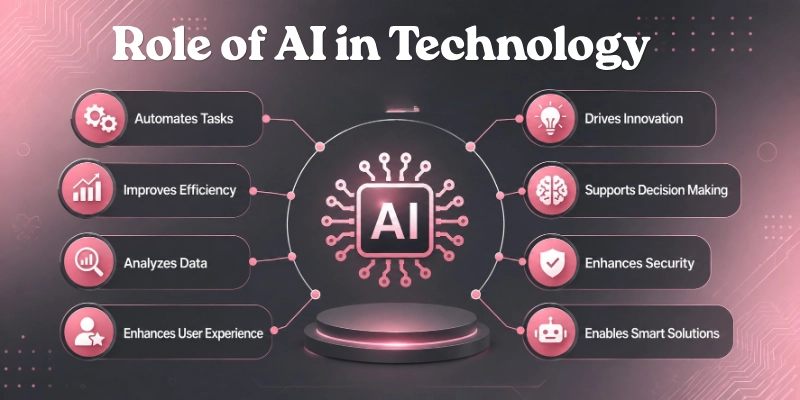
It also supports better decision-making by analyzing large amounts of data in a short time. As a result, businesses and users get more accurate results and improved performance in everyday applications.
The core role of artificial intelligence in technology can be understood through the following key areas:
- Automation of Processes
- Data Analysis and Decision Making
- Enhancing User Experience
- Improving Security Systems
- Powering Smart Technologies
Now let’s understand the core areas in detail where AI plays an important role in technology.
1. Automation of Processes
Artificial intelligence plays a significant role in automating routine and repetitive tasks across various industries. By reducing the need for manual intervention, AI helps organizations save time and minimize human errors.
Automation powered by AI enables businesses to streamline operations, increase productivity, and focus human resources on more complex and creative activities. This leads to improved efficiency and cost-effectiveness in the workplace.
The impact of AI-driven automation can be seen in several areas, including:
- Automating data entry and administrative tasks
- Managing manufacturing and assembly-line operations
- Improving workflow efficiency in businesses
- Reducing operational costs and human errors
- Enhancing productivity through continuous operation
2. Data Analysis and Decision Making
AI has transformed the way organizations analyze and interpret large volumes of data. Advanced algorithms can process information much faster than humans, identifying patterns and trends that might otherwise go unnoticed.
Through machine learning and predictive analytics, AI supports informed decision-making by providing accurate insights based on historical and real-time data. This helps businesses and institutions make strategic decisions with greater confidence.
The role of AI in data analysis and decision-making includes:
- Processing and analyzing big data efficiently
- Identifying hidden patterns and correlations
- Predicting future trends and market behavior
- Supporting business intelligence and planning
- Improving the accuracy of forecasts and recommendations
3. Enhancing User Experience
Artificial intelligence significantly improves user experience by creating personalized interactions across digital platforms. AI systems learn from user behavior and preferences to deliver relevant content and services.
This personalization increases user engagement and satisfaction by ensuring that individuals receive information, products, or recommendations that match their interests and needs.
Some key ways AI enhances user experience are:
- Personalized content and product recommendations
- Customized advertising and marketing campaigns
- Intelligent virtual assistants and chatbots
- Improved customer support services
- Recommendation systems used by platforms such as Netflix and YouTube
4. Improving Security Systems
AI has become an essential tool in strengthening cybersecurity and protecting digital systems. It continuously monitors networks and activities to identify unusual patterns that may indicate security threats.
By detecting potential risks in real time, AI helps organizations respond quickly to cyberattacks and prevent data breaches. This proactive approach enhances the overall security of digital environments.
AI contributes to security systems through
- Real-time threat detection and monitoring
- Fraud detection in banking and financial services
- Prevention of unauthorized system access
- Identification of suspicious online activities
- Enhanced cybersecurity response mechanisms
5. Powering Smart Technologies
Artificial intelligence serves as the foundation of many smart technologies that are becoming increasingly common in daily life. It enables devices to learn, adapt, and respond intelligently to user needs and environmental changes.
From smart homes to connected urban infrastructures, AI improves convenience, efficiency, and resource management. These technologies contribute to creating more sustainable and intelligent living environments.
The application of AI in smart technologies includes:
- Smart home devices and virtual assistants
- Internet of Things (IoT) systems
- Intelligent traffic management solutions
- Smart energy and resource management
- Development of smart cities with connected infrastructure
Applications of AI Across Technology Fields
Artificial intelligence is widely used across different fields of technology to improve efficiency, accuracy, and innovation. Its ability to analyze data, automate tasks, and support decision-making has made it an essential part of modern technological systems. AI applications continue to expand, transforming industries and enhancing everyday life.
The following points highlight the major applications of AI across various technology fields:
- AI in Software Development
- AI in Healthcare Technology
- AI in Communication Systems
- AI in Transportation Technology
- AI in Finance Technology (FinTech)
1. AI in Software Development
Artificial intelligence has significantly transformed software development by assisting programmers in writing, testing, and maintaining code. AI-powered tools can automate many development tasks, reducing the time and effort required to build software applications.
These technologies improve software quality by identifying errors, suggesting code improvements, and enhancing overall development efficiency. As a result, developers can focus more on solving complex problems and creating innovative solutions.
The application of AI in software development can be observed through:
- Code Generation Tools
- Bug Detection Systems
2. AI in Healthcare Technology
AI is revolutionizing healthcare technology by improving the accuracy and speed of medical diagnosis. Advanced AI systems can analyze patient data and support healthcare professionals in making informed clinical decisions.
Additionally, AI assists in predicting diseases and interpreting medical images, leading to earlier detection and better treatment outcomes. This contributes to improved patient care and healthcare efficiency.
The use of AI in healthcare technology includes:
- Diagnostic Systems
- Medical Imaging and Prediction
3. AI in Communication Systems
Artificial intelligence has enhanced communication systems by enabling more efficient and intelligent interactions between humans and technology. AI-powered communication tools help users access information and services quickly and effectively.
These systems also break language barriers and improve customer engagement through automated support solutions. As a result, communication becomes faster, more accessible, and more personalized.
Some important applications of AI in communication systems are:
- Chatbots and Virtual Assistants
- Language Translation Tools
4. AI in Transportation Technology
AI plays a crucial role in modern transportation by improving safety, efficiency, and traffic management. Intelligent systems can analyze road conditions, traffic patterns, and vehicle behavior in real time.
The integration of AI into transportation technologies supports the development of autonomous vehicles and smarter traffic control systems. This helps reduce congestion and enhances overall transportation performance.
The contribution of AI to transportation technology can be seen in the following:
- Self-Driving Vehicles
- Traffic Optimization Systems
5. AI in Finance Technology (FinTech)
Artificial intelligence has become an important component of financial technology by helping organizations manage risks and process financial data efficiently. AI systems can quickly analyze large volumes of transactions and identify unusual activities.
Furthermore, AI supports investment strategies and financial decision-making through advanced algorithms and predictive analysis. This increases accuracy and improves operational effectiveness in the financial sector.
The application of AI in FinTech includes:
- Fraud Detection
- Algorithmic Trading
Future of AI in Technology
Artificial intelligence is expected to play an even greater role in shaping the future of technology. As AI systems become more advanced, they will continue to transform industries, improve productivity, and create new opportunities for innovation.
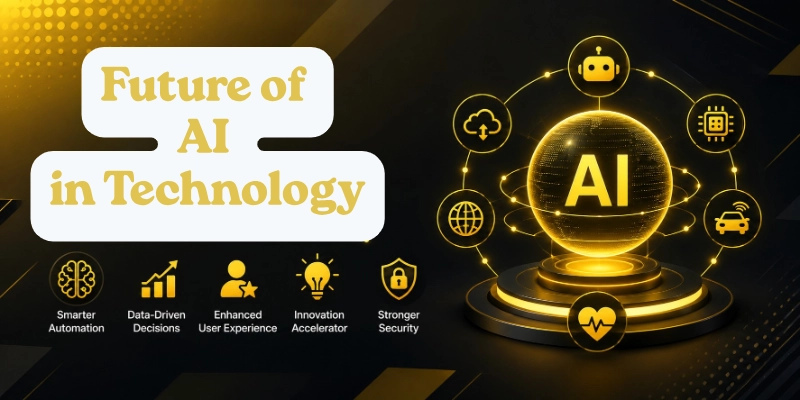
The following trends highlight the future direction of AI in technology:
- Rise of Autonomous Systems: AI-powered systems will increasingly perform tasks independently with minimal human intervention.
- AI-Human Collaboration: AI will work alongside humans to enhance decision-making, creativity, and productivity.
- Advanced Generative AI: Future AI models will generate more sophisticated content, including text, images, videos, and software code.
- Ethical AI Development Trends: Greater emphasis will be placed on fairness, transparency, privacy, and responsible AI governance.
- AI-Powered Robotics: Intelligent robots will become more capable of performing complex tasks in industries such as manufacturing, healthcare, and logistics.
- Enhanced Cybersecurity Solutions: AI will play a crucial role in detecting cyber threats, preventing attacks, and strengthening digital security systems.
Real-World Examples of AI in Technology
Artificial intelligence is already being widely applied by leading global technology companies. These organizations use AI to improve their products, services, and overall system performance. From cloud computing to autonomous systems, AI is deeply integrated into modern technological solutions.
The following examples highlight how AI is used in real-world technology platforms:
- Google AI Systems: Google uses AI for search optimization, voice assistants, translation, and smart recommendations.
- Microsoft AI Integration: Microsoft applies AI in cloud services, productivity tools, and enterprise solutions.
- Tesla Autonomous Technology: Tesla uses AI in self-driving systems and advanced vehicle automation.
- AI in Social Media Platforms: Platforms like Meta use AI for content recommendation, moderation, and user personalization.
- Amazon AI Services: Amazon uses AI in e-commerce recommendations, Alexa voice assistant, and cloud computing.
- IBM Watson: IBM develops AI systems for business analytics, healthcare solutions, and intelligent data processing.
Conclusion
In this guide, we have covered “Role of AI in technology.” We explored how AI supports automation, data analysis, user experience, security systems, and smart technologies. We also discussed its real-world applications across industries like healthcare, finance, software development, and transportation, along with future trends and practical examples.
AIerall, AI has become a key driver of modern technology systems. It continues to improve efficiency, accuracy, and innovation across almost every digital field. As technology grows, AI will play an even stronger role in shaping smarter and more advanced solutions.
Personal Recommendation: I recommend focusing on understanding how AI is applied in different industries rather than only learning theory. This approach helps build practical knowledge and improves your overall understanding of modern technology systems.
It is also important to stay updated with new AI tools and trends because this field is evolving very quickly.
Thank you for reading this article. I hope it helped you understand the topic in a clear and simple way.
💬 Share your thoughts in the comments below and let us know your opinion on this topic. 🚀✨
FAQs
Below are some frequently asked questions that help clarify common doubts about the role of AI in technology.
The role of AI in technology is to make systems smarter, faster, and more efficient. It helps machines analyze data, automate tasks, and support decision-making. AI is widely used in modern digital systems to improve performance and accuracy.
AI improves modern technology systems by adding intelligence to software and machines. It helps systems learn from data and respond in a better way over time. This makes technology more reliable and user-friendly.
Following are some key improvements:
- Faster data processing
- Better system accuracy
- Smarter automation
AI is important because it reduces manual work and increases efficiency in digital systems. It helps businesses make better decisions using data-driven insights. Today, most advanced technologies depend on AI to function effectively.
AI is used in almost every field of technology, including software, healthcare, finance, and communication systems. It powers tools like chatbots, recommendation engines, and self-driving systems. Its usage is growing rapidly across industries.
AI examples include Google search algorithms, Netflix recommendations, and Tesla self-driving systems. These systems use AI to analyze user behavior and improve results. Such examples show how AI is integrated into daily technology use.
Some common examples include:
- Virtual assistants like Siri and Alexa
- Fraud detection in banking
- Smart home devices
AI helps in data analysis by processing large datasets quickly and accurately. It identifies patterns and trends that humans may miss. This supports better forecasting and decision-making in technology systems.
The future of AI in technology is very advanced and promising. It will bring more automation, smarter systems, and improved human-machine collaboration. AI will continue to transform industries and create new innovations.
AI improves cybersecurity by detecting threats and unusual activities in real time. It helps prevent cyberattacks and protects sensitive data. This makes digital systems safer and more secure.
Key security roles include the following:
- Threat detection
- Fraud prevention
- Real-time monitoring
AI cannot fully replace humans in technology jobs, but it can automate repetitive tasks. It works as a support system that increases productivity and efficiency. Human creativity and decision-making are still very important.
AI provides many benefits such as automation, accuracy, and faster decision-making. It improves user experience and reduces operational costs. AIerall, it makes technology more advanced and efficient.





- Be Respectful
- Stay Relevant
- Stay Positive
- True Feedback
- Encourage Discussion
- Avoid Spamming
- No Fake News
- Don't Copy-Paste
- No Personal Attacks
- Be Respectful
- Stay Relevant
- Stay Positive
- True Feedback
- Encourage Discussion
- Avoid Spamming
- No Fake News
- Don't Copy-Paste
- No Personal Attacks
