What Is the Role of AI in Autonomous Vehicles?
Published: 31 Aug 2026
Autonomous vehicles use artificial intelligence to understand roads, recognize objects, predict movement, and make driving decisions. AI works with cameras, LiDAR, radar, GPS, and other systems to help vehicles understand their surroundings. Current research in 2026 also focuses on combining perception, reasoning, planning, and control to make autonomous vehicles more capable and adaptable.
AI powers many important driving tasks. It helps the vehicle detect pedestrians, identify traffic signs, predict the actions of other road users, choose a safe path, and respond to changing road conditions.
In this guide, we explore how AI supports autonomous driving, from environmental perception and decision-making to vehicle control, safety, challenges, and future developments.
Role Of AI In Autonomous Vehicles
Earlier automation systems followed carefully programmed instructions that determined how the vehicle should respond to specific situations. These systems are reliable because their behavior is predictable, and developers can easily trace why a specific action was taken.
However, their biggest limitation is that they struggle when they encounter situations that were not included in their original programming.
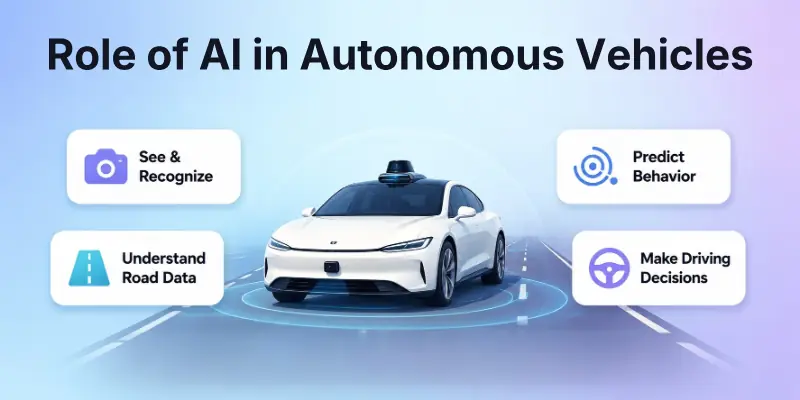
AI changes this approach by allowing driving systems to learn patterns from data instead of relying entirely on manually programmed responses. Autonomous vehicles can use machine learning, computer vision, and predictive models to analyze large datasets and respond to a wider range of driving conditions.
AI can help autonomous vehicles:
- Recognize vehicles, pedestrians, traffic signs, and road markings
- Interpret information collected from cameras, radar, and LiDAR
- Predict how nearby vehicles or pedestrians may behave
- Select appropriate actions based on changing road conditions
- Adjust to situations that may not follow a predictable pattern
- Improve driving decisions by learning from large datasets
However, teaching an AI system to deal with unusual driving situations is a major challenge. Some of the hardest situations to teach an autonomous system are unusual events that appear only rarely on real roads. These scenarios are commonly referred to as edge cases.
This is why autonomous driving development requires enormous amounts of driving data. Developers also use synthetic data and simulation environments to create unusual scenarios, test AI models, and expose autonomous systems to situations that may be difficult or dangerous to reproduce on real roads.
Together, real-world data, simulated environments, and AI models allow autonomous vehicles to become better at recognizing and responding to the wide range of situations they may encounter on the road.
How Do Self-Driving Cars Use AI?
The role of AI in a self-driving vehicle can vary depending on its automation level. To show that range, driving automation is classified from Level 0 to Level 5, from no driving automation to full driving automation.
At lower levels, such as Level 1, AI may support a driver with specific functions like steering or speed control. As automation advances, AI takes responsibility for more of the driving process. Level 3 systems, for example, can handle driving in specific conditions but may still require the human driver to take over when requested.
Levels 4 and 5 represent much greater automation. A Level 4 system can perform the entire driving task within its defined operational conditions. Level 5 represents full driving automation, where the vehicle is designed to perform the entire driving task under conditions in which a human driver could reasonably operate.
Exact capabilities vary by vehicle and manufacturer, but AI generally contributes to autonomous driving in three major areas: understanding the environment, making driving decisions, and controlling the vehicle.
1. AI Helps Self-Driving Cars Understand Their Environment
Every driving decision begins with environmental awareness. Before acting, the vehicle must determine what objects, road features, and potential hazards are around it. This is where AI-powered perception systems become essential.
Self-driving vehicles can combine information from several types of sensors, including:
- Cameras: Capture visual information such as road markings, traffic lights, signs, vehicles, and pedestrians.
- LiDAR: Creates detailed 3D information about nearby objects and their distance from the vehicle.
- Radar: Helps detect objects and estimate their distance and movement, including in conditions where visibility may be limited.
- Ultrasonic sensors: Provide short-range information useful for parking and detecting nearby obstacles.
- GPS and inertial sensors: Help determine the vehicle’s location, movement, and orientation.
Machine-learning models interpret the incoming sensor signals and turn them into a structured representation of the surrounding road scene. From there, the system can identify whether an object is a pedestrian, cyclist, vehicle, traffic sign, or road barrier. It can also monitor these objects as they move and estimate where they are likely to go next.
For example, the system may identify whether an object is a pedestrian, cyclist, vehicle, traffic sign, or road barrier. It can also monitor these objects as they move and estimate where they are likely to go next.
Related information: AI-powered perception is particularly important because autonomous vehicles must understand not only what is around them, but also how the surrounding environment is changing from one moment to the next.
2. AI Predicts What Other Road Users May Do
Detection alone is not enough for an autonomous vehicle. It must also estimate how nearby road users are likely to behave. From that understanding, the vehicle can determine what that object might do next.
AI models can analyze movement patterns and surrounding conditions to make predictions such as:
- Whether a pedestrian may cross the road
- Whether another vehicle may change lanes
- Whether a cyclist is likely to move into the vehicle’s path
- Whether traffic ahead is slowing down
- Whether an approaching vehicle may create a potential hazard
This predictive capability gives an autonomous vehicle more time to respond, rather than simply reacting after an event has already happened.
Related information: Prediction is especially valuable in busy environments where several vehicles, pedestrians, and cyclists may be moving simultaneously.
3. AI Makes Driving and Navigation Decisions
Once the system understands the scene and estimates what could happen next, it evaluates possible driving actions and selects the one that best fits the current situation. From there, it can weigh different possibilities based on the surrounding conditions.
It can evaluate different possibilities and select an action based on factors such as:
- Current traffic conditions
- Road layout
- Speed limits
- Nearby vehicles
- Pedestrian movement
- Obstacles
- Destination
- Safety requirements
AI can also help the vehicle choose and adjust its route as traffic, road conditions, or obstacles change. If traffic conditions change or a road becomes unavailable, the system can identify an alternative route and adjust its driving strategy.
For example, if a vehicle detects an obstacle blocking its lane, AI can assess the surrounding traffic, determine whether changing lanes is safe, and select an appropriate path.
Related information: Autonomous decision-making involves much more than choosing left or right. The system must consider multiple possible outcomes and select an action that balances safety, efficiency, and the vehicle’s intended destination.
4. AI Controls Steering, Braking, and Acceleration
Once the system determines what the vehicle should do, it must translate that decision into physical movement. From there, AI-driven control systems can work with the vehicle’s electronic and mechanical components to manage functions such as:
AI-driven control systems can work with the vehicle’s electronic and mechanical components to manage functions such as:
- Steering
- Braking
- Acceleration
- Speed adjustment
- Lane positioning
- Vehicle stability
For instance, if the perception system detects a pedestrian entering the vehicle’s path and the decision-making system determines that stopping is necessary, the control system can send the appropriate instructions to the braking system.
This creates a continuous feedback loop:
Sensors → AI perception → Prediction → Decision → Vehicle control → New sensor data
The process repeats constantly as the vehicle moves, allowing the system to respond to changes in its surroundings.
5. AI Combines Data Through Sensor Fusion
Each sensor provides a different view of the road, so autonomous vehicles combine their outputs to build a more dependable understanding of the environment. In this way, AI can use sensor fusion to create a more complete understanding of the vehicle’s surroundings.
Cameras can provide rich visual details, while radar can provide information about distance and movement. LiDAR can add detailed 3D environmental data.
AI can combine these different sources through sensor fusion to create a more complete understanding of the vehicle’s surroundings.
This can help the vehicle:
- Cross-check information from multiple sensors
- Reduce uncertainty about detected objects.
- Improve object tracking
- Build a more reliable representation of the road.
- Continue perception when one sensor has limited visibility.
6. AI Helps Autonomous Vehicles Handle Unexpected Situations
Road environments are not always predictable. As a result, construction zones, unusual traffic patterns, emergency vehicles, road debris, sudden braking, and unpredictable pedestrian behavior can create situations that were not expected during normal driving.
AI systems can use their learned patterns and real-time sensor information to evaluate these situations and determine an appropriate response.
However, rare scenarios remain one of the biggest challenges in autonomous driving. Because of this, developers rely on extensive real-world data, simulation, and synthetic data to expose AI models to a wider variety of driving conditions.
7. AI Continuously Processes New Driving Data
Every trip produces a continuous stream of sensor and vehicle data that can support system testing, analysis, and model improvement. This data can improve AI models, identify difficult scenarios, and refine the vehicle’s perception and decision-making capabilities.
A typical development cycle may involve:
- Collecting driving data
- Identifying difficult scenarios
- Training or improving AI models
- Testing models in simulation
- Validating them in controlled environments
- Deploying improved systems where appropriate
This data-driven approach helps developers improve autonomous-driving systems over time while reducing reliance on manually programmed rules for every possible situation.
Generative AI and Simulation
Teaching autonomous vehicles to respond safely to unusual situations is difficult because many of these scenarios rarely occur in real-world driving. As a result, developers may not have enough real-world examples to train AI systems effectively.
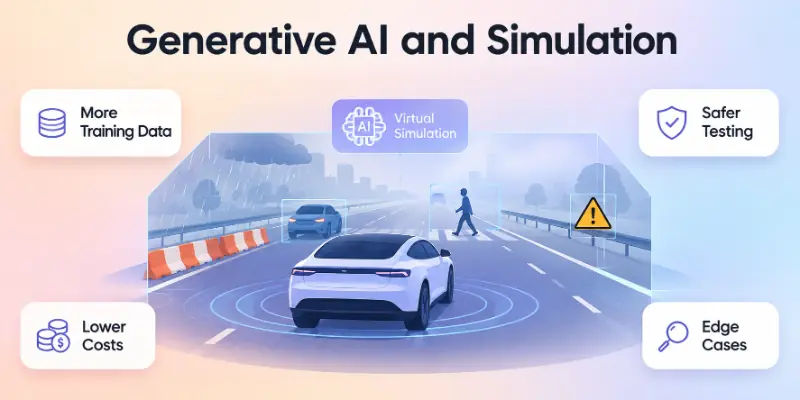
Instead of waiting for unusual situations to naturally appear during road testing, developers can use generative AI to construct additional scenarios in controlled virtual environments. AI models can produce synthetic images, videos, sensor readings, and virtual driving environments that represent situations an autonomous vehicle may encounter.
For example, synthetic environments can include:
- Pedestrians crossing unexpectedly
- Vehicles suddenly changing lanes.
- Heavy traffic
- Poor lighting conditions
- Rain, fog, or other difficult weather
- Road construction and temporary barriers
- Unusual vehicle movements
- Different road layouts and traffic patterns
Generative models, including GANs and newer AI approaches, can create synthetic images, videos, sensor data, and virtual driving scenarios for training and testing.
More advanced generative models can also help developers create diverse scenarios for training and testing autonomous-driving systems.
Using artificially generated scenarios can bring several practical benefits to autonomous-driving development:
- More training data: Rare scenarios can be generated artificially.
- Lower testing costs: Developers can run many scenarios virtually.
- Improved safety: Dangerous situations can be tested without putting people or vehicles at risk.
- Faster development: Thousands of scenarios can be created and tested in simulation.
- Better edge-case coverage: AI models can encounter unusual situations that may be difficult to collect from real roads.
Simulation also lets developers test an autonomous vehicle repeatedly under controlled conditions before moving to real-world testing.
AI Hardware
Autonomous driving requires high-performance onboard computing because the vehicle must process sensor data and respond to road conditions with very low latency. A vehicle continuously receives data from cameras, LiDAR, radar, ultrasonic sensors, positioning systems, and other sources.
That information must be processed with very low delay because driving decisions often need to happen within fractions of a second.
Important hardware components include:
- CPUs: Handle general-purpose computing tasks and system operations.
- GPUs: Perform large numbers of parallel calculations needed by many AI workloads.
- AI accelerators: Speed up machine-learning operations while improving efficiency.
- Systems-on-Chip (SoCs): Combine multiple processing components into a compact platform.
- Memory and storage: Handle the large volumes of sensor and model data generated by the vehicle.
- Edge computing: Allows data to be processed close to where it is collected rather than depending entirely on remote servers.
Local processing is especially important for autonomous vehicles because sending every sensor measurement to the cloud could introduce delays and create connectivity dependencies.
The hardware must therefore strike a difficult balance between processing speed, power consumption, heat generation, physical size, and reliability.
AI Technologies Used in Autonomous Vehicles
Autonomous vehicles rely on several AI technologies to understand their surroundings, predict road situations, make driving decisions, and respond to changing conditions. These technologies work together with sensors, onboard computers, and vehicle-control systems to support different stages of autonomous driving. The key AI technologies include:
- Machine Learning: Helps vehicles learn patterns from driving data and improve tasks such as object detection, prediction, and decision-making.
- Deep Learning: Uses neural networks to analyze complex data from cameras and sensors for tasks such as recognizing pedestrians, traffic signs, lanes, and vehicles.
- Computer Vision: Enables vehicles to interpret camera images and identify important visual elements such as road markings, traffic lights, obstacles, and other road users.
- Sensor Fusion: Combines data from cameras, LiDAR, radar, and other sensors to create a more complete and reliable view of the vehicle’s surroundings.
- Predictive AI: Analyzes movement patterns and road conditions to estimate what nearby vehicles, pedestrians, and cyclists may do next.
- Generative AI: Creates synthetic driving scenarios and training data that can help developers test autonomous systems against rare or difficult road situations.
- Edge AI: Processes AI workloads directly inside the vehicle, helping reduce latency and dependence on cloud connectivity for time-sensitive driving functions.
- Reinforcement Learning: Allows AI systems to learn driving strategies through simulated interactions and feedback, helping researchers improve planning and decision-making.
Future of AI in Autonomous Vehicles
The next stage of autonomous driving will depend on advances across several areas, including AI models, onboard computing, sensors, simulation, and safety validation.
In 2026, Level 4 driverless services are already operating commercially in more than 20 cities, although fully autonomous Level 5 vehicles are still not currently in sight. The future will focus less on simply making cars drive themselves and more on making them safer, more reliable, adaptable, and able to understand complex real-world situations.
Here are some key developments shaping the AIVPX}ndwXjj in autonomous vehicles:
- Smarter AI Models: Future vehicles will use advanced AI to understand roads better, predict behavior, and make safer decisions.
- Faster Processing: Powerful onboard computers will process large amounts of sensor data with minimal delay.
- Realistic Simulation: AI-generated simulations will help test rare and dangerous driving situations safely.
- Better Sensor Fusion: AI will combine data from cameras, LiDAR, and radar to improve environmental awareness.
- More Edge AI: More processing will happen inside vehicles, reducing delays and reliance on internet connectivity.
- Growth of Robotaxis: Driverless taxi services are expected to expand as autonomous technology becomes more practical.
- Stronger Safety: Future systems will focus more on testing, redundancy, monitoring, and safety validation.
- AI-Defined Vehicles: Vehicles will increasingly use AI to understand context and improve their software-driven capabilities.
- More Autonomous Uses: AI autonomy will expand into trucks, delivery vehicles, public transport, and other mobility services.
- Clearer Regulations: Governments will develop clearer rules for autonomous vehicle safety, testing, liability, and operation.
Conclusion
In this guide, we covered AI’s role in autonomous vehicles. We explored how AI helps vehicles understand their surroundings, predict road situations, make decisions, navigate, and control key driving functions. We also looked at AI technologies, generative AI, simulation, hardware requirements, key challenges, and the future of autonomous driving.
As these technologies mature, autonomous vehicles are becoming better equipped to interpret complex environments and respond to changing road conditions.
My recommendation: If you are interested in autonomous driving, keep an eye on developments in AI, sensor technology, and safety testing. Understanding these areas will help you better understand how self-driving technology is evolving.
Thank you for reading, and I hope this guide helped you understand AI’s role in autonomous vehicles. Goodbye, and see you in the next guide! 👋
💬 Have something to add or a question to ask? Share your thoughts in the comments below! 🚗🤖
FAQs
Below are some frequently asked questions about the role of AI in autonomous vehicles to help you understand how AI powers self-driving cars, improves decision-making, and supports safer autonomous driving.
AI powers many key functions in autonomous vehicles. It helps self-driving cars recognize objects, understand road conditions, predict the behavior of other road users, make driving decisions, and control the vehicle. In simple terms, AI helps a car understand what is happening around it and decide what to do next.
Self-driving cars use AI to process information collected from cameras, LiDAR, radar, GPS, and other sensors. The AI system interprets this data, predicts possible situations, chooses an appropriate action, and sends instructions to vehicle-control systems. This creates a continuous process of sensing, thinking, deciding, and acting.
Several AI technologies work together in autonomous driving, including:
- Machine learning for learning patterns from driving data.
- Deep learning and computer vision for recognizing vehicles, pedestrians, lanes, and traffic signs.
- Sensor fusion for combining data from multiple sensors.
- Generative AI for creating synthetic driving scenarios.
- Edge AI for processing information inside the vehicle with low latency.
AI-powered perception systems analyze information from cameras, LiDAR, radar, and other sensors to identify objects around the vehicle. For example, machine-learning models can help distinguish pedestrians, cyclists, vehicles, traffic signs, and road barriers. This environmental awareness allows the vehicle to understand the road before making a driving decision.
Yes, predictive AI can analyze movement patterns and surrounding conditions to estimate what nearby road users may do next. It can predict situations such as a pedestrian crossing the road, a vehicle changing lanes, or traffic slowing down. This gives an autonomous vehicle more time to respond, rather than reacting only after an event occurs.
AI evaluates factors such as traffic, road layout, speed limits, nearby vehicles, pedestrians, obstacles, and the destination. It then compares possible actions and selects a suitable driving strategy based on safety and the current situation. For example, it can determine whether changing lanes is appropriate when an obstacle blocks the vehicle’s path.
AI plays an important role in improving the safety of autonomous vehicles by:
- Detecting hazards around the vehicle.
- Predicting movements of vehicles and pedestrians.
- Combining sensor data for better accuracy.
- Responding to changing road conditions.
- Testing rare edge cases through simulation.
Machine learning helps autonomous vehicles learn patterns from large amounts of driving data rather than depending entirely on manually programmed rules. It can support tasks such as object detection, prediction, perception, and decision-making. Developers can also use new driving data and difficult scenarios to test and improve AI models over time.
Generative AI can create synthetic images, videos, sensor data, and virtual driving scenarios to train and test autonomous vehicles. These simulations can represent rare situations such as sudden lane changes, poor weather, unexpected pedestrians, road construction, and unusual vehicle movements. As a result, developers can test more edge cases without waiting for them to occur naturally on real roads.
The future of AI in autonomous vehicles will focus on:
- Smarter AI models for better driving decisions.
- Faster processing with advanced onboard computing.
- Better sensor fusion for improved road awareness.
- Realistic simulations for safer testing.
- Stronger safety systems for reliable driving.
- More edge AI for faster local processing.
- Expanded use in robotaxis, trucks, and public transport.
- Advanced autonomy, with Level 5 still a major challenge.






- Be Respectful
- Stay Relevant
- Stay Positive
- True Feedback
- Encourage Discussion
- Avoid Spamming
- No Fake News
- Don't Copy-Paste
- No Personal Attacks
- Be Respectful
- Stay Relevant
- Stay Positive
- True Feedback
- Encourage Discussion
- Avoid Spamming
- No Fake News
- Don't Copy-Paste
- No Personal Attacks
