Autonomous AI vs Artificial Intelligence: Key Differences
Published: 1 Sep 2026
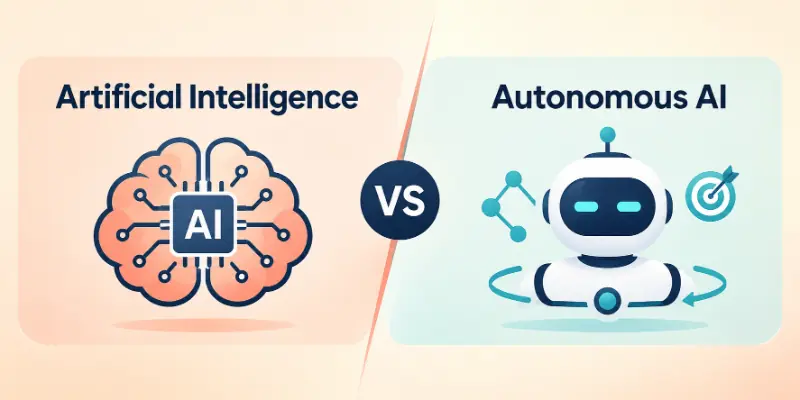
Artificial intelligence (AI) is a broad field that enables machines and software to perform tasks that normally require human intelligence, such as analyzing information, recognizing patterns, making predictions, understanding language, and supporting decisions. Autonomous AI extends these capabilities by allowing systems to pursue goals, make decisions, plan multiple steps, and take actions with less ongoing human input.
In simple terms, artificial intelligence provides the intelligence, while autonomous AI focuses on using that intelligence to operate more independently.
This guide explains the difference between autonomous AI and artificial intelligence, how each works, their key characteristics, real-world examples, benefits, risks, and the technologies behind autonomous systems. You will also learn how autonomous AI compares with traditional AI, AI agents, agentic AI, and generative AI.
Autonomous AI vs. Artificial Intelligence: Quick Answer
Artificial intelligence is the broader field of technology that enables machines to perform tasks associated with human intelligence. Autonomous AI is a type or application of AI designed to operate with greater independence by making decisions, planning tasks, and taking actions toward a goal with limited human intervention.
The main difference is autonomy. A traditional AI system may analyze information and provide an answer or recommendation, while an autonomous AI system can use that information to decide what to do next and carry out approved actions.
Autonomous AI vs Artificial Intelligence: Key Differences
The easiest way to understand the difference is to compare how much independence each system has.
| Feature | Artificial Intelligence | Autonomous AI |
| Definition | Broad field of intelligent computer systems | AI designed to operate with greater independence |
| Scope | Covers many AI technologies and applications | Focuses on autonomous decision-making and action |
| Human Input | Often requires instructions or prompts | Requires less ongoing human input |
| Decision-Making | Can analyze information or support decisions | Can make certain decisions toward a goal |
| Planning | Often performs defined tasks | Can plan multiple steps |
| Task Execution | Usually produces an output or recommendation | Can take actions using connected tools or systems |
| Goal | Often focused on a specific task or output | Usually focused on achieving a broader goal |
| Adaptability | Depends on the individual system | Can be designed to respond to changing conditions |
| Tool Use | May not interact with external systems | Can use APIs, software, databases, or other tools |
| Autonomy | Can range from low to high | Emphasizes greater operational independence |
| Example | AI chatbot that answers a question | AI agent that plans and completes a multi-step task |
Autonomous AI is not a completely separate technology from AI. It uses AI capabilities while emphasizing independence, goal-oriented behavior, planning, and action.
What Is Artificial Intelligence?
Artificial intelligence refers to computer systems and machines that can perform tasks associated with human intelligence, including understanding language, recognizing images, finding patterns, making predictions, solving problems, and supporting decisions.
AI can be implemented through different approaches, including machine learning, deep learning, natural language processing, computer vision, and other computational techniques. NIST describes AI in several ways, including systems that can perform tasks involving perception, cognition, planning, learning, communication, decision-making, and physical action.
AI does not always operate independently. Many AI applications wait for user instructions, process the provided information, and return a result.
How Does Artificial Intelligence Work?
The exact process depends on the AI system, but many applications follow a general flow:
- Data Collection: The system receives information from databases, documents, sensors, images, websites, or other sources.
- Data Processing: The system organizes and prepares the information for analysis.
- Machine Learning: A trained model identifies patterns or relationships within data.
- Pattern Recognition: The system identifies useful features, trends, or relationships.
- Reasoning and Decision Support: The AI uses available information to generate predictions, recommendations, or decisions.
- Output Generation: The system produces an answer, classification, prediction, recommendation, or other result.
Not every AI system uses machine learning, and not every AI application follows the same process.
What Can Artificial Intelligence Do?
Artificial intelligence can perform a wide range of tasks, including:
- Analyze Data: AI can process large datasets and identify useful patterns and insights.
- Recognize Images and Speech: AI can identify objects in images and process spoken language.
- Generate Content: Generative AI can create text, images, audio, video, and other digital content. NIST defines generative AI as a class of AI models that generate derived synthetic content such as text, images, audio, and video.
- Predict Outcomes: AI can use existing information to estimate trends, risks, demand, and other possible outcomes.
- Recommend Actions: AI can suggest products, strategies, decisions, or next steps.
- Automate Specific Tasks: AI can handle repetitive processes such as document processing, customer support, classification, and data analysis.
Examples of Artificial Intelligence
Common examples of AI include:
- Chatbots: Answer questions and communicate with users.
- Recommendation Systems: Suggest products, movies, music, or content based on user behavior.
- AI Writing Tools: Help users create, rewrite, summarize, and edit content.
- Image Recognition: Identify objects, faces, text, or other visual information.
- Voice Assistants: Understand spoken commands and respond to requests.
- Fraud Detection: Identify unusual transaction patterns that may indicate fraud.
- Predictive Analytics: Use historical data to estimate future outcomes.
What Is Autonomous AI?
Autonomous AI refers to AI systems designed to operate with a higher degree of independence. Instead of requiring a person to provide instructions for every step, an autonomous system can receive a goal, assess information, determine an approach, take actions, evaluate results, and adjust its next steps.
The amount of autonomy can vary significantly. Some systems may only perform limited actions after receiving approval, while others can manage longer workflows with minimal human involvement.
Autonomous AI commonly combines capabilities such as machine learning, reasoning, planning, natural language processing, computer vision, AI agents, tool use, and feedback mechanisms.
How Does Autonomous AI Work?
A simple way to understand the process is:
Goal → Perception → Reasoning → Planning → Action → Feedback → Adaptation
Here is what each stage means:
- Goal: The system receives a specific objective.
- Perception: It collects and interprets information from its environment, data sources, sensors, or connected applications.
- Reasoning: It evaluates the available information and determines possible next steps.
- Planning: It creates a sequence of actions needed to achieve the goal.
- Action: It performs approved actions using software, APIs, tools, robots, or connected systems.
- Feedback: It checks the results of those actions.
- Adaptation: It adjusts future actions based on new information or feedback.
This process is closely related to modern AI-agent architectures, where systems can plan tasks and use external tools or APIs to accomplish goals.
Key Characteristics of Autonomous AI
The main characteristics of autonomous AI include:
- Goal-Oriented Behavior: It works toward a defined objective rather than only responding to individual prompts.
- Independent Decision-Making: It can make certain decisions without requiring instructions at every step.
- Multi-Step Planning: It can divide a larger goal into smaller tasks.
- Tool Use: It can interact with APIs, databases, applications, or other systems when designed to do so.
- Environmental Awareness: It can process information about its operating environment.
- Adaptability: It can adjust its approach when circumstances change.
- Feedback Loops: It can evaluate the results of previous actions and use that information to guide future actions.
- Reduced Human Intervention: It can complete some workflows without continuous human direction.
The degree of autonomy depends on the system’s design, operating environment, safeguards, and the level of human control built into it.
A Simple Example: AI vs Autonomous AI
Imagine a company wants to improve its online sales.
Traditional AI:
The company asks an AI system to analyze sales data.
The AI examines the data and reports:
“Sales have decreased by 12% in the last month.”
The system provides useful information, but a person decides what to do next.
Autonomous AI:
The company gives an autonomous AI system a goal:
“Identify ways to improve this month’s online sales.”
Depending on its permissions and connected tools, the system could analyze sales data, identify weak-performing products, research relevant information, create a plan, perform approved actions, monitor results, and adjust the approach.
The key difference is not simply intelligence. It is the system’s ability to move from analysis toward goal-based action with less human direction.
Traditional AI vs Autonomous AI
Traditional AI is often designed to perform a defined task based on an input, prompt, model, or set of rules. Autonomous AI places more emphasis on what happens after the initial instruction and how the system acts on it.
From Responding to Acting
- Traditional AI: Provides an answer, prediction, classification, or recommendation.
- Autonomous AI: Can use its analysis to determine what action should happen next and execute approved actions.
From Single Tasks to Multi-Step Workflows
- Traditional AI: Often handles a specific task at a time.
- Autonomous AI: Can break a larger goal into multiple steps and coordinate those steps as part of a workflow.
From Human Direction to Goal-Based Execution
- Traditional AI: Usually depends more heavily on users to provide instructions.
- Autonomous AI: Can receive a goal and determine a sequence of actions needed to pursue it.
From Static Responses to Adaptive Decisions
- Traditional AI: Often generates an output based on the information and instructions available.
- Autonomous AI: Can monitor outcomes, process feedback, and adjust its actions when conditions change.
Autonomous AI vs AI Agents
Autonomous AI and AI agents are closely related, but they are not necessarily identical terms.
An AI agent is a software system that can perform tasks on behalf of a user or another system by planning actions and using available tools. Modern AI agents can interact with APIs, databases, applications, and other external systems to accomplish goals.
Autonomous AI is a broader concept focused on how independently an AI system operates.
A simple distinction is:
- AI agent: A system designed to perceive, reason, plan, and act toward a goal.
- Autonomous AI: AI that operates with a greater degree of independence.
- Overlap: An AI agent can be autonomous, and autonomous AI systems can use agents as part of their architecture.
Not every AI agent has the same level of autonomy. Some require approval before taking important actions, while others can complete longer workflows with minimal supervision.
Autonomous AI vs Agentic AI
Autonomous AI and agentic AI are also closely connected.
Agentic AI generally describes AI systems that demonstrate agency through goal-oriented behavior, planning, decision-making, tool use, and action. IBM describes agentic AI as systems that can accomplish goals with limited supervision and adapt their actions as they work.
The terms can overlap, but they emphasize slightly different ideas:
| Feature | Autonomous AI | Agentic AI |
| Main focus | Independence | Agency and goal-driven behavior |
| Goal pursuit | Common | Central |
| Planning | Often important | Common |
| Tool use | Often used | Common |
| Adaptability | Important | Important |
| Human involvement | Reduced | Often limited |
| Relationship | Describes autonomy | Describes systems with agency |
In practice, the terms are sometimes used interchangeably because modern agentic systems are often designed to operate autonomously.
Autonomous AI vs Generative AI
Autonomous AI and generative AI serve different primary purposes.
Generative AI focuses on creating new content such as text, images, audio, video, and other digital outputs.
Autonomous AI focuses on pursuing goals, making decisions, planning tasks, and taking actions with limited human input.
| Feature | Generative AI | Autonomous AI |
| Main purpose | Generate content | Pursue goals and take actions |
| Typical output | Text, images, audio, video | Decisions, actions, workflow results |
| Human input | Often starts with a prompt | Can require only a high-level goal |
| Planning | Can be limited or system-dependent | Often central to the workflow |
| Tool use | May be available | Often important for action |
| Autonomy | Usually limited by the application | Emphasizes greater independence |
The two technologies can work together. For example, an autonomous AI system may use a generative AI model to write an email, summarize information, or create a response before taking an approved action.
What Technologies Power Autonomous AI?
No single technology creates complete autonomy. Autonomous systems often combine multiple technologies and system components.
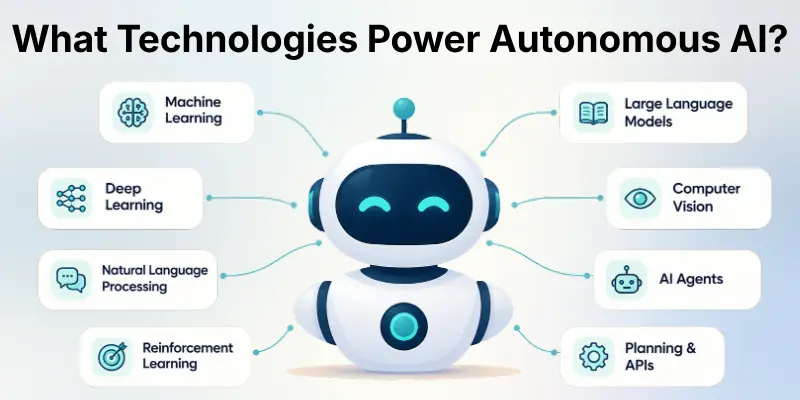
- Machine Learning: Machine learning allows systems to identify patterns in data and make predictions or decisions based on learned relationships.
- Deep Learning: Deep learning uses neural networks to process complex information and is widely used in areas such as computer vision, speech, and language processing.
- Large Language Models: Large language models can provide language understanding, reasoning capabilities, content generation, and decision support within autonomous systems.
- Natural Language Processing: NLP allows AI systems to understand and process human language.
- Computer Vision: Computer vision enables systems to interpret images, video, and visual information.
- Reinforcement Learning: Reinforcement learning allows systems to learn strategies through interactions with an environment and feedback about actions.
- AI Agents: AI agents can help autonomous systems plan and execute tasks using available tools and resources.
- Planning and Reasoning Systems: Planning and reasoning components help systems determine the steps needed to reach a goal.
- APIs and Tool Integration: APIs and other tools allow AI systems to retrieve information, perform calculations, update records, interact with applications, and take actions beyond simply generating text.
Levels of AI Autonomy
No single universal scale applies to every autonomous AI system. However, you can use the following simple framework to understand increasing levels of independence:
- Level 1: Human-Directed AI: A person performs most actions while AI provides information, suggestions, or predictions.
- Level 2: AI-Assisted Work: AI performs selected tasks, but humans remain responsible for most decisions and actions.
- Level 3: AI With Approval: AI can analyze information, recommend actions, and prepare tasks, but a person approves important actions before execution.
- Level 4: Workflow Autonomy: AI can manage multiple connected steps and make routine decisions with limited human involvement.
- Level 5: High Autonomy: The system can independently manage complex tasks within a defined environment, subject to safety controls, permissions, and monitoring.
These levels offer a simple way to understand autonomy, not a universal industry standard.
Real-World Examples of Autonomous AI
Autonomous AI can be used in digital and physical environments where systems need to make decisions and take actions.
- Autonomous Vehicles: Autonomous vehicles use AI, sensors, perception systems, planning, and control technologies to understand their environment and navigate with reduced human control.
- AI Agents: AI agents can receive a goal, plan multiple steps, use digital tools, and complete tasks on behalf of a user or organization. Modern agent systems can interact with APIs and external applications to take action.
- Autonomous Robots: Robots can use sensors, computer vision, planning, and control systems to navigate environments and perform physical tasks.
- Autonomous Cybersecurity: AI systems can monitor network activity, identify suspicious behavior, investigate potential threats, and trigger predefined responses.
- Autonomous Customer Service: AI agents can classify customer requests, retrieve information, update records, resolve routine issues, and escalate more complex cases to human employees.
- Autonomous Business Operations: Businesses can use autonomous systems to manage workflows across areas such as sales, finance, IT, customer operations, and supply chains.
Benefits of Autonomous AI
When properly designed and monitored, autonomous AI can provide several benefits.
- Reduces Repetitive Work: It can handle routine processes, allowing employees to focus on higher-value work.
- Speeds Up Decision-Making: AI can process large amounts of information quickly.
- Supports Continuous Operation: Some systems can operate continuously without regular breaks.
- Handles Multi-Step Workflows: Autonomous systems can coordinate multiple tasks within a larger process.
- Improves Scalability: Businesses can handle growing workloads without increasing manual effort at the same rate.
- Responds to Changing Conditions: Systems can adjust their actions when new information becomes available.
- Reduces Manual Intervention: Routine processes can continue without a person guiding every step.
- Improves Workflow Efficiency: Connected AI systems can reduce delays between different stages of a process.
However, greater autonomy does not automatically mean greater accuracy. Performance depends on factors such as data quality, system design, permissions, testing, monitoring, and the environment in which the AI operates.
Challenges and Risks of Autonomous AI
Greater independence also creates greater responsibility. When AI systems can make decisions and take actions, organizations need strong safeguards.
- Incorrect Decisions: An autonomous system can make a wrong decision because of poor data, incomplete information, system limitations, or an incorrect interpretation of a situation.
- Lack of Human Oversight: Too little human supervision can allow mistakes to continue without being detected quickly.
- Security Risks: Attackers may attempt to manipulate an autonomous system, its data, connected tools, or the environment in which it operates.
- Privacy Concerns: Autonomous systems may process large amounts of personal or business information, making access control and data protection important.
- Unexpected Behavior: A system may behave differently when it encounters conditions that were not adequately represented during testing.
- Bias and Fairness: AI systems can produce unfair outcomes when their data, design, or decision-making process contains bias.
- High Implementation Costs: Building, testing, securing, monitoring, and maintaining autonomous systems can require significant technical resources.
- Accountability: Organizations need clear rules about who is responsible when an autonomous system makes an incorrect or harmful decision.
For higher-risk applications, human oversight, testing, access controls, monitoring, and clear intervention procedures are especially important.
When Should You Use Autonomous AI?
Autonomous AI can be useful when a task involves multiple steps and requires a system to make routine decisions or interact with different tools.
Consider autonomous AI when:
- The workflow contains many connected steps.
- The system needs to respond to changing information.
- Humans spend significant time on repetitive decisions.
- The task can be safely automated.
- The system needs to use multiple software tools or APIs.
- A high-level goal is more useful than giving instructions for every individual step.
For example, an AI agent could monitor incoming support requests, classify them, retrieve customer information, suggest or provide a solution, update the relevant system, and escalate unusual cases.
When Is Traditional AI Better?
Autonomous AI is not always the best choice.
Traditional AI may be more appropriate when:
- The task is simple and predictable.
- You need tight human control over every action.
- The system only needs to provide information or predictions.
- The workflow has clearly defined rules.
- Mistakes could have serious consequences.
- You do not need the system to interact with external tools.
- Human approval is required before taking action.
For example, if you only need an AI system to classify customer emails or predict product demand, adding unnecessary autonomy may make the system more complex without providing much additional value.
The Future of Autonomous AI
The future of autonomous AI is likely to focus on making systems more capable while improving reliability, safety, monitoring, and human control.
Several developments are likely to shape the field:
- More Capable AI Agents: Agents will handle increasingly complex multi-step tasks.
- Autonomous Business Workflows: Businesses will use AI to coordinate routine processes across departments.
- Multi-Agent Systems: Multiple specialized agents may work together to complete larger tasks.
- Advanced Robotics: Robots will become better at understanding environments and performing physical tasks.
- Autonomous Transportation: AI will continue supporting automated driving and other transportation applications.
- AI-Powered Cybersecurity: Autonomous systems will help identify and respond to security threats.
- Human-AI Collaboration: AI will handle more routine work while people remain responsible for important decisions.
- Stronger AI Governance: Organizations will place greater emphasis on monitoring, access controls, testing, safety, and accountability.
As autonomous systems become more connected to real-world tools and environments, the quality of their safeguards will matter as much as their intelligence.
Conclusion
In this guide, we have covered ‘autonomous vs. artificial intelligence.’ Artificial intelligence is the broader field, while autonomous AI focuses on systems that can make decisions, plan tasks, and take actions with less human involvement.
Both technologies have useful applications, but autonomous AI brings greater independence and also requires stronger oversight. The right choice depends on your goals, the level of control you need, and the complexity of the tasks you want to handle.
My Recommendation: Start with traditional AI for simple and well-defined tasks, and consider autonomous AI when you need systems to manage complex workflows with less human input. Always use proper monitoring and human oversight for important or high-risk tasks.
Thank you for reading, and I hope this guide helped you understand the difference between autonomous AI and artificial intelligence. Take care, and see you in the next guide!
💬 Have thoughts or questions about autonomous AI? Share them in the comments below! 👇✨
FAQs
Below are some frequently asked questions about autonomous vs. artificial intelligence to help you understand the topic more clearly.
Artificial intelligence is the broader technology that enables machines to learn, analyze information, and perform intelligent tasks. Autonomous AI is a type of AI that can make decisions and complete tasks with less human intervention. In simple terms, AI provides intelligence, while autonomous AI uses that intelligence to act independently.
Yes, autonomous AI falls under the broader field of artificial intelligence. It combines AI technologies such as machine learning, reasoning, and planning to operate more independently. However, not every artificial intelligence system has autonomous capabilities.
Autonomous AI follows a process that helps it achieve a specific goal with limited human input. The main steps include perception, reasoning, planning, action, feedback, and adaptation. This process allows the system to respond to information and adjust its actions when conditions change.
You can find autonomous AI in several areas, including:
- Autonomous vehicles that make driving decisions.
- AI agents that complete multi-step digital tasks.
- Autonomous robots that navigate and perform physical tasks.
- Cybersecurity systems that detect and respond to threats.
Traditional AI often performs specific tasks based on user instructions, predefined rules, or trained models. Autonomous AI can take greater responsibility for planning, decision-making, and task execution. This makes autonomy a key difference between traditional AI systems and more independent AI systems.
Yes, autonomous AI can make certain decisions without requiring human approval at every step. The level of independence depends on how developers design and control the system. High-risk applications should still include human oversight to prevent serious mistakes.
Autonomous AI can reduce repetitive work, speed up decision-making, and handle complex workflows. It can also operate continuously and respond to changing conditions. These capabilities can help businesses improve efficiency and manage larger workloads.
Autonomous AI can produce incorrect decisions, unexpected actions, or biased results. It can also create security, privacy, and accountability challenges when it connects to important systems or sensitive data. Proper testing, monitoring, security controls, and human oversight can help reduce these risks.
Here is the simplest way to separate them:
- Generative AI: Focuses mainly on creating content such as text, images, audio, or video.
- Autonomous AI: Focuses on making decisions and taking actions toward a goal.
- Overlap: An autonomous system can use generative AI as one of its capabilities.
Autonomous AI will likely become more capable in areas such as AI agents, robotics, business automation, cybersecurity, and transportation. Businesses will also focus more on multi-agent systems, human-AI collaboration, and stronger AI safety controls. The future will likely combine greater AI autonomy with responsible human oversight.





- Be Respectful
- Stay Relevant
- Stay Positive
- True Feedback
- Encourage Discussion
- Avoid Spamming
- No Fake News
- Don't Copy-Paste
- No Personal Attacks
- Be Respectful
- Stay Relevant
- Stay Positive
- True Feedback
- Encourage Discussion
- Avoid Spamming
- No Fake News
- Don't Copy-Paste
- No Personal Attacks
