What is Autonomy in AI – Complete Guide to AI Independence
Published: 2 Sep 2026
AI can now do more than answer questions or follow a single command. Modern AI agents can plan tasks, use tools, make decisions, and complete several steps with less human input. This growing ability makes what autonomy in AI is an important question for anyone who wants to understand how modern AI systems work.
In simple terms, AI autonomy describes how independently an AI system can make decisions and take actions after a person gives it a goal. It does not mean the system operates without any human-defined purpose, permissions, or boundaries. The level of autonomy can range from simple AI assistance to systems that manage complex tasks with limited human involvement.
In this article, we will discuss AI autonomy in detail, including its levels, examples, benefits, challenges, and real-world uses. You will also learn how AI autonomy differs from automation and how humans can keep autonomous systems under control.
Autonomy in AI
Autonomy in AI means an AI system’s ability to make decisions and perform actions with limited human involvement. The level of autonomy shows how much a system can work on its own after a person gives it a goal or task.
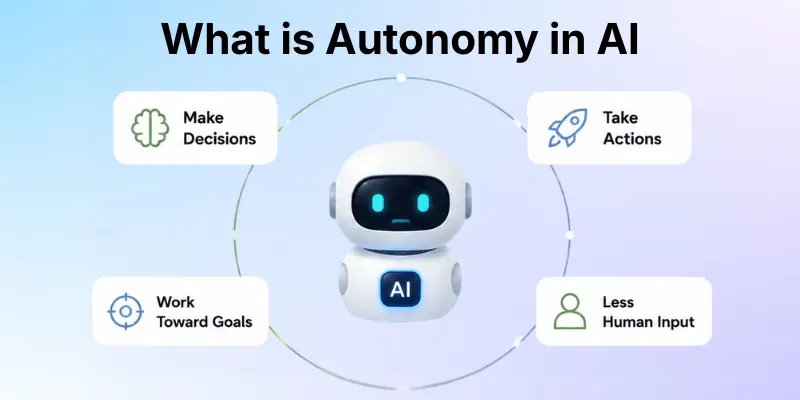
Unlike a basic AI tool that waits for instructions at every step, an autonomous AI system can decide what to do next and continue working toward a given goal. However, it still operates within the purpose, permissions, and boundaries humans define.
Definition of Autonomy in AI
- Independent decision-making: The AI can choose between different actions based on the information it receives.
- Independent action: The system can perform certain tasks without requiring a person to approve every step.
- Goal-based work: The AI works toward a specific goal instead of only responding to individual commands.
- Limited human input: The system needs less direct guidance while completing its assigned task.
Role of Human Involvement
Human involvement remains important even when an AI system has a high level of autonomy. Humans can set goals, define rules, monitor results, provide feedback, and step in when the system makes a wrong or risky decision. The exact amount of oversight depends on the task and its potential impact.
Real-world Example
For example, an AI customer service agent can handle a customer’s request without a human employee guiding every step. Some simple examples include:
- Customer service: Checks an order status and updates the customer.
- AI research: Finds relevant information, organizes it, and prepares a summary.
- Software development: Reviews code, identifies an issue, and suggests or applies a fix.
- Navigation: An autonomous vehicle can monitor its surroundings and choose actions based on road conditions.
- Business tasks: An AI agent can collect information from different systems and complete a multi-step workflow.
AI autonomy works within boundaries set by people. Developers and organizations can control the tools, data, permissions, and actions available to an AI system, while human oversight can monitor and intervene when needed.
How Does Autonomy Work in AI?
Autonomy in AI works through a continuous process in which an AI system receives a goal, understands the situation, chooses what to do, takes action, and checks the result. Instead of stopping after one response, an autonomous system can repeat this process and change its next action when new information appears. This approach commonly appears in AI agents that use a goal-plan-act-observe-adjust cycle.
A simple way to understand this process is to imagine an AI system as a worker who receives a task. It first understands what you want, then decides which steps can help it complete the task. After each action, it checks the result and continues, changes its plan, or asks a human for help when it reaches a limit.
1. Receives a Goal or Objective
The process starts when a person or another system gives the AI a clear goal. The AI uses this goal to understand what result it needs to achieve and can break a larger objective into smaller tasks.
Example: A business might ask an AI agent to find potential customers and organize their information.
2. Understands the Environment and Available Information
Next, the AI collects the information it needs to understand the current situation. It may use databases, documents, sensors, APIs, websites, or other available sources depending on the task.
3. Makes a Decision
After gathering information, the AI evaluates the situation and decides what it should do next. It considers the goal, available information, rules, and possible actions before selecting the next step.
4. Creates or Selects an Action
The AI then creates a plan or selects a suitable action from the available options. For complex tasks, it can break the goal into smaller steps and decide which step comes first.
5. Uses Tools or Systems to Perform the Action
Once the AI chooses an action, it can use connected tools or systems to carry it out. Depending on its permissions, it may search for information, call an API, query a database, run code, update a record, or trigger another workflow.
6. Observes the Result
After taking action, the AI checks what happened. It uses the result as new information and compares it with the goal it needs to achieve.
7. Adjusts Its Approach When Needed
If the action does not produce the expected result, the AI can change its approach and try another suitable step. For example, if a search returns poor results, an AI agent may change its search strategy instead of simply stopping.
8. Repeats the Process Until the Goal Is Completed
The AI continues this cycle until it completes the goal, reaches a defined limit, encounters a problem, or needs human intervention. This repeating observe, decide, act, and adjust process is what allows autonomous AI systems to handle multi-step tasks with less continuous human direction.
In simple terms, the process looks like this:
Goal → Understand → Decide → Act → Observe → Adjust → Repeat → Complete
Technologies Behind AI Autonomy
AI autonomy depends on several technologies that help systems understand information, make decisions, plan tasks, and take actions. Together, these technologies help AI move beyond simple instructions and handle tasks with less human guidance.
Some technologies focus on understanding data, while others help AI reason, remember information, or interact with external tools. The following technologies play an important role in making autonomous AI systems more capable and useful.
- Machine Learning: Helps AI learn patterns from data and improve its performance over time.
- Large Language Models: Help AI understand and generate human language while supporting tasks such as planning, analysis, and decision-making.
- AI Agents: Enable AI systems to work toward a goal by planning tasks, taking actions, and checking results.
- Natural Language Processing: Helps AI understand human language, questions, commands, and written information.
- Computer Vision: Allows AI to understand images, videos, objects, and visual information from its surroundings.
- Reinforcement Learning: Helps AI learn which actions produce better results through feedback and rewards.
- Planning and Reasoning: Help AI break complex goals into smaller steps and decide which actions can help complete them.
- Memory and Context: Allow AI systems to use previous information and maintain context while working on longer tasks.
- Tool Use and APIs: Allow AI to connect with external software, databases, websites, and other systems to perform actions beyond generating text.
What Makes an AI System Autonomous?
An AI system becomes autonomous when it can handle tasks with less direct human guidance. Basic AI tools usually wait for a specific instruction and respond, while autonomous AI can decide what steps to take and continue working toward a goal.
Several characteristics help distinguish autonomous AI from basic AI systems. These features allow an AI system to understand a task, make decisions, take actions, learn from results, and respond to changes without a person controlling every step.
- Independent Decision-Making: Allows AI to choose suitable actions based on the goal, available information, and system rules.
- Goal-Directed Behavior: Keeps the AI focused on achieving a specific objective instead of responding to isolated instructions.
- Planning: Helps AI divide a complex task into smaller steps and determine the order in which to complete them.
- Reasoning: Enables AI to compare information, evaluate possible choices, and select an appropriate course of action.
- Adaptability: Allows AI to change its approach when the situation, information, or task requirements change.
- Learning From Feedback: Helps AI use results and feedback to improve future decisions and actions.
- Tool Use: Allows AI to interact with external tools, software, databases, APIs, and other systems to complete tasks.
- Environmental Awareness: Helps AI understand changes in its surroundings or the information available to it before taking action.
- Continuous Task Execution: Allows AI to work through multiple steps and continue a task without needing a new instruction after every action.
- Ability to Handle Unexpected Situations: Helps AI respond to problems or changes by adjusting its plan or requesting human assistance when necessary.
Levels of Autonomy in AI
AI autonomy does not work at just one level. Some AI systems need humans to control almost every action, while others can complete complex tasks with very little direct guidance. These levels help us understand how much independence an AI system has and how much human involvement it still needs.
Level 0: No Autonomy
At Level 0, the AI system does not make decisions or perform actions on its own. A human controls the task from beginning to end, while AI may have little or no role.
- Human Performs the Task: A person makes the decisions and completes the required actions.
- AI Has Little or No Role: AI may provide basic information or support, but it does not independently control any part of the task.
Example: A person drives a car and makes every driving decision without assistance from an AI system.
Level 1: AI-Assisted
At Level 1, AI can support a person by providing suggestions, recommendations, or useful information. However, the human remains responsible for reviewing the AI’s output and making the final decision.
- AI Provides Suggestions or Recommendations: AI analyzes available information and suggests an option or action that may help complete the task.
- Human Makes the Final Decision: A person reviews the AI’s suggestion and decides whether to accept, change, or reject it.
Example: An AI writing tool suggests improvements to an email, but the user decides which changes to use before sending it.
Level 2: Partially Autonomous
At Level 2, AI can perform certain actions on its own, but a human still stays actively involved throughout the process. The system can handle some parts of a task while the person monitors its work and remains ready to intervene.
- AI Performs Selected Actions: AI can complete specific steps without asking for approval every time.
- Human Remains Actively Involved: A person monitors the system, makes important decisions, and can take control when needed.
Example: A driver-assistance system can help keep a car in its lane or maintain a set speed, while the driver continues to monitor the road and remains responsible for driving.
Level 3: Conditionally Autonomous
At Level 3, AI can manage a complete workflow within clearly defined boundaries. The system can make decisions and perform several steps on its own, but it asks for human help when it reaches a limit or faces an important decision.
- AI Handles Complete Workflows: The system can complete multiple connected steps without requiring constant human instructions.
- Human Intervention When Needed: A person takes control when the AI faces an unusual situation, reaches its limits, or needs approval for a significant action.
Example: An AI system can manage a customer support request from start to finish, but it sends complex complaints to a human employee.
Level 4: Highly Autonomous
At Level 4, AI can manage complex tasks with very little direct human involvement. It can plan the work, take action, monitor progress, and change its approach when the situation requires it.
- AI Plans and Executes Tasks: The system can decide which steps to take and carry them out toward a specific goal.
- AI Monitors and Adjusts: It checks its results and changes its approach when something does not go as planned.
- Human Mainly Supervises: A person monitors the system instead of controlling every individual action.
Example: An AI agent can research a topic, collect information, organize the findings, and prepare a report while a human reviews its overall work.
Level 5: Fully Autonomous
At Level 5, AI can operate independently within a defined environment without needing regular human intervention. Humans mainly set the overall goals, rules, safety requirements, and limits rather than directing individual actions.
- AI Operates Independently: The system can make decisions and perform tasks without continuous human guidance.
- Human Sets Goals and Rules: People define what the system should achieve and what actions it can or cannot take.
- Monitoring and Safety Remain Important: Humans continue to monitor the system and maintain safeguards even when direct control is minimal.
Example: A fully autonomous system could manage a defined operation from planning to execution while following preset rules and safety limits.
Examples of Autonomy in AI
Autonomy in AI appears in many systems that can make decisions and complete tasks with limited human input. These systems can work with information, choose suitable actions, use connected tools, and adjust their approach when needed.
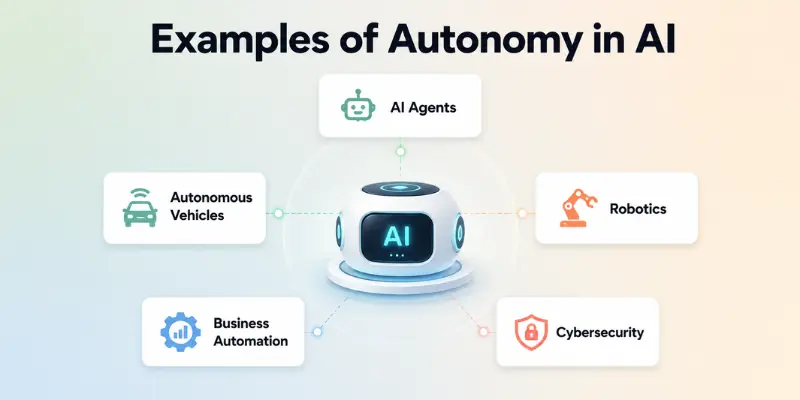
Today, autonomous AI appears in areas such as research, customer service, software development, scheduling, and data analysis. Autonomous AI agents are a clear example because they can handle multiple steps toward a specific goal instead of waiting for a person to guide every action.
1. Autonomous AI Agents
The following are some common examples of autonomous AI agents:
- Research Agents: Find information from different sources, organize relevant findings, and prepare useful summaries with limited human guidance.
- Customer Service Agents: Understand customer requests, find relevant information, and handle routine support tasks without constant human involvement.
- Coding Agents: Analyze code, identify problems, create solutions, and perform development tasks based on a given objective.
- Scheduling Agents: Manage calendars, find suitable times, arrange meetings, and update schedules based on defined preferences.
- Data Analysis Agents: Collect and examine data, identify useful patterns, and produce insights or reports based on a specific goal.
2. Autonomous Vehicles
Autonomous vehicles use AI, sensors, cameras, and other technologies to understand their surroundings and make driving or movement decisions with limited human input. The technology now appears in robotaxis, delivery vehicles, and drones, although the level of autonomy differs between systems. In 2026, Level 4 driverless taxis already operate commercially in more than 20 cities, while fully autonomous Level 5 cars remain out of reach.
The following are common examples of autonomous vehicles:
- Self-Driving Cars: Use AI and sensors to detect roads, vehicles, pedestrians, and obstacles and make driving decisions with limited human control.
- Autonomous Delivery Vehicles: Small driverless vehicles can transport food, groceries, or packages over short routes and navigate their surroundings without a person controlling every movement.
- Drones: Autonomous drones can plan routes, avoid obstacles, and perform tasks such as deliveries, inspections, and inventory checks with limited human input. Some warehouse drones already operate without GPS or direct human control.
3. Robotics
Robotics is another major area where AI autonomy helps machines perform physical tasks with less human direction. Modern robots can use sensors, cameras, AI models, and navigation systems to understand their surroundings, move through changing environments, and complete specific jobs.
Here are some important examples of autonomous robotics:
- Warehouse Robots: Move goods, support picking and sorting, and navigate warehouse spaces while coordinating tasks with other robots and warehouse systems.
- Industrial Robots: Perform tasks such as inspection, handling, assembly, and maintenance, including work in hazardous environments where reducing human exposure improves safety.
- Service Robots: Perform useful tasks for people or businesses, such as delivery, cleaning, inspection, and assistance, with different levels of human involvement.
4. Business Automation
AI autonomy is becoming useful in business because AI systems can handle repetitive and multi-step workflows with less manual involvement. Instead of following a single fixed command, some AI systems can monitor information, identify what needs attention, and take approved actions based on predefined rules and permissions.
The following are some common examples of autonomous AI in business:
- AI Systems That Monitor Workflows: Track business processes, identify delays or unusual activity, and notify people or trigger approved actions when a problem appears.
- AI-Powered Customer Support: Understand customer questions, find relevant information, resolve routine issues, and escalate more complex cases to human agents.
- Automated Decision-Making Systems: Analyze available data and make routine decisions based on defined rules, business goals, and approved limits.
5. Cybersecurity
AI autonomy also plays an important role in cybersecurity, where systems need to analyze large amounts of information and respond quickly to potential threats. AI can continuously examine network activity, identify suspicious behavior, and support security teams without requiring them to review every event manually. Recent cybersecurity approaches increasingly use AI agents for tasks such as threat detection, investigation, and response. (microsoft.com)
Here are some key examples of autonomous AI in cybersecurity:
- Threat Detection: AI analyzes network traffic, devices, applications, and user activity to identify patterns that may indicate a security threat.
- Automated Incident Response: AI can investigate detected threats and take approved actions, such as isolating a device or blocking suspicious activity, while following predefined security policies.
- Continuous System Monitoring: AI continuously watches systems and security events to detect unusual activity and alert security teams when human attention is needed.
Difference Between AI Autonomy and Automation?
The following comparison shows the main difference between traditional AI automation and AI autonomy:
| AI Automation |
|---|
|
Follows predefined workflows Relies mainly on fixed rules Best for repetitive tasks Humans define most steps Has limited decision-making |
| AI Autonomy |
|---|
|
Works toward goals and can choose actions Adapts to changing situations Can handle complex, multi-step tasks AI can decide some of the steps Provides greater independent decision-making |
Automation and autonomy can work together, but they are not the same. Automation follows a defined process, while autonomy gives an AI system more freedom to decide, adapt, and act within set boundaries.
Role of Human Oversight in Autonomous AI?
Human oversight remains important even when an AI system can make decisions and perform tasks independently. As AI autonomy increases, people may need to provide fewer instructions for each action, but they still need to set goals, permissions, safety limits, and rules for when the AI should stop or ask for help. The following are the main ways humans can oversee autonomous AI:
- Human-in-the-Loop: A human reviews or approves important AI decisions before the system takes action.
- Human-on-the-Loop: AI can act independently while a human monitors its activities and steps in when necessary.
- Human Approval: The system asks for permission before performing sensitive or high-impact actions, such as making major financial decisions.
- Human Intervention: A person can take control or stop the AI when it makes an incorrect decision or faces an unexpected situation.
- Monitoring and Escalation: Humans monitor AI performance, while predefined escalation rules send unusual or risky cases to the right person.
- Stronger Controls for High-Risk Tasks: Healthcare, finance, cybersecurity, transportation, and other high-impact areas need stronger safeguards because an incorrect autonomous decision can cause serious harm. Clear permissions, monitoring, testing, and human intervention help keep these systems under control.
In simple terms, autonomy reduces the need for constant human instructions, but it does not remove human responsibility. Good autonomous AI systems know their limits and provide clear points where humans can review, approve, or take control.
Benefits of Autonomy in AI
Autonomous AI can do more than provide information or suggestions. It can make decisions, take action, and handle multiple steps toward a goal with less direct human involvement. This can help businesses and individuals save time, manage workloads, and respond to tasks more efficiently.
The benefits depend on how the system works and how much autonomy it has. When organizations give AI clear goals, suitable permissions, and proper human oversight, autonomous systems can support a wide range of tasks.
1. Saves Time
Autonomous AI can complete tasks without requiring a person to guide every step.
Example: An AI agent can collect information from different sources and automatically prepare a basic report.
2. Reduces Repetitive Work
AI can handle routine tasks that people perform repeatedly.
Example: A customer service agent can answer common questions and process simple requests without sending every case to a human employee.
3. Improves Operational Efficiency
Autonomous AI can manage multiple steps in a workflow and reduce delays between tasks.
Example: An AI system can monitor an order, identify a delay, and automatically notify the appropriate team.
4. Supports Faster Decision-Making
AI can quickly analyze available information and recommend or take suitable actions within its permissions.
Example: A cybersecurity system can identify suspicious activity and immediately flag it for the security team.
5. Works Continuously
Autonomous systems can operate around the clock without needing regular breaks.
Example: An AI monitoring system can watch network activity throughout the day and alert security teams when it detects unusual behavior.
6. Handles Multi-Step Tasks
Autonomous AI can break a larger goal into smaller actions and complete them in sequence.
Example: A research agent can search for information, organize its findings, compare sources, and prepare a summary.
7. Improves Scalability
AI can handle a growing number of tasks without increasing human workload at the same rate.
Example: An online store can use AI agents to manage thousands of routine customer questions during a busy sales period.
8. Personalizes User Experiences
AI can analyze user information and adjust its responses or actions according to individual needs.
Example: An AI shopping assistant can recommend products based on a customer’s previous searches and preferences.
9. Reduces Manual Errors
AI can perform repetitive processes consistently and follow predefined rules without the tiredness or distraction that can affect people.
Example: An AI system can automatically check large amounts of data for missing information or unusual entries.
10. Helps Businesses Respond Faster
Autonomous AI can detect changes and take approved actions quickly, which helps businesses respond to customer needs and operational problems.
Example: An AI support system can identify a common service issue, provide customers with the relevant solution, and escalate unusual cases to a human employee.
Challenges of AI Autonomy
As AI systems become more independent, they can handle more tasks without constant human direction. However, this higher level of autonomy can also create risks related to accuracy, security, privacy, control, and accountability.
The following are some of the main challenges of AI autonomy:
- Lack of Explainability: It can be difficult to understand why an autonomous AI system made a particular decision.
- Incorrect Decisions: AI can make unsuitable decisions when it works with incomplete, outdated, or incorrect information.
- Hallucinations and Unreliable Outputs: AI may generate false or unsupported information and use it when completing a task.
- Security Risks: Connected AI systems can create security risks if attackers manipulate their inputs, tools, or access.
- Privacy Concerns: Autonomous AI may process large amounts of personal or business data, creating risks when organizations do not protect that information properly.
- Loss of Human Control: Greater autonomy can reduce direct human involvement, making it harder to notice or stop an unwanted action quickly.
- Unexpected Behavior: An AI system may respond poorly when it encounters a situation that falls outside its training, rules, or expected environment.
- Accountability Problems: It can become unclear who is responsible when an autonomous AI system makes a harmful or incorrect decision.
- Bias: AI can repeat unfair patterns from its data or design, which may lead to biased decisions when the system acts independently.
How Can We Make Autonomous AI Safer?
Making autonomous AI safer requires clear limits, careful monitoring, and human control when the system handles important tasks.
The following steps can help organizations use autonomous AI more safely:
- Set Clear Goals and Boundaries: Define what the AI should do and which actions it must avoid.
- Limit Permissions: Give the AI access only to the tools, systems, and data it actually needs.
- Use Human Approval for High-Risk Actions: Require human confirmation before sensitive or high-impact actions.
- Monitor AI Decisions: Regularly review the system’s actions and results to identify problems early.
- Keep Activity Logs: Record important AI actions so teams can review what happened when needed.
- Add Escalation Rules: Make the AI send unusual, uncertain, or risky situations to a human.
- Test AI Before Deployment: Test the system with different situations to find errors and weaknesses before real use.
- Use Reliable Data: Provide accurate, relevant, and properly managed data to support better decisions.
- Apply Access Controls: Protect systems and information by controlling who and what the AI can access.
- Regularly Evaluate Performance: Check the AI over time to make sure it continues to work as expected.
- Create Emergency Shutdown Mechanisms: Provide a reliable way to stop the AI quickly if it behaves unexpectedly or creates a serious risk.
Where is AI Autonomy Used Today?
AI autonomy is now used across many industries to handle tasks, make decisions, and complete workflows with less direct human involvement.
Here are the major industries where autonomous AI is making a growing impact:
- Healthcare
- Finance
- E-commerce
- Manufacturing
- Transportation
- Cybersecurity
- Education
- Customer Service
- Software Development
- Marketing
- Logistics
Future of AI Autonomy
The future of AI autonomy is moving toward systems that can handle more complex tasks with less human guidance. AI agents will improve their planning, tool use, adaptability, and ability to work across different systems, while developers will focus more on safety, human oversight, clear permissions, and reliable controls.
- Growth of Autonomous AI Agents: AI agents will handle more multi-step tasks, from research and coding to business workflows and customer support.
- Multi-Agent Systems: Multiple AI agents will work together, with each agent handling a specific part of a larger task.
- More Sophisticated AI Planning: AI systems will improve their ability to break complex goals into steps, select suitable actions, and adjust plans when conditions change.
- AI-Powered Workplace Automation: Businesses will use autonomous AI to manage more routine workflows, analyze information, and support employees across different departments.
- Greater Use of Autonomous Systems in Robotics: AI-powered robots will take on more tasks in warehouses, factories, healthcare, transportation, and other physical environments.
- More Adaptive AI Systems: Future AI systems will become better at responding to changing information and situations, rather than relying only on fixed workflows.
- Increased Focus on AI Governance: Organizations will need stricter rules for permissions, monitoring, accountability, safety, and human oversight as AI takes on more independent tasks.
- Better Methods for Controlling and Evaluating Autonomy: Developers will create better ways to measure how independently an AI system operates and determine whether it can safely handle a particular task.
Overall, AI autonomy is likely to increase gradually rather than suddenly reach complete independence. The most useful systems will combine greater AI capability with appropriate human oversight, clear boundaries, and reliable safety controls.
AI Autonomy vs Traditional AI: Quick Comparison
Traditional AI usually responds to specific instructions, while autonomous AI can make decisions, plan actions, and complete multiple steps with less direct human guidance.
The following table highlights the key differences between traditional AI and autonomous AI:
| Feature | Traditional AI | Autonomous AI |
| Human Input | Requires frequent instructions | Needs less frequent guidance |
| Decision-Making | Makes limited decisions | Makes more independent decisions |
| Task Execution | Usually handles single tasks | Can handle multi-step tasks |
| Planning | Uses predefined plans | Can create or adjust plans |
| Adaptation | Has limited adaptability | Can adapt to changing situations |
| Tool Use | Usually controlled by users | Can select and use tools independently |
| Human Oversight | Requires direct supervision | Uses supervisory or conditional oversight |
How to Choose the Right Level of AI Autonomy
Not every task needs the same level of AI independence. The following steps can help you choose an appropriate level of autonomy based on the task, risk, and amount of human control required:
- Define the Task: Clearly explain what you want the AI system to achieve and what tasks it should handle.
- Assess the Risk: Consider the possible impact if the AI makes a wrong decision or takes an incorrect action.
- Determine What Decisions AI Can Make: Decide which decisions the AI can handle independently and which ones require human judgment.
- Set Permissions: Give the AI access only to the tools, data, and systems it needs to complete its assigned tasks.
- Decide Where Human Approval Is Required: Require human approval for sensitive, high-impact, or difficult-to-reverse actions.
- Test the System: Test the AI in different situations before allowing it to operate with greater independence.
- Monitor Performance: Regularly check its decisions, actions, accuracy, and overall performance.
- Increase Autonomy Gradually: Start with a lower level of independence and increase it only after the system shows reliable performance.
Conclusion
In this guide, we have covered ‘what is autonomy in AI’ and explored how autonomous AI systems make decisions, perform tasks, and adapt with less human guidance. We also looked at its levels, benefits, challenges, real-world applications, and the role of human oversight.
AI autonomy can make many tasks faster and easier, but it works best when people set clear goals, permissions, and safety limits. As autonomous AI continues to develop, responsible use and proper human oversight will remain important.
My recommendation: Start with a low level of autonomy for important tasks and increase it only after the system proves reliable. Always keep human approval for actions that can create serious risks.
Thank you for reading, and I hope this guide helped you understand AI autonomy more clearly. Take care and goodbye! 😊
💬 Have a question or opinion about AI autonomy? Share your thoughts in the comments below, and don’t forget to join the conversation! 👇✨
FAQs
Below are some important FAQs about autonomy in AI.
AI autonomy means an AI system can make decisions and perform tasks without a human guiding every step. It can understand a goal, choose actions, and respond to results on its own. The level of independence depends on how much control and permission humans give the AI.
The basic process of AI autonomy usually follows these steps:
- The user gives the AI a goal.
- The AI creates a plan and chooses actions.
- It performs the actions, checks the results, and adjusts its approach when needed.
This allows autonomous AI systems to complete multi-step tasks instead of simply responding to one instruction at a time.
The levels of autonomy in AI describe how much independence an AI system has and how much human involvement remains. Lower levels require humans to approve or guide most actions, while higher levels allow AI agents to plan and execute more tasks independently. There is no single universal level system so different organizations may use slightly different frameworks.
An autonomous AI agent is a system that can work toward a goal by planning tasks, using tools, taking actions, and responding to results with limited human input. Unlike a basic chatbot, it can continue through multiple steps without waiting for a new instruction after every action. Examples include AI research agents, coding agents, and customer service agents.
No, AI automation usually follows predefined workflows, while AI autonomy gives the system more freedom to decide what actions to take. AI automation is useful for repetitive and predictable tasks, whereas autonomous AI can adapt its actions when circumstances change. The two concepts can overlap, but autonomy generally involves greater independent decision-making.
AI autonomy can provide several practical benefits:
- Saves time by reducing manual work.
- Helps complete complex, multi-step tasks.
- Allows systems to operate continuously.
- Can improve productivity and scalability.
These benefits make autonomous AI useful in areas such as software development, customer service, cybersecurity, and business operations.
The main risks include incorrect decisions, security problems, privacy issues, unexpected actions, and reduced human control. These risks can become more serious when an AI agent has access to important systems or can take consequential actions without approval. Strong permissions, monitoring, testing, and human oversight can help reduce these risks.
Yes, especially when an AI system handles high-risk or difficult-to-reverse tasks. Human oversight can involve approving important actions, monitoring activity, reviewing results, or intervening when the AI reaches a predefined limit. Oversight can decrease as autonomy increases, but responsible deployment still requires clear controls and safeguards.
AI autonomy refers mainly to how independently an AI system can operate, while AI agency describes its ability to take actions toward goals. A highly capable AI agent can still have low autonomy if a human must approve every action. In other words, capability and autonomy are related but not necessarily the same.






- Be Respectful
- Stay Relevant
- Stay Positive
- True Feedback
- Encourage Discussion
- Avoid Spamming
- No Fake News
- Don't Copy-Paste
- No Personal Attacks
- Be Respectful
- Stay Relevant
- Stay Positive
- True Feedback
- Encourage Discussion
- Avoid Spamming
- No Fake News
- Don't Copy-Paste
- No Personal Attacks
