What Is Agentic SEO? How AI Agents Are Changing Search
Published: 16 Sep 2026
Confused about what agentic SEO actually means? You’re not alone. The term sounds like just another buzzword thrown around in marketing circles, but it points to something genuinely different from regular SEO or basic AI writing tools. At first glance, it can feel like AI is simply helping with tasks you already do, like keyword research or content writing. But agentic SEO goes further than that.
Instead of waiting for you to type a prompt or assign a task, AI agents in this system work on their own. They research keywords, audit your site, draft content, and monitor performance, often without a human clicking a single button along the way.
This shift from “AI as a helper” to “AI as an independent worker” is exactly what makes agentic SEO confusing for so many people. So how is this different from the automation tools you might already be using? And does it actually replace human SEO strategy, or just support it?
In this article, I’ll walk you through exactly what agentic SEO means, how it works, and where it fits into your own SEO efforts, so the confusion clears up for good.
What Is Agentic SEO?
Now that we’ve set up the confusion, let’s clear it up properly. This section breaks down the meaning of agentic SEO in simple terms before we get into how it actually works.
Simple Definition
Agentic SEO explained simply: it’s an approach where AI agents handle SEO tasks on their own, from start to finish, instead of just responding to a single prompt. These agents can plan a task, carry it out, check the results, and adjust their approach, much like a human team member would. This is the core of the agentic SEO definition most experts agree on today.
- Uses autonomous AI agents, not just single AI responses.
- Agents can plan, act, and adjust without constant human input.
- Covers tasks like keyword research, audits, and content optimization.
- Works continuously, not just when someone starts a task manually.
How Is This Different from Basic AI Tools?
Many people already use AI agents for SEO in a basic way, like asking ChatGPT to write a blog post or suggest keywords. True agentic SEO works differently, since it doesn’t stop after one response.
- Basic AI tools respond once, then wait for the next prompt.
- Autonomous SEO agents keep working, step by step, without needing a new prompt each time.
- Agents can pull data from tools like Google Search Console or SEMrush directly.
- Agents remember past actions and use that history to improve future decisions.
Why Is This Becoming So Popular Now?
Agentic SEO isn’t appearing out of nowhere. Understanding what does agentic SEO mean for the industry starts with looking at how search itself is changing.
- AI Overviews and chatbots now answer many searches directly.
- SEO now needs to work across both traditional search and AI-powered search.
- Manual SEO work can’t keep up with this scale of change alone.
- Autonomous agents help brands adapt faster, without needing a bigger team.
Simple Difference
Basic AI tools are like a helpful assistant who waits for instructions. An SEO agent built for agentic work is like a team member who understands the goal and keeps working toward it, step by step, without needing to be told what to do next.
Agentic SEO vs Traditional SEO
Understanding the difference between these two approaches makes everything else in this guide easier to follow. Traditional SEO has worked the same way for years: a person picks a task, does the research, makes the changes, and checks back later to see what happened. It’s effective, but it’s also slow, and it depends heavily on how much time a person or team actually has.
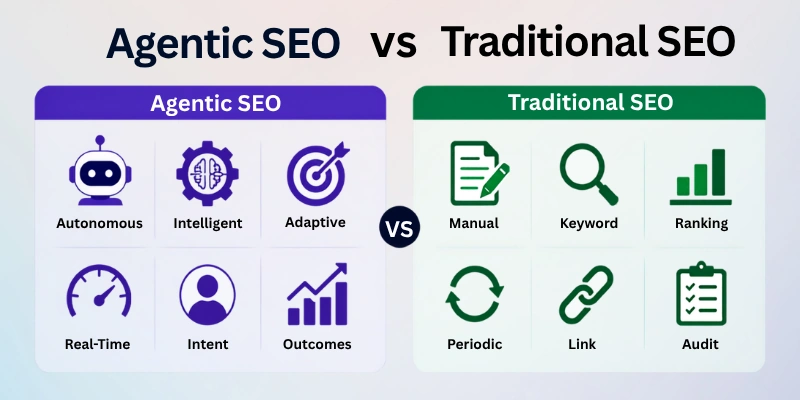
Agentic SEO changes this by removing the need for a human to manage every single step. Instead of waiting for someone to start a task, agents work continuously in the background, adjusting their approach as new data comes in. This doesn’t mean traditional SEO becomes useless; it just means the work gets done differently, often faster and at a much larger scale.
Agentic SEO
- Agents run tasks continuously, without needing a manual trigger.
- Multiple agents can work together, each handling a different part of SEO.
- Agents adjust strategy automatically based on new data or ranking changes.
- Work can scale to thousands of pages without needing more staff.
Traditional SEO
- A person manually starts each task, like keyword research or audits.
- Reviews typically happen weekly or monthly, not continuously.
- Adjustments depend on someone noticing a problem first.
- Scaling up usually means hiring more people or spending more time.
Pro Tip: You don’t have to choose one over the other completely. Many successful SEO strategies now blend both, letting agentic systems handle repetitive, large-scale tasks like audits and monitoring, while humans focus on strategy, creativity, and final decision-making where judgment really matters.
How Does Agentic SEO Work?
Now let’s break down what agentic SEO actually looks like in practice. Instead of one big, vague process, it’s made up of several smaller tasks, each handled by a specialized agent working toward the same overall goal.
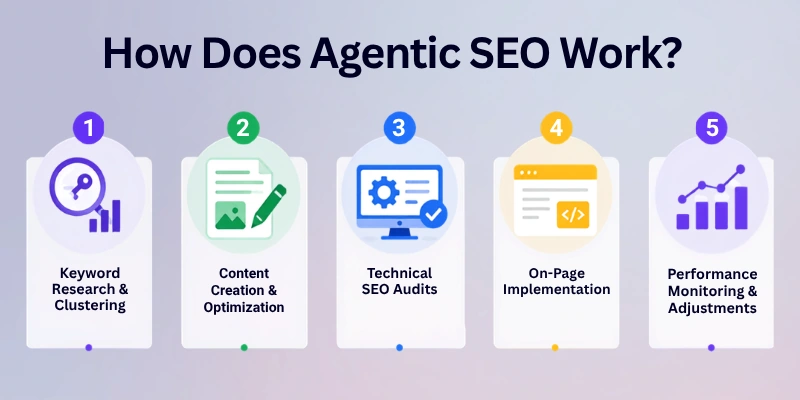
Before diving into each one, here’s a quick list of what this section covers.
How Agentic SEO Works:
- Keyword Research and Clustering
- Content Creation and Optimization
- Technical SEO Audits
- On-Page Implementation
- Performance Monitoring and Adjustments
Let’s figure it out in detail:
1. Keyword Research and Clustering
Keyword research is often one of the most time-consuming parts of SEO, and it’s also one of the easiest tasks to hand over to an agent. Instead of manually searching for terms one by one, an agent can expand a single seed keyword into hundreds of related terms almost instantly.
Once these keywords are collected, the agent doesn’t just dump them into a spreadsheet. It groups them by topic and search intent, creating clusters that make it easier to plan content around a full subject, rather than just one narrow term at a time.
- Expands one keyword into many related variations.
- Groups keywords by topic and search intent.
- Pulls real search volume and competition data from tools.
- Builds content clusters instead of single, isolated keywords.
2. Content Creation and Optimization
Writing content is another area where agents can take on real responsibility, not just generate a rough draft. An agent can study top-ranking pages for a topic, identify what they cover, and use that research to guide its own writing.
This means the content isn’t created in isolation. It’s built with a clear structure in mind, based on what’s already working well in search results, then optimized further for both traditional rankings and AI-powered answers.
- Analyzes top-ranking pages before writing.
- Builds a content brief with structure and target keywords.
- Drafts articles that already include headings and metadata.
- Optimizes content for both search engines and AI tools.
3. Technical SEO Audits
Technical issues can quietly hurt a website for months before anyone notices. This is exactly the kind of repetitive, detail-heavy work that suits an agent far better than a busy human team.
Instead of waiting for a scheduled audit, an agent can scan a site regularly, checking for common problems that affect performance and visibility, then flag or fix them before they cause bigger issues.
- Scans for broken links and duplicate content.
- Checks for missing alt text and slow-loading pages.
- Flags Core Web Vitals issues automatically.
- Runs checks continuously, not just once a month.
4. On-Page Implementation
Finding a problem is only half the job. Agentic SEO also includes agents that can act on what they find, making real changes directly on the page instead of just creating a report for someone else to fix later.
This step often includes small but important details that are easy to overlook manually, especially across a large website with hundreds or thousands of pages.
- Applies structured data and schema markup.
- Adjusts page titles and meta descriptions.
- Updates internal links where relevant.
- Makes changes across many pages at once, not one at a time.
5. Performance Monitoring and Adjustments
The work doesn’t stop once content is published or fixes are made. Agents continue watching how everything performs, which is something manual SEO teams often struggle to keep up with consistently.
If rankings drop or an algorithm update causes changes, an agent can notice the shift quickly and adjust its strategy, instead of waiting for someone to catch the problem during a routine check.
- Tracks rankings, impressions, and engagement over time.
- Detects performance drops early, often before humans notice.
- Adjusts strategy automatically based on new data.
- Reduces the delay between a problem and its fix.
Examples of Agentic SEO in Action
Reading definitions and steps is helpful, but seeing how agentic SEO actually plays out in real situations makes it much easier to understand. Here are a few simple examples of what this looks like in practice.
Example 1: A Keyword Research Chain
Imagine a small content team gives an agent just one seed keyword. Instead of stopping there, the agent expands it into dozens of related terms, checks search volume for each one, and groups them into clear content clusters, all without anyone manually searching a single term.
- Starts with one keyword, ends with a full content plan.
- Groups terms by intent, like informational or commercial.
- Saves hours of manual research time.
- Hands off a ready-to-use keyword list to the content team.
Example 2: A Content Optimization Agent
Picture a blog that’s losing rankings on an older article. Instead of waiting for someone to notice and fix it, an agent reviews the page, compares it to newer competing articles, and updates outdated sections, headings, and internal links on its own.
- Notices ranking drops before a human might catch them.
- Compares content against current top-ranking pages.
- Updates outdated information automatically.
- Improves structure without needing a full rewrite request.
Example 3: A Technical Audit Agent
Think of a large e-commerce site with thousands of product pages. Instead of a team manually checking each page for issues, an agent continuously scans the entire site, flags broken links or missing alt text, and fixes simple issues immediately.
- Runs checks across thousands of pages at once.
- Fixes small technical issues without manual approval.
- Flags bigger problems for human review when needed.
- Keeps technical health steady without constant oversight.
Simple Takeaway
These examples show that agentic SEO isn’t just theory. It’s already handling real, practical tasks that used to take hours of manual work, freeing up time for people to focus on strategy instead of repetitive checks.
Benefits of Agentic SEO
Once agentic SEO is set up correctly, the benefits become clear fairly quickly. Here’s what makes this approach worth considering for many websites.
- Handles thousands of pages without needing more staff.
- Runs checks and updates continuously, not just weekly or monthly.
- Reduces small human errors in repetitive SEO tasks.
- Adjusts strategy quickly when rankings or algorithms change.
- Frees up time for humans to focus on strategy, not routine tasks.
- Improves consistency, since every task follows the same process.
- Spots problems early, often before they affect performance.
- Scales easily as a website or business grows over time.
Overall, these benefits explain why more businesses are starting to test agentic SEO, especially as competition in AI-powered search keeps growing.
Limitations and Things to Watch
Agentic SEO isn’t perfect, and it’s important to know its limits before relying on it too heavily. Here are the main things to watch for.
- Risk of Fabricated Data: Agents can sometimes present incorrect information with full confidence. They may pull outdated numbers or even invent keywords that don’t actually exist, so results still need a quick human check.
- Not a Guaranteed Ranking Boost: Agentic SEO improves consistency and speed, but it doesn’t guarantee higher rankings on its own. Rankings still depend on other factors, like backlinks, domain authority, and overall content quality.
- Still Needs Human Judgment: Agents are strong at repetitive, data-heavy tasks, but they aren’t great at big-picture strategy. Decisions involving brand voice, major content direction, or business goals still need a real person involved.
- Setup Can Be Complex: Getting agentic systems properly connected to tools like Google Search Console or content platforms takes time and technical setup. It’s not always a simple, plug-and-play process.
- Bad Data Can Multiply Quickly: Since agents work continuously and at scale, small mistakes can spread fast. If bad data or outdated information slips in, it can affect many pages before anyone notices.
- Doesn’t Replace Full SEO Strategy: Agentic SEO works best alongside a solid overall strategy, not as a replacement for one. Without clear goals and oversight, even automated systems can end up optimizing in the wrong direction.
Agentic SEO Tools Worth Knowing
If you’re ready to explore agentic SEO tools, it helps to know a few names already active in this space. Each one takes a slightly different approach, so understanding what makes them different can help you figure out which one actually fits your needs.
These tools show different pieces of the agentic SEO workflow in action, from keyword research to full content and monitoring cycles. Some focus on just one part of the process, while others try to handle the entire journey from research to publishing, all within a single connected system.
1. WordLift’s AI SEO Agent
Works like a junior SEO assistant inside your existing workflow. It connects with tools like Google Search Console and Google Ads, and can automatically cluster keywords and recommend schema markup, making it a solid entry point into AI agents for SEO.
- Connects directly with Google Search Console and Google Ads.
- Automatically clusters keywords by topic.
- Recommends schema markup for pages.
- Works well for beginners exploring agentic tools.
2. Frase
Built to run research, optimization, publishing, and monitoring in one connected loop. Rather than stopping at just keyword suggestions, Frase’s system reflects a fuller version of an agentic SEO strategy, covering more of the process end-to-end.
- Handles research, writing, and publishing together.
- Optimizes content for both SEO and AI search.
- Publishes directly to supported content platforms.
- Monitors performance after content goes live.
3. Conductor
Aimed more at larger businesses, Conductor focuses on autonomous content strategy. It continuously monitors content performance and suggests updates, topic clusters, and optimizations, acting as one example of autonomous SEO agents at an enterprise scale.
- Monitors content performance continuously.
- Suggests topic clusters automatically.
- Forecasts which topics may gain search volume.
- Best suited for large, enterprise-level websites.
4. Ahrefs (Agentic Features)
Known mainly as a traditional SEO tool, Ahrefs has started building agent-style capabilities that expand a single keyword into a much wider set of related terms, then sort them by real growth in search volume, a practical example of agentic SEO 2026 in progress.
- Expands one keyword into many related terms.
- Tracks which keywords are growing in volume.
- Clusters keywords into themed groups.
- Builds on an already familiar SEO platform.
Quick Note: These tools vary in how much of the full workflow they handle. Some only assist with research, while others manage research, content, and monitoring together, so it’s worth checking exactly what each tool covers before committing to one.
Conclusion
So, in this article, we’ve covered what is agentic SEO in detail. It’s not just another buzzword or a fancy way of describing AI writing tools. It’s a real shift in how SEO work gets done, moving from manual, one-task-at-a-time processes to autonomous agents that plan, execute, and adjust on their own. From keyword research to technical audits to content optimization, agentic SEO touches almost every part of the SEO process we already know.
My honest recommendation is simple. Don’t feel pressured to replace your entire SEO process overnight. Start small. Let agents handle repetitive, data-heavy tasks like audits or keyword clustering, while you stay focused on strategy, creativity, and the decisions that really need a human touch.
Most importantly, remember that agentic SEO isn’t a magic fix. It works best alongside good judgment, not instead of it. Ready to see where agentic SEO could fit into your own workflow? Start by picking one repetitive task, test an agent on it, and see the difference for yourself.
FAQs
Still have questions about agentic SEO? Here are quick answers to help clear up any final confusion.
Agentic SEO uses AI agents to complete SEO tasks through a series of connected steps. Instead of giving an answer to one prompt, the agent can research information, make decisions, complete a task, and move to the next step.
This makes the process more independent. For example, an agent may research keywords, group related terms, and prepare a content plan without needing a separate prompt for every small action.
Regular AI tools usually wait for you to give a new instruction before starting another task. Autonomous SEO agents can follow a workflow and continue working toward a specific goal.
They can also use new information to adjust their next action. This makes them more suitable for tasks that involve several connected steps instead of one simple request.
No. Agentic SEO can reduce manual work, but human experts still play an important role in strategy and decision-making.
- Humans: Set goals, review important decisions, and guide brand strategy.
- AI agents: Handle repetitive tasks and process large amounts of SEO data.
For example, an agent can suggest content opportunities, but a human can decide which topic actually fits the brand and its audience.
more time for planning and creative work.
Common tasks include:
- Keyword research and clustering
- Content optimization
- Technical SEO checks
- On-page improvements
- Ranking and traffic monitoring
- Finding potential content gaps
The exact tasks depend on the tool and the access you give it
No. Small websites can also use agentic SEO for tasks that take a lot of manual time. You do not need a huge SEO team to benefit from automation.
For a small website, an agent could help with keyword grouping, basic audits, or content checks. Starting with one simple task can make the technology easier to understand before expanding its use.
result will be accurate.
Human review is still important, especially when an agent changes important website content or makes technical recommendations. I would always check important outputs before publishing or applying them.
A keyword research workflow is a simple example. You give an agent a seed keyword, and it can explore related terms, organize them, and identify useful topic groups.
For example, instead of manually collecting hundreds of keywords, the agent can create groups based on similar topics and search goals. You can then review those groups and choose the ones that fit your website.
You may need some basic knowledge, but you do not always need advanced technical skills. Many tools provide guided setup options for connecting data sources and SEO platforms.
You should still understand what the agent is allowed to access and change. Knowing basic SEO concepts also makes it easier to review its work and spot problems.
No. Agentic SEO can improve your workflow, but it cannot guarantee a specific Google ranking. Search performance depends on many factors and can change over time.
- Content quality: Your pages should genuinely help readers.
- Authority: Your website needs useful and trustworthy signals.
- Technical health: Search engines should be able to access and understand your site.
So, I see agentic SEO as a way to improve the work behind SEO, not as a shortcut to guaranteed rankings.
Start with one task that takes time but follows a clear process. Keyword research, basic audits, or performance checks can be good starting points.
Run the workflow, review the results, and note where the agent performs well or needs human input. Once you trust the process, you can gradually introduce more tasks into your SEO workflow.






- Be Respectful
- Stay Relevant
- Stay Positive
- True Feedback
- Encourage Discussion
- Avoid Spamming
- No Fake News
- Don't Copy-Paste
- No Personal Attacks
- Be Respectful
- Stay Relevant
- Stay Positive
- True Feedback
- Encourage Discussion
- Avoid Spamming
- No Fake News
- Don't Copy-Paste
- No Personal Attacks
