Positive Impacts of AI – The Benefits You Need to Know
Published: 8 Sep 2026
AI is changing how people work, learn, and solve everyday problems. In a 2026 U.S. Census Bureau survey, 55% of workers said they had used AI for at least one work task. Among those who used it in the previous week, 31% said AI saved them one to two hours of work. These figures highlight how the positive impacts of artificial intelligence are already extending beyond technology companies and benefiting everyday workplaces.
The benefits also reach healthcare, education, agriculture, and public services. The World Bank’s 2026 report explains how low-cost AI tools can help developing countries improve medical screening, support teachers, and give farmers better weather information.
In this article, we will discuss the positive impacts of AI in detail, from saving time and improving decisions to creating new opportunities for people and businesses.
Positive Impacts of AI
Artificial intelligence is changing how people work, learn, and solve everyday problems. From saving time on routine tasks to helping doctors examine medical images, AI can make many activities easier and more efficient. The AI positive impacts become clearer when we look at the real benefits it brings to people, businesses, and society.
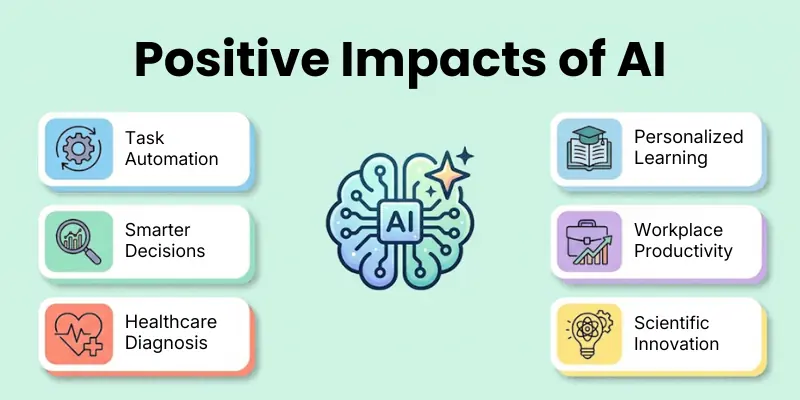
The following are 15 positive impacts of AI that show how this technology can improve daily life, support important industries, and create new opportunities.
- Saves Time and Automates Repetitive Tasks
- Improves Decision-Making
- Enhances Healthcare and Medical Diagnosis
- Improves Education and Learning
- Increases Workplace Productivity
- Supports Scientific Research and Innovation
- Improves Accessibility and Inclusion
- Makes Everyday Life More Convenient
- Improves Customer Service
- Helps Businesses Reduce Costs
1. Saves Time and Automates Repetitive Tasks
One of the most useful artificial intelligence positive effects is its ability to automate repetitive tasks and save time. It can help with data entry, email drafting, document summaries, scheduling, and customer support, allowing people to focus on important work that needs human judgment and creativity.
For example, an AI assistant can summarize meeting notes and highlight key action items, helping employees make decisions faster.
How AI Saves Time at Work
The following are some common ways AI can reduce routine workload:
- Data entry: AI can extract information from documents and organize it into the required format.
- Email drafting: AI can help prepare routine emails, replies, and follow-up messages.
- Document summaries: AI can shorten long reports and highlight important points.
- Scheduling: AI can help organize meetings, appointments, and reminders.
- Customer support: AI can answer common questions and direct complex issues to human agents.
Real-World Example
- Customer support: An AI assistant can summarize customer messages, suggest replies, and organize common questions. Human agents can then focus on complex issues that need personal attention.
- Meeting notes: AI can turn a long meeting recording into a short summary with key decisions and action items.
- Data entry: AI can extract information from invoices or forms and organize it into a spreadsheet.
- Email drafting: AI can prepare routine replies, follow-up emails, and appointment confirmations.
- Scheduling: AI can help arrange meetings, manage calendars, and send reminders.
These examples show how AI can reduce repetitive work and give people more time for important tasks.
2. Improves Decision-Making
AI helps people make informed decisions by analyzing data, finding patterns, and showing possible outcomes. Instead of relying only on guesswork, businesses can use AI insights to understand what may happen next and plan their actions.
The following are some ways AI supports better decision-making:
- Analyzes large amounts of data: AI can process sales records, customer feedback, and other business information to find useful patterns.
- Identifies trends: AI can help businesses understand changing customer preferences and market conditions.
- Supports demand forecasting: AI can estimate future demand, helping businesses plan inventory, production, and staffing.
- Improves resource planning: Businesses can use AI insights to decide where to allocate their budget, time, and resources.
- Helps people compare options: AI can show possible outcomes and support decisions based on available information.
- Saves decision-making time: AI can reduce the time teams spend collecting and reviewing information, allowing them to act faster.
Real-World Example
- Retail business: A store can use AI to analyze past sales, seasonal trends, and customer demand. The business can then decide how much stock to order and avoid unnecessary overstocking.
- Marketing: A company can use AI to study customer behavior and identify which products or campaigns may perform better.
- Healthcare: AI can help doctors review medical information and identify patterns that support clinical decisions. Human professionals still need to review the results.
Key benefit: AI helps people make faster, more informed decisions by turning large amounts of data into useful insights.
3. Enhances Healthcare and Medical Diagnosis
AI is improving healthcare by helping medical professionals examine information, detect possible health problems, and manage patient care. It can support faster diagnosis, more personalized treatment, and better use of healthcare resources.
The following are some important AI positive effects in healthcare:
- Medical image analysis: AI can examine X-rays, CT scans, and other medical images to help doctors spot possible abnormalities.
- Early disease detection: AI can identify patterns in medical data that may help healthcare professionals detect diseases earlier.
- Personalized treatment: AI can analyze patient information to help doctors consider treatment options that fit individual needs.
- Patient monitoring: AI can help monitor patients and identify signs of possible health changes, supporting timely medical attention.
- Administrative healthcare tasks: AI can help with medical documentation, appointment scheduling, and other routine tasks, giving healthcare workers more time for patient care.
Real-World Examples
- Medical scans: AI can help radiologists identify possible problems in X-rays and other scans.
- Patient monitoring: AI can analyze patient data to help healthcare professionals identify possible health risks.
- Medical documentation: AI can turn patient conversations into draft clinical notes, reducing routine paperwork.
Key benefit: AI can support better healthcare by helping professionals analyze information, identify possible health problems, and spend more time caring for patients. Human professionals remain responsible for diagnosis and treatment decisions.
4. Improves Education and Learning
AI helps students understand difficult topics, practice new skills, and learn at their own pace. It also helps teachers prepare lessons and give students more useful feedback. UNESCO highlights personalized tutoring and smarter lesson planning as important opportunities for AI in education.
The following are some positive effects of artificial intelligence in education:
- AI tutors: AI can explain difficult topics, answer questions, and provide extra practice.
- Personalized learning paths: AI can use a student’s progress to suggest lessons and activities that match their learning needs.
- Instant feedback: AI can review answers and help students understand their mistakes.
- Language learning: AI can support vocabulary practice, writing, pronunciation, and conversation.
- Teacher support: AI can help teachers prepare lesson plans, create learning materials, and manage routine tasks.
Real-World Examples
- AI tutor: A student can ask an AI learning tool to explain a difficult math concept in a simpler way.
- Personalized learning: An AI system can suggest extra practice when a student struggles with a topic.
- Language learning: A student can use AI to practice English conversation and receive feedback.
- Teacher support: A teacher can use AI to prepare a lesson outline and create practice questions.
Key benefit: AI can make learning more personalized and help teachers spend more time supporting students. It works best as a learning aid, not a replacement for teachers or independent thinking.
5. Increases Workplace Productivity
AI helps employees complete tasks more efficiently by reducing routine work and making information easier to use. It can support writing, research, data analysis, coding, project planning, and workflow automation.
The following are some ways AI can improve workplace productivity:
- Writing and research: AI can help prepare drafts, summarize information, and find useful sources.
- Data analysis: AI can examine business data and help teams identify patterns and trends.
- Coding assistance: AI coding tools can suggest code, explain errors, and help developers complete routine programming tasks.
- Project planning: AI can help organize tasks, create schedules, and identify possible delays.
- Workflow automation: AI can connect routine tasks and reduce the need for manual work.
Real-World Examples
- Marketing: A marketing team can use AI to analyze customer feedback and prepare a campaign faster.
- Research: A researcher can use AI to summarize relevant papers before reviewing the original sources.
- Coding: A developer can use AI to explain an error and suggest a possible fix.
- Project management: A team can use AI to organize tasks and identify work that needs attention.
Key benefit: AI helps employees save time, improve work quality, and focus on tasks that need human judgment.
6. Supports Scientific Research and Innovation
AI helps researchers analyze large datasets, identify patterns, and explore ideas that may take much longer to study manually. It can also support scientific writing, data analysis, and the development of new medicines and materials.
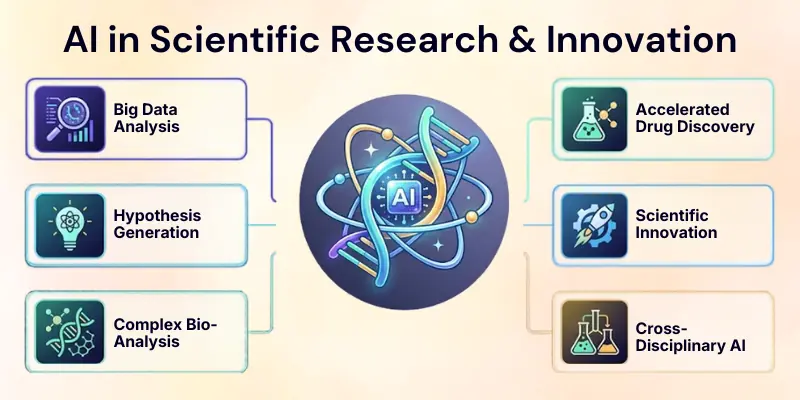
The following are some ways AI supports scientific research:
- Analyzes large datasets: AI can process scientific data and help researchers find useful patterns.
- Supports hypothesis development: AI can help researchers explore possible explanations and research questions.
- Improves data analysis: AI can assist with analyzing images, biological data, and other complex information.
- Supports drug discovery: AI can help researchers study molecules, predict their properties, and explore possible drug candidates.
- Encourages innovation: AI can help researchers explore new ideas and identify connections between different areas of science.
Real-World Examples
- Drug discovery: Researchers can use AI to study molecules and identify promising drug candidates for further testing.
- Scientific research: AI can help researchers analyze large datasets and explore possible explanations for complex problems.
- Material science: Researchers can use AI to explore new materials and predict their properties.
Key benefit: AI helps researchers explore more information, test ideas, and support scientific discoveries more efficiently.
7. Improves Accessibility and Inclusion
AI helps people access information, communicate, and use digital services more easily. It can support people with disabilities and those who face language barriers, making technology more useful for a wider range of users.
The following are some ways AI improves accessibility and inclusion:
- Speech-to-text tools: AI converts spoken words into text, helping people communicate and follow conversations.
- Text-to-speech systems: AI reads digital content aloud, making websites, documents, and other information easier to access.
- AI translation: AI translates text and speech between languages, helping people communicate across language barriers.
- Image descriptions: AI can describe images and visual content, helping people who cannot see them clearly.
- Assistive technologies: AI supports tools that help people with disabilities communicate, learn, and complete daily tasks.
Real-World Examples
- Speech recognition: A person can use speech-to-text to write messages without typing.
- Text-to-speech: A student with a visual impairment can listen to digital study materials.
- AI translation: A traveler can use AI translation to communicate with people who speak another language.
- Image descriptions: AI can describe an image on a website, helping users understand its visual content.
Key benefit: AI can make information and digital services easier to access, helping more people participate in education, work, and everyday life.
8. Makes Everyday Life More Convenient
AI makes everyday tasks easier by helping people find information, plan activities, and use digital services. Many people already use AI through navigation apps, recommendation systems, smart devices, and email filters without thinking about the technology behind them.
The following are some common examples of AI in daily life:
- Navigation and traffic prediction: AI analyzes traffic patterns to suggest routes and estimate travel times.
- Personalized recommendations: AI suggests videos, music, products, and other content based on user preferences.
- Smart home devices: AI helps smart devices respond to voice commands and automate routine activities.
- Voice assistants: AI can answer questions, set reminders, and help users complete simple tasks.
- Email spam filters: AI identifies suspicious or unwanted messages and moves them away from the main inbox.
Real-World Examples
- Navigation: A navigation app can suggest a faster route when traffic increases.
- Shopping: An online store can recommend products based on what a customer views or buys.
- Smart home: A voice assistant can set a reminder or control a connected device.
- Email: An AI spam filter can move unwanted messages out of the inbox.
Key benefit: AI saves time and makes common digital services more convenient and easier to use.
9. Improves Customer Service
AI helps businesses respond to customers faster and provide more relevant support. It can handle common questions, organize customer information, and help support teams resolve issues more efficiently.
The following are some ways AI improves customer service:
- AI chatbots: AI can answer common questions and guide customers through simple problems.
- 24/7 assistance: AI-powered support tools can provide help outside normal business hours.
- Customer feedback analysis: AI can analyze reviews and messages to identify common concerns.
- Personalized recommendations: AI can suggest products or services based on customer needs and preferences.
- Faster issue resolution: AI can help agents find relevant information and suggest possible solutions.
Real-World Examples
- AI chatbot: A customer can ask about an order and receive an instant update.
- Customer feedback: A business can analyze reviews to identify a common complaint.
- Personalized support: An online store can recommend products based on a customer’s previous purchases.
- Faster resolution: A support agent can use AI to find relevant information while helping a customer.
Key benefit: AI helps businesses provide faster, more personalized customer service while allowing human agents to focus on complex issues.
10. Helps Businesses Reduce Costs
AI can help businesses reduce costs by improving efficiency, reducing errors, and making better use of resources. Instead of waiting for problems to occur, businesses can use AI to identify possible issues and plan maintenance or operations more effectively.
The following are some ways AI can help businesses reduce costs:
- Workflow automation: AI can automate routine tasks and reduce the time employees spend on manual work.
- Predictive maintenance: AI can analyze equipment data to identify possible failures before they cause expensive downtime.
- Inventory management: AI can help businesses forecast demand and avoid unnecessary overstocking.
- Error detection: AI can identify unusual patterns and possible mistakes in business processes.
- Resource planning: AI can help businesses plan staff, equipment, and other resources more efficiently.
Real-World Examples
- Predictive maintenance: A factory can use AI to detect early signs of equipment failure and schedule repairs before a breakdown.
- Inventory management: A retailer can use AI to forecast demand and avoid ordering too much stock.
- Workflow automation: A business can automate routine data processing and reduce manual work.
- Error detection: A company can use AI to identify unusual transactions or process errors.
Key benefit: AI helps businesses reduce unnecessary costs, improve resource use, and prevent avoidable operational problems.
How to Maximize the Positive Impacts of AI
AI can save time, improve decisions, and make everyday tasks easier, but its benefits depend on how people use it. By choosing the right tasks, protecting personal data, and checking AI-generated results, you can use AI more safely and effectively.
The following are practical ways to maximize the positive effects of AI:
- Use AI for the Right Tasks: Choose repetitive, time-consuming, or data-based tasks where AI can save time and improve results.
- Keep Humans Involved: Review AI decisions carefully and use human judgment for important matters, especially in healthcare, finance, and education.
- Protect Data and Privacy: Avoid entering sensitive personal, financial, or business information into AI tools without proper privacy and security protections.
- Check AI-Generated Results: Verify facts, calculations, and recommendations before using AI-generated information in important work.
- Keep Learning New Skills: Learn how AI works and practice using relevant AI tools to improve your productivity and stay prepared for future opportunities.
Conclusion
In this guide, we have covered positive impacts of AI. AI saves time, improves healthcare and education, supports businesses, and makes everyday life more convenient. It also helps people solve problems, create new opportunities, and protect the environment.
However, people must use AI responsibly to gain its full benefits. Human review, data protection, and continuous learning can help us enjoy the positive impacts of artificial intelligence while reducing possible risks.
My Recommendation: Start by using AI for simple tasks that save time and improve your daily work. Always check important results and keep developing your own skills alongside AI.
Thank you for reading this guide. I hope it helped you understand how AI can create positive changes in our lives.
💬 What is your favorite positive impact of AI? Share your thoughts in the comments below! 😊
FAQs
Below are some frequently asked questions about the positive impacts of AI to help you understand its benefits, uses, and importance in everyday life.
The positive impacts of AI include faster work, better decision-making, improved healthcare, and easier access to information. AI also supports education, business growth, scientific research, and environmental protection. These benefits help people solve problems and complete tasks more efficiently.
AI makes everyday life easier through voice assistants, navigation apps, spam filters, and personalized recommendations. It can help people find the best route, organize tasks, and discover useful content. These small improvements save time and make daily activities more convenient.
The following are some major business benefits of artificial intelligence:
- Lower Costs: AI automates repetitive work and reduces unnecessary expenses.
- Better Decisions: It analyzes data and helps businesses identify useful patterns.
- Improved Customer Service: AI chatbots provide quick answers and support at any time.
Yes, AI can help doctors analyze medical images, identify health risks, and support early diagnosis. It can also assist with patient monitoring, drug research, and treatment planning. However, healthcare professionals should review AI results before making important medical decisions.
AI supports personalized learning by adjusting lessons to a student’s needs and learning speed. It can explain difficult topics, provide practice questions, and help teachers prepare educational content. Students should use AI as a learning assistant rather than depending on it for every answer.
AI can replace some repetitive tasks, but it also creates new jobs in technology, data analysis, cybersecurity, and AI management. Many existing roles will change as workers use AI tools to complete tasks more efficiently. Learning new skills can help people prepare for these changes.
AI improves accessibility through speech-to-text, text-to-speech, translation, image descriptions, and other assistive technologies. These tools help people communicate, read digital content, and use devices more independently. As a result, AI can support greater inclusion in education, work, and everyday life.
The following are some ways AI can support environmental protection:
- Energy Efficiency: AI helps reduce energy waste in buildings and industries.
- Climate Research: It analyzes large amounts of climate data and identifies environmental patterns.
- Smart Agriculture: AI helps farmers use water, fertilizer, and other resources more carefully.
People can use AI responsibly by choosing suitable tasks, protecting private information, and checking generated results. Human review is especially important when AI supports decisions about health, money, education, or safety. Users should also understand the limits of AI before trusting its recommendations.
Start with simple tasks where AI can save time, such as research, writing, planning, or data organization. Keep learning new skills, review important AI-generated information, and avoid sharing sensitive data with untrusted tools. This approach helps you gain the benefits of AI while reducing possible risks.



- Be Respectful
- Stay Relevant
- Stay Positive
- True Feedback
- Encourage Discussion
- Avoid Spamming
- No Fake News
- Don't Copy-Paste
- No Personal Attacks
- Be Respectful
- Stay Relevant
- Stay Positive
- True Feedback
- Encourage Discussion
- Avoid Spamming
- No Fake News
- Don't Copy-Paste
- No Personal Attacks
