What Is Prompt Engineering? Everything You Need to Know
Published: 30 Jul 2026
Artificial intelligence has rapidly changed how people work, learn, and create content. Large language models like GPT, Claude, and Gemini can now write articles, answer questions, generate code, and even solve complex problems. But these models only perform well when they are guided properly.
This is where prompt engineering comes in. It is becoming one of the most important skills in the AI era. From developers to marketers, designers to students, everyone is now learning how to communicate effectively with AI systems.
Prompt engineering is not just about writing a question. It is about designing instructions in a way that helps AI produce accurate, useful, and high-quality results. As AI tools become more advanced in 2026, the way we interact with them is becoming even more structured and intentional.
In this article, we will discuss prompt engineering in detail.
You will also learn how it works, its benefits, applications, challenges, and future trends.
What Is Prompt Engineering?
Prompt engineering is the practice of designing and refining input instructions (called prompts) to get the best possible output from an AI model.
AI models respond based on patterns in data, so the way you ask a question directly affects the answer you receive. A well-designed prompt can significantly improve accuracy, creativity, and relevance.
Simple Definition: Prompt engineering is the process of writing clear and structured instructions to guide AI systems to generate better responses.
Prompt engineering is used in many AI systems today, especially large language models (LLMs). It helps users control tone, format, depth, and accuracy of responses without changing the underlying AI model.
Why Prompt Engineering Matters
Prompt engineering is important because AI systems do not “think” like humans. They generate outputs based on patterns, probabilities, and context.
A small change in wording can produce very different results. This makes prompt design a critical skill.
The following points explain why it matters in modern AI systems:
- It improves output quality by giving clear instructions to the model.
- It reduces errors and misunderstandings in AI-generated responses.
- It helps users control tone, style, and structure of content.
- It increases efficiency by reducing the need for multiple revisions.
- It allows non-technical users to use AI effectively.
How Does Prompt Engineering Work?
Prompt engineering works by shaping the input provided to an AI model. The model then uses this input to generate a response based on its training data.
It is not about changing the AI itself. Instead, it is about improving how we communicate with it.
1. Understanding the AI Model
Before creating prompts, it is important to understand how AI models process information. These systems use deep learning and transformer architectures.
Learning how models interpret instructions helps users write better prompts and achieve more accurate results. It also reduces confusion when working with different types of AI applications.
The following points explain the basics of how models interpret prompts:
- They break text into tokens (small pieces of words).
- They analyze context based on surrounding words.
- They predict the most likely next word or sentence.
- They adjust output based on instructions in the prompt.
- They use patterns learned from large amounts of training data.
2. Designing the Prompt
This step involves writing clear and structured instructions. A good prompt reduces confusion and improves output quality.
Well-designed prompts help AI systems understand user intent more effectively. They also increase the chances of receiving accurate, relevant, and properly formatted responses.
Here are several important elements involved in prompt design:
- Clarity: Use simple and direct language.
- Context: Provide background information when needed.
- Format: Specify how the output should look.
- Constraints: Define limits such as word count or tone.
- Examples: Show sample outputs for better accuracy.
- Role Assignment: Tell the AI what role or perspective it should follow.
3. Testing and Refining Prompts
Prompt engineering is an iterative process. You test a prompt, review the output, and improve it.
Continuous refinement helps identify what works best for different tasks and use cases. Small changes in wording can often produce significantly better results.
The following methods are commonly used to refine prompts:
- Adjusting wording for better clarity.
- Adding or removing context.
- Changing output format instructions.
- Experimenting with different prompt styles.
- Comparing multiple prompts to find the most effective approach.
Types of Prompt Engineering
Prompt engineering includes different techniques depending on the task and complexity. Each method is designed to help AI generate better responses for specific use cases.
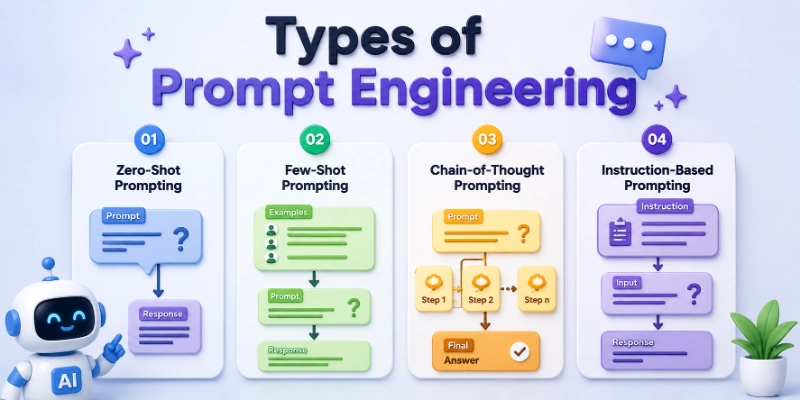
Understanding these techniques can help users choose the most effective prompting strategy for their goals and improve overall output quality.
1. Zero-Shot Prompting
This is when you ask the AI to perform a task without giving examples. The model relies entirely on the instructions provided in the prompt.
Zero-shot prompting is one of the simplest techniques and is widely used for everyday tasks. It works best when the request is straightforward and easy for the AI to understand.
The following points explain its characteristics:
- It relies only on instructions.
- It is fast and simple to use.
- It works best for general tasks.
- It may be less accurate for complex problems.
2. Few-Shot Prompting
This method provides a few examples before asking the AI to generate a response. The examples help the model understand the expected pattern and structure.
By showing sample inputs and outputs, users can guide the AI more effectively. This often leads to higher-quality and more consistent responses.
Here are several common features of few-shot prompting:
- It improves accuracy by showing patterns.
- It helps AI understand the expected output format.
- It is useful for classification tasks.
- It reduces ambiguity in responses.
3. Chain-of-Thought Prompting
This technique encourages AI to explain its reasoning step by step. Instead of giving only a final answer, the model shows how it reached the conclusion.
This approach is particularly useful for tasks that require analysis, calculations, or logical thinking. It helps improve both accuracy and transparency in responses.
Below are the key benefits of this approach:
- It improves logical reasoning.
- It helps solve complex problems.
- It makes outputs more transparent.
- It reduces incorrect assumptions.
4. Instruction-Based Prompting
This method gives clear step-by-step instructions to the AI. The model follows these instructions to produce the desired output.
Providing detailed guidance helps reduce misunderstandings and improves consistency. It is commonly used in content creation, research, and business workflows.
The following points highlight its importance:
- It provides structured guidance.
- It ensures consistent output format.
- It works well for content generation.
- It reduces confusion in tasks.
Examples of Prompt Engineering
Prompt engineering is used in many real-world scenarios. It helps individuals and organizations communicate with AI systems more effectively to achieve better results.
From content creation to business operations, prompt engineering supports a wide range of tasks across different industries. As AI adoption continues to grow, its practical applications are becoming more important than ever.
Here are some practical applications of this technology:
- Content writing: Generating blogs, articles, and marketing copy.
- Programming: Writing and debugging code.
- Customer support: Creating automated chatbot responses.
- Education: Explaining complex topics in simple language.
- Business analysis: Summarizing reports and data insights.
- Language Translation: Converting content between different languages while preserving meaning and context.
- Research Assistance: Gathering information, summarizing sources, and organizing findings more efficiently.
- Social Media Management: Creating captions, post ideas, and content strategies for different platforms.
Technologies Behind Prompt Engineering
Prompt engineering is powered by advanced AI technologies.
The following technologies support this process:
- Large Language Models (LLMs): These are AI models trained on massive datasets.
- Transformer Architecture: A deep learning structure used for understanding context.
- Natural Language Processing (NLP): Helps AI understand human language.
- Reinforcement Learning: Improves model responses using feedback.
These technologies work together to make prompt-based systems more intelligent and responsive.
Benefits of Prompt Engineering
Prompt engineering offers many advantages for individuals and businesses. It helps users communicate more effectively with AI systems and achieve better results.
As AI tools become more common, strong prompting skills can improve efficiency, creativity, and overall productivity. These benefits make prompt engineering valuable across different industries and use cases.
Below are the key benefits of this approach:
- Improved Accuracy: Well-designed prompts reduce errors in AI responses.
- Better Productivity: Users can complete tasks faster with fewer revisions.
- Cost Efficiency: Reduces the need for manual content creation.
- Customization: Allows control over tone, style, and format.
- Accessibility: Makes AI tools usable for non-technical users.
- Enhanced Creativity: Effective prompts help generate fresh ideas and creative solutions for different tasks.
- Consistent Results: Structured prompts improve the reliability and quality of AI-generated outputs.
- Faster Learning: Users can gain knowledge and solve problems more quickly with well-crafted instructions.
Challenges of Prompt Engineering
Despite its benefits, prompt engineering also has limitations. Users must understand these challenges to use AI systems more effectively and responsibly.
Many of these issues can be reduced through practice and experimentation, but they still play an important role in determining the quality of AI outputs.
The following challenges are worth understanding:
- Inconsistency: Small changes in prompts can lead to different results.
- Learning Curve: Beginners may struggle to write effective prompts.
- Model Limitations: AI still makes mistakes and lacks true understanding.
- Over-Reliance: Users may depend too heavily on AI-generated outputs.
- Context Limits: Models can only process a limited amount of information.
- Prompt Maintenance: Existing prompts may require updates as AI models continue to evolve.
- Bias in Outputs: AI responses can reflect biases present in training data or prompt wording.
- Time-Consuming Testing: Finding the most effective prompts often requires multiple rounds of experimentation.
Real-World Applications of Prompt Engineering
Prompt engineering is widely used across industries.
Here are some practical examples of how it works in real-world situations:
- Marketing teams use prompts to generate ad copy and social media posts.
- Developers use it to write code snippets and documentation.
- Teachers use AI prompts to create lesson plans and quizzes.
- Businesses use it to analyze customer feedback.
- Writers use it to generate ideas and improve drafts.
Popular Tools and Models
Prompt engineering is mainly used with modern AI platforms.
The following tools and platforms are widely used today:
- ChatGPT (OpenAI): A powerful conversational AI model.
- Claude (Anthropic): Known for safety and long-form reasoning.
- Gemini (Google): Integrated with search and productivity tools.
- LLaMA (Meta): Open-source model used for research and development.
- Microsoft Copilot: AI assistant for productivity and coding tasks.
These tools all rely heavily on effective prompt design to generate high-quality results.
Future Trends in Prompt Engineering
Prompt engineering is evolving quickly as AI becomes more advanced.
Below are some important trends shaping the future:
- Automated Prompting: AI systems will create better prompts automatically.
- Multimodal Prompts: Integration of text, image, and audio inputs.
- Personal AI Assistants: Customized prompting based on user behavior.
- No-Code AI Tools: More platforms will simplify prompt usage.
- Enterprise Integration: Businesses will standardize prompt workflows.
Best Practices for Prompt Engineering
To get the best results from AI systems, certain practices should be followed. These methods help users create more effective prompts and achieve higher-quality outputs.
As prompt engineering continues to evolve, following proven techniques can improve accuracy, consistency, and overall user experience. Small improvements in prompt design often lead to significantly better results.
The following best practices can help improve results:
- Be clear and specific in instructions.
- Provide context whenever necessary.
- Use structured formats for complex tasks.
- Test multiple versions of a prompt.
- Define output style and tone clearly.
- Include examples when appropriate to guide the expected response format.
- Break complex tasks into smaller steps to improve clarity and accuracy.
- Review and refine prompts regularly based on the quality of generated outputs.
Conclusion
In this guide, we have covered what prompt engineering is, how it works, its types, benefits, challenges, tools, and real-world applications.
Prompt engineering is becoming a core skill in the age of AI. It helps bridge the gap between human intent and machine understanding. As AI systems continue to improve, the ability to communicate effectively with them will become even more valuable.
The future of prompt engineering is closely tied to the growth of artificial intelligence. It will play a major role in education, business, healthcare, software development, and creative industries.
Personal Recommendation: My recommendation is to practice prompt writing regularly. Experiment with different styles and observe how small changes affect AI outputs. This hands-on approach will help you master the skill faster and use AI more effectively in real-life situations.
Thank you for reading.
💬 Feel free to share your thoughts, questions, or experiences in the comments section below. We would love to hear from you and continue the conversation! 😊
FAQs
Below are some FAQs about prompt engineering that can help you better understand this topic.
Prompt engineering is the skill of writing clear instructions for AI tools. It helps the AI understand what you want and gives better results. Strong prompting skills can significantly improve the quality and relevance of generated outputs.
No, it is not purely technical. It requires clear thinking and communication skills more than coding knowledge. Many people from non-technical backgrounds can learn and apply prompt engineering effectively in their work.
It is important because AI tools depend on prompts to generate responses. Better prompts lead to better results. Effective prompt engineering also saves time by reducing the need for multiple revisions and corrections.
Yes, beginners can easily learn it. It mainly requires practice and understanding how AI responds to instructions. With regular experimentation, anyone can develop strong prompting skills over time.
Prompt engineering is used in many practical situations across different fields. The following examples highlight some of its common applications:
- Writing blog posts and articles.
- Generating and debugging code.
- Creating marketing content.
- Summarizing information.
- Translating content into different languages.
These use cases show how prompt engineering can support both personal and professional tasks.
No, coding is not required for basic prompt engineering. However, advanced use cases in AI development may involve coding. Understanding programming concepts can be helpful, but it is not essential for most everyday applications.
Many modern AI platforms support prompt engineering activities. The following tools are widely used by individuals and businesses:
- ChatGPT
- Claude
- Gemini
- Microsoft Copilot
- Perplexity AI
Each platform offers different features and capabilities depending on the user’s requirements.
A prompt is a single instruction, while prompt engineering is the process of designing effective prompts. Prompt engineering focuses on improving clarity, structure, and output quality. This process often involves testing and refining prompts for better performance.
Yes, it is becoming a valuable skill in AI-related jobs, especially in content creation, automation, and AI development. Many organizations now look for professionals who can work effectively with AI tools. As adoption grows, demand for prompt engineering skills is likely to increase further.
The future includes automated prompting, multimodal AI inputs, and deeper integration into business and education systems. New tools will make prompt creation easier and more efficient for users. Prompt engineering is expected to remain an important skill as AI technologies continue to evolve.






- Be Respectful
- Stay Relevant
- Stay Positive
- True Feedback
- Encourage Discussion
- Avoid Spamming
- No Fake News
- Don't Copy-Paste
- No Personal Attacks
- Be Respectful
- Stay Relevant
- Stay Positive
- True Feedback
- Encourage Discussion
- Avoid Spamming
- No Fake News
- Don't Copy-Paste
- No Personal Attacks
