Ethical Issues in Artificial Intelligence – Explained
Published: 8 Jul 2026
Can we really trust artificial intelligence to make fair decisions for humans? Many people use AI tools every day, but very few understand how these systems collect data, make decisions, or influence human behavior. This confusion raises serious concerns about the ethical issues in artificial intelligence and the growing risks behind automated systems.
From hiring software to facial recognition tools, AI now affects important parts of daily life. I have studied many real cases where AI systems produced biased results or violated user privacy because companies focused more on innovation than responsibility. As AI becomes more powerful, people want clear answers about safety, fairness, and accountability.
In this article, we will discuss ethical issues in artificial intelligence in detail. We will also explain how AI affects society, businesses, jobs, privacy, and human decision-making.
What Is AI Ethics?
Artificial intelligence ethics (often called “AI ethics”) refers to the moral principles and guidelines used to design, develop, deploy, and use AI systems responsibly.
It asks questions such as:
- Is the AI fair?
- Does it respect human rights and privacy?
- Can people trust its decisions?
- Who is responsible if something goes wrong?
- Does it benefit society or cause harm?
AI ethics combines ideas from technology, philosophy, law, sociology, and public policy to ensure AI systems support human well-being instead of creating unfair or dangerous outcomes.
Definition of AI Ethics
AI ethics is the study and application of moral values and standards in the creation and use of AI systems. While the definition of AI focuses on machines performing tasks that normally require human intelligence, AI ethics ensures that these systems are developed and used responsibly.
Its goal is to make AI:
- Fair – avoiding discrimination and bias
- Transparent – understandable and explainable
- Accountable – with clear responsibility for outcomes
- Safe and secure – minimizing harm
- Privacy-respecting – protecting personal data
- Human-centered – supporting human dignity and control
Organizations such as UNESCO and the European Union have developed ethical guidelines for trustworthy AI.
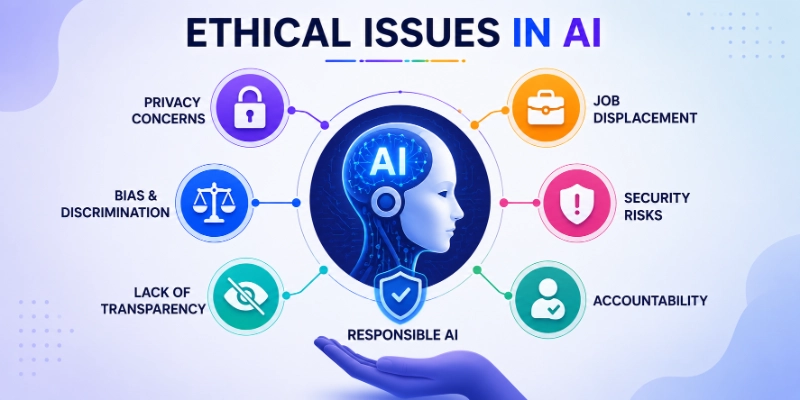
Major Ethical Issues in Artificial Intelligence
As artificial intelligence becomes more advanced and integrated into daily life, it raises serious ethical concerns. These issues affect individuals, businesses, governments, and society as a whole.
Understanding these ethical challenges is essential for developing responsible and trustworthy AI systems.
The following are the major ethical issues in artificial intelligence:
- Bias and Discrimination in AI
- Privacy and Data Protection
- Lack of Transparency and Explainability
- Accountability and Responsibility
- Job Displacement and Automation
- AI Security and Misuse
- Human Rights and Ethical Concerns
- Environmental Impact of AI
- Intellectual Property and Copyright Issues
- Emotional Manipulation and Human Dependency
Let’s have a look at them in detail.
1. Bias and Discrimination in AI
Bias and discrimination remain major ethical issues in artificial intelligence because AI systems learn from human-created data. When datasets contain unfair patterns or social prejudice, AI systems can repeat those same problems in decision-making.
This issue affects industries like healthcare, banking, education, and recruitment. Many companies now use AI tools to speed up important decisions, but biased algorithms can create unfair outcomes for certain groups.
In several real-world cases, AI systems showed discrimination because developers failed to use balanced and diverse training data.
The following points explain how bias and discrimination affect AI systems:
- Algorithmic bias causes unfair decisions
- Biased training data creates inaccurate results
- Some hiring systems favored certain groups unfairly
- Facial recognition tools showed lower accuracy for minorities
- Marginalized communities often face greater harm
- Diverse datasets help reduce AI bias
- Regular testing improves fairness and transparency
Real-Life Example: Some facial recognition systems showed inaccurate results for people with darker skin tones, which created public criticism and ethical concerns worldwide.
2. Privacy and Data Protection
Privacy and data protection have become serious concerns as AI systems collect and process massive amounts of user information. AI tools rely heavily on personal data to improve performance, recommendations, and decision-making. Without proper safeguards, companies may misuse sensitive information.
Many users do not fully understand how businesses collect, store, and share their data. AI-powered surveillance systems also continue to grow worldwide, which raises concerns about personal freedom and ethical responsibility.
The following points highlight the major privacy concerns linked to AI:
- AI systems depend on massive datasets
- Companies collect personal and behavioral data
- Users often lack clear consent options
- AI surveillance increases privacy risks
- Data breaches can expose sensitive information
- Weak cybersecurity creates misuse risks
- Ethical data governance improves user protection
Quick Tip: Always check privacy settings and permissions before using AI-powered apps or online platforms.
3. Lack of Transparency and Explainability
Many AI systems work like black boxes because users cannot clearly understand how these systems make decisions. This lack of transparency creates confusion, especially in industries where AI decisions directly affect human lives and financial stability.
People want AI systems that explain their actions clearly and fairly. In sectors like healthcare and finance, unclear AI decisions can reduce trust and create ethical and legal challenges for businesses.
The following points explain why transparency matters in AI systems:
- Black-box AI systems hide decision-making processes
- Explainable AI improves public trust
- Transparency helps reduce hidden bias
- Healthcare AI mistakes may harm patients
- Financial AI systems may reject applicants unfairly
- Clear explanations support accountability
- Transparent AI models improve reliability
Pro Tip: Companies should provide simple explanations for AI decisions to improve user trust and transparency.
4. Accountability and Responsibility
Accountability becomes difficult when AI systems make harmful or incorrect decisions. Businesses, developers, and governments often struggle to decide who should take responsibility for AI failures and ethical mistakes.
As AI systems become more powerful, human oversight becomes increasingly important. Companies must ensure that AI systems operate safely and follow ethical standards to protect users and society.
The following points explain accountability challenges in AI:
- AI failures create legal confusion
- Companies and developers share responsibility
- Human oversight reduces harmful outcomes
- Weak regulations increase ethical risks
- Businesses must test AI systems regularly
- Accountability improves public confidence
- Ethical AI policies reduce legal problems
Important Note: Human supervision remains necessary because AI systems cannot fully understand morality, emotions, or social consequences.
5. Job Displacement and Automation
AI automation continues to change the modern workforce as businesses replace repetitive tasks with machines and software systems. While automation improves efficiency and productivity, many workers fear losing their jobs and financial stability.
Industries like manufacturing, customer service, and transportation already rely heavily on AI-powered systems. Workers now need new technical skills to adapt to changing workplace demands.
The following points explain how AI affects employment and the economy:
- AI replaces repetitive human labor
- Manufacturing faces strong automation changes
- Customer service uses AI chat systems
- Transportation industries adopt self-driving technology
- Low-income workers face higher risks
- Automation may increase economic inequality
- Reskilling programs help workforce adaptation
Real-Life Example: Many companies now use AI chatbots for customer support, which reduces the need for large support teams.
6. AI Security and Misuse
AI technology offers many benefits, but people can also misuse it for harmful activities. Criminals and unethical organizations now use AI tools to spread misinformation, launch cyberattacks, and manipulate public opinion.
The rapid growth of generative AI has increased concerns about fake content and digital deception. Governments and businesses now face pressure to strengthen AI security and ethical regulations.
The following points explain major AI security risks:
- Deepfakes spread false information online
- AI-generated content manipulates public opinion
- Cybercriminals use AI for advanced attacks
- AI phishing scams continue to increase
- Autonomous weapons raise ethical concerns
- Generative AI can create misleading media
- Strong regulations improve AI safety
Quick Tip: Verify online videos, images, and news from trusted sources because AI-generated fake content has become more realistic.
7. Human Rights and Ethical Concerns
AI systems can strongly affect freedom, equality, and personal rights when organizations misuse technology. Governments and companies increasingly use AI for surveillance, monitoring, and behavior analysis.
Many people worry that uncontrolled AI systems may reduce privacy and weaken democratic values. Ethical AI development must protect human dignity and social fairness.
The following points explain human rights concerns connected to AI:
- AI surveillance reduces personal privacy
- Facial recognition raises ethical questions
- Social scoring systems create discrimination risks
- AI manipulation may affect democracy
- Automated systems influence human choices
- Excessive monitoring weakens public trust
- Ethical regulations protect human rights
Important Note: Responsible AI laws can help protect freedom, equality, and public trust in modern society.
8. Environmental Impact of AI
AI systems require massive computing power, large data centers, and continuous energy consumption. As AI models become more advanced, their environmental impact also continues to increase.
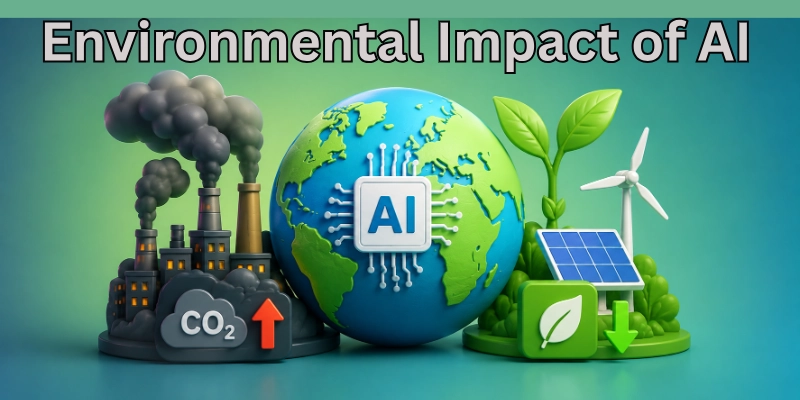
Training large AI systems consumes huge amounts of electricity and produces carbon emissions. Many companies now focus on sustainable AI practices to reduce environmental damage.
The following points explain the environmental impact of AI:
- AI models consume high amounts of energy
- Data centers increase carbon emissions
- Cooling systems require additional electricity
- Large AI training systems affect sustainability
- Green AI practices reduce environmental harm
- Energy-efficient models improve sustainability
- Responsible AI development supports climate goals
Quick Fact: Training advanced AI models can consume as much electricity as hundreds of homes use in a year.
9. Intellectual Property and Copyright Issues
AI-generated content creates new ethical and legal challenges for businesses, artists, and creators. Many AI systems learn from online content without direct permission from original creators.
Artists and writers worry that AI tools may copy their work or reduce the value of human creativity. Governments and legal systems still continue to debate ownership rights for AI-generated content.
The following points explain copyright concerns related to AI:
- AI-generated content creates ownership confusion
- AI systems train on copyrighted material
- Artists fear unauthorized use of their work
- Legal disputes continue to increase
- Human creativity faces growing competition
- Ethical AI should respect intellectual property
- Fair compensation remains important for creators
Real-Life Example: Several artists and authors have filed lawsuits against AI companies for using copyrighted content without permission.
10. Emotional Manipulation and Human Dependency
AI systems now influence human emotions, communication, and daily behavior more than ever before. Some AI tools create emotional connections with users through personalized conversations and interactions.
Excessive dependence on AI systems may reduce human interaction and increase social isolation. Experts also worry that companies may use emotional AI to influence consumer behavior unfairly.
The following points explain emotional and social risks connected to AI:
- AI companions create emotional attachment
- Users may become dependent on AI tools
- Excessive AI use affects social behavior
- Human interaction may decrease over time
- AI systems can manipulate emotions
- Social isolation may continue to increase
- Responsible AI use helps maintain balance
Pro Tip: Use AI tools as assistants instead of replacements for real human relationships and communication.
Why AI Ethics Matters More Than Ever in AI
As AI becomes more advanced and widely used, ethical concerns are increasingly important for safety, fairness, and trust.
Growth of Generative AI and Automation
The rapid expansion of AI systems is transforming industries and daily life.
- AI is used for content creation and automation
- Businesses rely on AI for faster work
- Many jobs are being automated
AI in Healthcare, Finance, Education, and Law Enforcement
AI is now deeply integrated into critical sectors that affect human lives directly.
- AI supports medical diagnosis
- AI helps in fraud detection
- AI is used in surveillance systems
Real-World Consequences of Unethical AI
Unethical AI systems can cause serious harm in society.
- Bias causes unfair decisions
- Misinformation spreads easily
- Privacy can be violated
Public Trust and Responsible Innovation
Ethical AI is essential to maintain trust between users and technology developers.
- Transparency builds trust
- Ethical AI ensures safety
- Rules prevent misuse
Future Ethical Challenges in Artificial Intelligence
As AI technology continues to evolve, future ethical challenges may become more complex and difficult to control. The following are some major future concerns related to AI development and regulation:
- Artificial General Intelligence (AGI) – Advanced AI systems may eventually perform human-level thinking and decision-making.
- AI and Human Control – Humans may struggle to maintain control over highly autonomous AI systems in the future.
- Ethical Concerns in Robotics – Intelligent robots may create safety, privacy, and social responsibility challenges.
- Future AI Governance – Governments and organizations will need stronger policies to regulate advanced AI technologies.
- Balancing Innovation with Regulation – Society must support AI innovation while ensuring ethical and legal protections.
Conclusion
In this guide, we have covered “ethical issues in artificial intelligence.” We discussed how AI affects privacy, security, jobs, human rights, transparency, and daily decision-making. We also explored the ethical challenges of generative AI, including misinformation, deepfakes, plagiarism, and emotional manipulation.
As artificial intelligence continues to grow, responsible AI development will become more important for businesses, governments, and society.
Personal Recommendation: From my experience, people should use AI as a helpful tool instead of depending on it completely. Companies should also focus on fairness, transparency, and human oversight before applying AI systems in sensitive areas like healthcare, education, and finance.
Thank you for taking the time to read this guide. I hope this article helped you understand the ethical issues in artificial intelligence more clearly and provided useful insights for the future.
FAQs
Below are some frequently asked questions that will help you understand AI ethics more clearly and simply.
1. What are the biggest ethical issues in artificial intelligence?
The biggest ethical issues in artificial intelligence include bias, privacy violations, misinformation, lack of transparency, and job displacement. AI systems can sometimes make unfair decisions because they learn from biased human data. These concerns continue to grow as businesses use AI in healthcare, finance, education, and security systems.
2. Why is AI ethics important in modern technology?
AI ethics helps ensure that artificial intelligence works fairly and safely for everyone. It protects users from harmful AI decisions and privacy risks.
Key reasons why ethical AI matters include:
- Preventing discrimination
- Protecting personal data
- Reducing misinformation
- Improving public trust
- Supporting responsible AI development
3. Can artificial intelligence become dangerous for humans?
Artificial intelligence can become harmful if people misuse it or develop it without proper safety rules. Problems like deepfakes, AI-powered cyberattacks, and automated surveillance already create risks in modern society. Responsible AI development and human oversight help reduce these dangers.
4. How does AI bias affect society?
AI bias affects society when algorithms unfairly treat people based on race, gender, age, or background, impacting areas like hiring, healthcare, banking, and law enforcement decisions.
AI bias may lead to issues such as:
- Unfair job rejection
- Incorrect facial recognition results
- Discrimination in financial services
- Reduced trust in AI systems
- Social inequality problems
5. How does generative AI create misinformation?
Generative AI can create realistic fake text, videos, audio, and social media posts, making it difficult for people to tell whether the content is human-made or AI-generated.
This creates risks like:
- Fake news spreading online
- Deepfake videos manipulating opinions
- False information confusing users
- Scams using AI-generated content
- Damage to public trust
6. Can AI replace human jobs completely?
AI can automate repetitive tasks, but it cannot fully replace human creativity, emotions, and critical thinking. Some industries already use AI for customer service, manufacturing, and data analysis. Workers can stay competitive by learning new digital and technical skills.
7. What are the privacy concerns in artificial intelligence?
AI systems use large amounts of personal data to improve results, but without strong protection, this information can be misused or exposed in data breaches.
Major privacy concerns include:
- User tracking without consent
- AI-powered surveillance
- Data leaks and hacking risks
- Misuse of personal information
- Weak cybersecurity systems
8. How can companies reduce ethical issues in AI?
Companies can reduce ethical issues in artificial intelligence by using diverse datasets, transparent AI systems, and regular testing. Human oversight also helps identify harmful AI decisions before they affect users. Ethical AI policies improve trust, safety, and accountability.
9. What is the future of ethical artificial intelligence?
The future of ethical AI relies on strong rules, responsible innovation, and global cooperation, with more focus on transparency, fairness, and safety.
Future ethical AI trends may include:
- Stronger AI laws and regulations
- Safer generative AI systems
- Better transparency tools
- Increased human oversight
- More focus on AI accountability






- Be Respectful
- Stay Relevant
- Stay Positive
- True Feedback
- Encourage Discussion
- Avoid Spamming
- No Fake News
- Don't Copy-Paste
- No Personal Attacks
- Be Respectful
- Stay Relevant
- Stay Positive
- True Feedback
- Encourage Discussion
- Avoid Spamming
- No Fake News
- Don't Copy-Paste
- No Personal Attacks
