How Does Artificial Intelligence Affect Our Society?
Published: 27 Sep 2026
Is artificial intelligence making society better, or is it creating new problems that we have not fully understood yet? This question has become more important as AI enters more parts of everyday life. People use AI to find information, receive recommendations, communicate, study, manage tasks, and access different services. In 2025, more than one-third of people across OECD countries reported using generative AI tools, showing how quickly this technology has entered everyday activities.
The answer is not simply positive or negative. AI can save time, support workers, improve medical services, and help students learn in more personalized ways. However, it can also affect employment, privacy, human decision-making, and the way people trust information. Understanding how artificial intelligence affects our society requires a closer look at both sides.
In this article, we will discuss how artificial intelligence affects our society in detail, along with its effects on work, education, healthcare, communication, privacy, inequality, and our future.
How Is AI Changing Everyday Life?
Artificial intelligence is no longer limited to research labs or large technology companies. It now works quietly behind many everyday services that people use for communication, shopping, learning, entertainment, travel, and financial activities. In 2025, more than one-third of people across OECD countries reported using generative AI tools, which shows how quickly AI has become part of daily life.
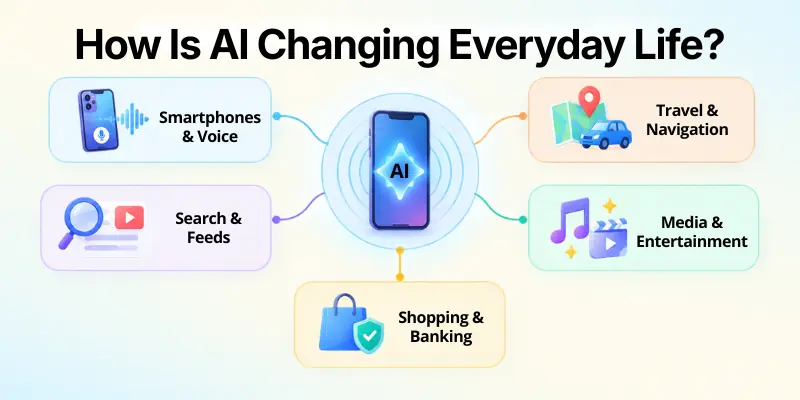
AI often works in the background, so people may not always notice when they interact with it. A smartphone can recognize a face, a search engine can rank results, a shopping website can recommend products, and a navigation app can suggest a faster route. These examples show how artificial intelligence affects everyday life by using data, recognizing patterns, and making predictions or recommendations.
Here are some of the most common ways AI is changing daily activities:
1. AI in Smartphones and Personal Assistants
Modern smartphones use AI for many features that make everyday tasks faster and easier. AI can analyze images, recognize speech, translate languages, summarize information, improve photos, and provide personalized suggestions. Current smartphones increasingly integrate AI directly into features such as visual search, photo editing, transcription, and real-time translation.
AI-powered personal assistants can also understand spoken or written requests and help users perform routine tasks.
- Voice recognition helps users interact with devices without typing.
- AI assistants can answer questions and organize information.
- AI-powered cameras can improve images and recognize objects or faces.
- Real-time translation can help people communicate across languages.
- Predictive features can suggest actions based on user behavior.
These features show the growing role of AI in daily life and AI-powered personal assistants.
2. AI in Search and Recommendations
Every time people search for information online, AI can help determine which results appear first. Search systems analyze language, relevance, previous interactions, and other signals to provide useful results. Recommendation systems also use machine learning to identify patterns in user behavior.
For example, an online platform may learn what a person watches, reads, or searches for and use that information to suggest related content.
- Search engines use AI to understand the meaning behind queries.
- Streaming platforms recommend movies, shows, and music.
- Social platforms personalize feeds and content suggestions.
- News platforms can recommend stories based on user interests.
- AI recommendation systems can help users discover relevant information faster.
This personalization makes digital services more convenient, but it also means that AI can influence what people see and consume online.
3. AI in Online Shopping and Banking
AI has changed how people shop and manage financial services online. E-commerce platforms use artificial intelligence and machine learning to analyze browsing behavior, purchase history, product information, and customer preferences. These systems can then provide personalized product recommendations.
Banks and financial institutions also use AI to support customers and detect unusual activity.
- Online stores recommend products based on customer behavior.
- AI chatbots answer common customer questions.
- Fraud detection systems can identify unusual transactions.
- Banks can use AI to analyze financial patterns and assess potential risks.
- Personalized offers can help businesses provide more relevant services.
AI can make online shopping and banking more convenient, but financial AI systems also require careful oversight because incorrect or biased decisions can affect people’s money and access to services.
4. AI in Transportation and Navigation
AI also helps people move around more efficiently. Navigation applications analyze traffic conditions, road information, travel patterns, and other data to estimate travel times and suggest routes. AI-powered transportation systems can also support traffic management and vehicle safety.
Some important examples include:
- Navigation apps can suggest alternative routes when traffic increases.
- AI can estimate arrival times using real-time and historical data.
- Driver-assistance systems can identify objects, lanes, and potential hazards.
- Transportation systems can use AI for traffic monitoring and prediction.
- Autonomous vehicle research uses computer vision, machine learning, and sensor data to understand road environments.
The growing use of AI in transportation shows how artificial intelligence affects society beyond computers and smartphones. Recent AI research also continues to focus on intelligent transportation, traffic safety, and smart-city applications.
5. AI in Entertainment and Social Media
AI has also changed how people create, discover, and consume digital content. Streaming platforms, social networks, gaming services, and other entertainment platforms use algorithms to personalize content for individual users.
AI can also create new content, including text, images, audio, and video. The OECD describes generative AI as a category of AI that can create new content across these formats.
- Streaming platforms recommend content based on viewing or listening habits.
- Social media platforms personalize feeds and recommendations.
- AI tools can generate images, videos, music, and written content.
- Gaming systems can adapt experiences based on player behavior.
- Content platforms can use AI to identify spam and potentially harmful material.
However, personalization also affects what people see online. This makes AI and social media an important part of the wider social impact of artificial intelligence. OECD research shows that younger adults currently have particularly high levels of digital engagement and generative AI adoption.
Positive Effects of AI on Society
Artificial intelligence can improve many parts of society by helping people work more efficiently, access better services, and solve complex problems faster.
Below are some of the major positive effects of artificial intelligence on society, from healthcare and education to scientific research and public services.
1. Better Healthcare and Medical Services
AI can support healthcare professionals by analyzing large amounts of medical information and helping them identify patterns more quickly.
Below are some important ways AI in healthcare can benefit patients and medical professionals:
- Earlier detection of some diseases
- Faster analysis of medical images
- More personalized treatment plans
- Support for drug discovery and development
- Assistance with clinical decision-making
- Better analysis of patient data
- Support for healthcare professionals with routine tasks
2. More Personalized Education
AI can make learning more personalized by adapting educational content to individual students and their learning needs.
Below are some ways AI in education can improve the learning experience:
- Adaptive learning based on student progress
- AI tutoring and learning assistance
- Personalized feedback on assignments
- Faster access to educational information
- Translation and language support
- Accessibility features for students with disabilities
- Support for teachers with routine educational tasks
3. Higher Productivity and Efficiency
AI can help people and businesses complete repetitive work faster and analyze information more efficiently.
Below are some ways AI productivity tools can improve work and business processes:
- Automation of repetitive tasks
- Faster analysis of large datasets
- More efficient business processes
- Automated customer support
- Faster document and information processing
- Decision-making support
- More time for employees to focus on complex tasks
4. Improved Accessibility and Inclusion
AI can make digital services easier to use for people with different abilities, languages, and communication needs.
Below are some examples of how AI accessibility can support greater inclusion:
- Speech-to-text for people who have difficulty typing
- Text-to-speech for people with visual or reading difficulties
- Real-time language translation
- Voice-based interaction with digital services
- Automated captions for audio and video
- Image and object recognition
- Assistive technologies for people with disabilities
5. Faster Scientific Research and Innovation
AI can help researchers process large amounts of information and identify patterns that may take much longer to find manually.
Below are some ways AI in scientific research can support new discoveries:
- Faster analysis of research data
- Scientific simulations and modeling
- Support for drug research
- Faster analysis of complex scientific problems
- Climate and environmental data analysis
- Identification of patterns in large datasets
- Support for developing new technologies
6. Smarter Transportation and Public Services
AI can help cities and transportation systems use data more effectively to improve services and manage resources.
Below are some important applications of AI in transportation and smart cities:
- Better traffic management
- More efficient route planning
- Real-time traffic prediction
- Predictive maintenance for vehicles and infrastructure
- Improved public transportation planning
- Smart energy and resource management
- Faster analysis of public-service data
Negative Effects of AI on Society
Artificial intelligence can create significant benefits, but its growing use also introduces risks that can affect jobs, privacy, equality, trust, and the environment. Understanding these risks helps people use AI more carefully and make better decisions about where human oversight remains necessary.
Here are the major negative effects of artificial intelligence on society and how they can affect people in real life.
1. Job Displacement and Workforce Changes
AI can automate tasks that people previously performed, which can change job roles and increase the need for new skills.
For a closer look at AI and employment, consider these effects:
- Automation of repetitive tasks
- Changes in existing job responsibilities
- Greater demand for AI and digital skills
- Need for employee reskilling and training
- Creation of new AI-related jobs
- Greater pressure on workers to adapt
- Unequal effects across different industries and skill levels
2. Growing Economic Inequality
AI can increase productivity and create new economic opportunities, but these benefits may not reach everyone equally. Businesses and workers with better access to AI can gain an advantage over those with fewer resources.
This can contribute to AI and economic inequality in several ways:
- Unequal access to advanced AI technology
- Different effects on high- and low-skilled workers
- Greater advantages for companies with large technology budgets
- Higher demand for workers with specialized AI skills
- Concentration of AI-related profits among a smaller number of companies
- Wider gaps between people who can access and use AI effectively and those who cannot
3. Privacy and Data Collection
Many AI systems depend on large amounts of data to recognize patterns and make predictions. When organizations collect and analyze personal information, people can face greater privacy risks.
These examples explain the connection between AI and data privacy:
- Collection of personal information
- Facial recognition and identification
- Tracking of online behavior
- Analysis of location and browsing data
- Processing of sensitive personal information
- Greater risk when organizations fail to protect collected data
- Limited understanding of how some AI systems use personal information
4. Algorithmic Bias and Discrimination
AI systems can produce unfair results when their training data contains existing biases or when developers fail to test systems properly. This can affect important decisions about people’s lives.
The following examples show why AI bias and discrimination need careful attention:
- Biased training data can influence AI results
- Automated systems can produce unfair decisions
- AI hiring systems may disadvantage certain groups
- Automated lending decisions can affect access to financial services
- Facial recognition systems can perform differently across demographic groups
- Lack of transparency can make unfair decisions difficult to challenge
- Human oversight can help identify and correct problematic outcomes
5. Misinformation and Deepfakes
Generative AI makes it easier to create realistic images, videos, voices, and written content. People can use these capabilities for useful purposes, but they can also create misleading content that looks genuine.
This makes AI-generated misinformation and deepfakes an important social concern:
- AI-generated images can create false impressions
- Fake videos can make people appear to say or do things they never did
- Synthetic voices can imitate real people
- AI can produce misleading news or social media content
- Scammers can use realistic content to deceive victims
- Repeated exposure to fake content can reduce public trust in genuine information
6. Overdependence on AI
When people rely too heavily on AI, they may stop checking information or making decisions independently. This can become a problem when an AI system provides inaccurate, incomplete, or misleading information.
Overreliance on AI decision-making can lead to several problems:
- Reduced independent thinking
- Less critical evaluation of information
- Blind trust in AI-generated answers
- Reduced use of human judgment
- Difficulty identifying incorrect AI outputs
- Poor decisions when people accept AI recommendations without verification
7. Cybersecurity and AI Misuse
AI can help organizations detect threats and improve cybersecurity, but malicious users can also use the technology to make attacks more convincing and efficient.
The main concerns surrounding AI cybersecurity risks include:
- More convincing phishing messages
- AI-assisted online scams
- Automated cyberattacks
- Faster creation of malicious content
- Voice and identity impersonation
- More personalized social engineering attacks
- Increased difficulty in distinguishing legitimate messages from fraudulent ones
8. Environmental Impact
AI systems require computing infrastructure to train and operate. As AI adoption grows, the demand for data centers, electricity, cooling systems, and other resources can also increase.
The environmental concerns linked to AI and sustainability include:
- High electricity demand from data centers
- Greater demand for computing infrastructure
- Water use for cooling some data-center facilities
- Increased demand for computer chips and hardware
- Electronic waste from technology infrastructure
- Additional pressure on energy and natural resources
- Need for more energy-efficient and sustainable AI systems
Effect of AI in Education
AI is changing education by making learning more personalized, helping teachers manage routine work, and giving students faster access to information and feedback. However, schools and students also need to consider accuracy, academic integrity, privacy, and overdependence on AI.
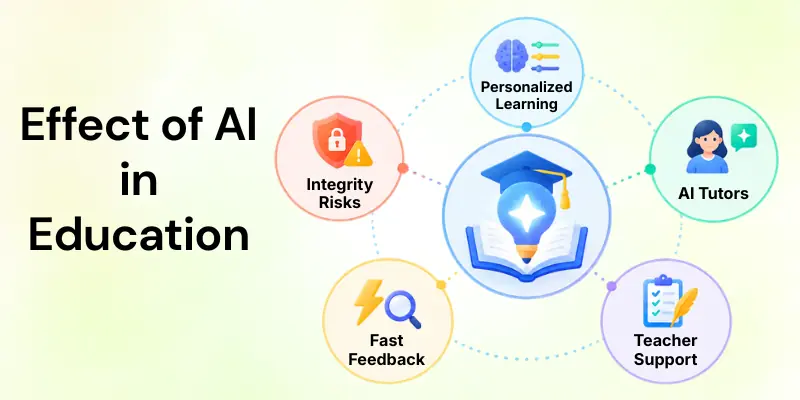
The following points explain the main effects of AI on education and how artificial intelligence is changing the learning experience.
- Personalized Learning: AI can adapt learning materials, activities, and difficulty levels to match each student’s progress and learning needs.
- AI Tutors and Assistants: AI-powered tutors can answer questions, explain difficult topics, and provide learning support outside regular classroom hours.
- Teacher Support: AI can help teachers with lesson planning, administrative tasks, grading support, and preparing educational materials.
- Faster Research and Feedback: Students can use AI to find information, organize ideas, summarize material, and receive quick feedback on their work.
- Risks of AI in Education: Excessive AI use can encourage academic dishonesty, reduce independent thinking, spread incorrect information, and create privacy concerns.
Impact of AI on Jobs
AI is changing the workplace by automating some tasks, reshaping existing roles, and creating demand for new skills. The overall effect depends on the type of work, how organizations use AI, and how quickly workers can adapt to these changes.
The following points explain the connection between AI and employment and show what the future of work may look like.
- Tasks AI Can Automate: AI can automate repetitive and predictable tasks such as data entry, scheduling, customer support, and basic data analysis.
- Changing Job Roles: AI can change existing jobs by reducing routine work and increasing the need for digital and AI-related skills.
- New Jobs From AI: AI can create new career opportunities in areas such as AI development, data analysis, AI training, and AI governance.
- Reskilling and AI Literacy: Workers need AI literacy and updated digital skills to adapt to changing job requirements and remain competitive.
- AI and Human Work: AI is more likely to support many workers by handling routine tasks while humans focus on judgment, creativity, communication, and complex decisions.
AI’s Effect on Healthcare
AI is changing healthcare by helping medical professionals analyze information, identify health conditions, personalize care, and speed up medical research. At the same time, healthcare providers must carefully manage accuracy, patient privacy, and human oversight.
The following points explain the main effects of AI in healthcare and how artificial intelligence is changing medical services.
- Earlier Disease Detection: AI can analyze medical data and images to help healthcare professionals identify signs of certain diseases earlier.
- AI-Assisted Diagnosis: AI can support doctors by analyzing symptoms, medical images, and patient records to assist with diagnosis.
- Personalized Treatment: AI can analyze patient information to help healthcare professionals choose treatments that better match individual needs.
- Drug Discovery and Research: AI can analyze large datasets and help researchers identify potential drug candidates and speed up medical research.
- Healthcare Risks and Limitations: AI can produce incorrect results, reflect bias in data, and create privacy concerns, so medical professionals still need to review and verify its outputs.
Future Impact of AI on Society
AI is likely to influence how people work, make decisions, access services, and interact with technology. Its future impact will depend on how quickly organizations adopt AI, how governments regulate it, and how effectively people learn to work alongside it.
The following points highlight some of the future impacts of AI on society without making unsupported predictions about exactly what will happen.
- Future of Work: AI is likely to automate more routine tasks while changing existing roles and increasing demand for workers with digital and AI skills.
- Human Decision-Making: AI may provide more data-driven recommendations, but people will still need to review important decisions and consider context, ethics, and responsibility.
- Personalized Services: AI can make services more personalized by using user preferences and behavior to provide more relevant recommendations, support, and experiences.
- Social Relationships: AI may influence how people communicate and interact through AI assistants, virtual companions, and personalized digital experiences.
- Regulation and Accountability: Governments and organizations are likely to place greater focus on AI rules, transparency, privacy, safety, and accountability as adoption grows.
- Human-AI Collaboration: People and AI are likely to work together more often, with AI handling data-heavy or repetitive tasks while humans contribute creativity, judgment, empathy, and decision-making.
Conclusion
In this guide, we have covered how artificial intelligence affects our society and explored how AI is changing everyday life, work, education, healthcare, communication, and public services. We also discussed its positive effects, potential risks, privacy concerns, job changes, and possible future impact on society.
Artificial intelligence can make many tasks easier and help society solve complex problems, but people should use it carefully and responsibly. Human judgment, privacy, fairness, and proper oversight will remain important as AI continues to develop.
My recommendation is to learn how AI works and use it as a helpful tool rather than depending on it for every decision. Keep improving your digital and AI skills so you can adapt to changes in work and everyday life.
Thank you for reading, and I hope this guide helped you understand the impact of AI on society. Take care and keep learning!
💬 What do you think about the growing role of AI in society? Share your thoughts in the comments below! 👇
FAQs
Below are some frequently asked questions about how artificial intelligence affects our society.
Artificial intelligence affects society by changing how people work, learn, communicate, shop, travel, and access services. It can improve efficiency and convenience while also creating concerns about privacy, jobs, bias, and misinformation. Its overall impact depends on how people and organizations develop and use AI.
AI can provide several benefits across different areas of society.
- It can improve healthcare and education.
- It can automate repetitive work and increase productivity.
- It can improve accessibility, transportation, and public services.
The negative effects of AI include job disruption, privacy concerns, algorithmic bias, misinformation, and cybersecurity risks. People may also become too dependent on AI for information and decision-making. These risks make human oversight and responsible AI use important.
AI can automate repetitive tasks and change the responsibilities of many workers. It can also create new jobs that require AI, technology, data, and digital skills. The effect varies by industry, occupation, and the type of tasks involved.
AI can make education more personalized by helping students access explanations, feedback, and learning resources. It can also support teachers with tasks such as lesson planning and educational content creation. However, excessive use can affect critical thinking, academic integrity, and independent learning.
AI can help healthcare professionals analyze medical images, patient data, and other information more efficiently. It can support disease detection, diagnosis, personalized treatment, and medical research. However, doctors still need to review AI results because errors and biased outputs can affect patient care.
Yes, AI can make many everyday activities faster and more convenient. Search engines, navigation apps, recommendation systems, smartphones, online shopping platforms, and digital assistants already use AI in different ways. These applications show how AI is changing everyday life without always being visible to users.
AI can affect privacy because many systems collect and analyze personal information to provide predictions or personalized services. Facial recognition, online tracking, location data, and behavioral analysis can increase privacy risks when organizations do not handle data responsibly. Strong data protection and clear privacy practices can help reduce these risks.
AI will likely automate some tasks and change many existing jobs, but this does not mean that it will replace every human worker. Many roles still require creativity, communication, judgment, empathy, and responsibility. Workers who develop relevant skills and learn to work with AI may adapt more easily to changes in the workplace.
Responsible AI use requires people and organizations to consider safety, fairness, privacy, transparency, and human oversight. Important decisions should not rely blindly on AI without appropriate human review. AI literacy and responsible AI practices can help society gain the benefits of artificial intelligence while reducing its potential harms.



- Be Respectful
- Stay Relevant
- Stay Positive
- True Feedback
- Encourage Discussion
- Avoid Spamming
- No Fake News
- Don't Copy-Paste
- No Personal Attacks
- Be Respectful
- Stay Relevant
- Stay Positive
- True Feedback
- Encourage Discussion
- Avoid Spamming
- No Fake News
- Don't Copy-Paste
- No Personal Attacks
