Best AI Chatbots for Business: Top Picks
Published: 18 May 2026
Artificial intelligence chatbots are transforming how businesses communicate with customers, handle support, generate leads, and automate repetitive tasks.
Modern AI chatbots can answer inquiries instantly, personalize conversations, qualify leads, and integrate with CRM and e-commerce systems. If you want to improve customer experience and boost efficiency, choosing the right AI chatbot for business is essential.
This guide will explain the top business AI chatbots and how they help companies at every stage, from marketing to support.
Best AI Chatbots for Business
Here are the leading AI chatbots that businesses can use to automate communication, improve support, and increase conversions:
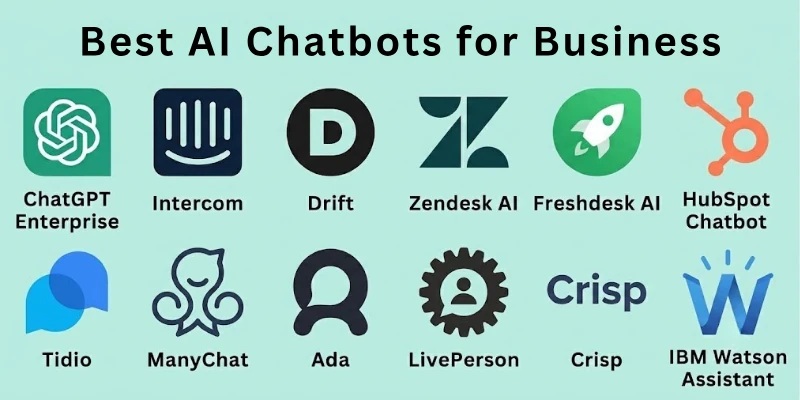
- ChatGPT Enterprise
- Intercom
- Drift
- Zendesk AI
- Freshdesk AI
- HubSpot Chatbot
- Tidio
- ManyChat
- Ada
- LivePerson
- Crisp
- IBM Watson Assistant
So guys, let us learn about each in detail.
1. ChatGPT Enterprise
ChatGPT Enterprise is the business version of ChatGPT designed for secure, scalable AI chatbot experiences across teams. It leverages advanced language understanding to automate responses, assist support teams, generate content, and engage customers in real time. With enterprise-grade security and API access, it’s ideal for businesses of all sizes, especially those needing customized conversational workflows.
How to Use It:
- Deploy on your website or app for customer queries
- Customize responses for your business FAQs
- Integrate with internal dashboards and CRM
- Automate support ticket suggestions
- Generate real-time sales responses
2. Intercom
Intercom is a popular conversational AI platform designed to boost customer engagement and support. Its AI chatbot helps businesses qualify leads, answer customer questions, and route conversations to live agents when needed. It also integrates with email, help desks, and product usage data to personalize chat experiences. Intercom is great for scaling support and improving user onboarding.
How to Use It:
- Configure chatbot workflows for lead qualification
- Set canned answer styles for common questions
- Route complex chats to human agents
- Use analytics to track engagement
- Automate customer onboarding sequences
3. Drift
Drift’s conversational AI focuses on accelerating revenue through real-time customer engagement. It specializes in sales conversations by qualifying leads, booking meetings, and handing off hot prospects to sales reps. Drift’s AI understands intent and can be scripted to ask high-value questions that move prospects down the funnel. It’s ideal for B2B and SaaS companies focused on pipeline acceleration.
How to Use It:
- Create playbooks for different landing pages
- Automatically qualify inbound leads
- Book meetings with sales reps
- Analyze conversion metrics
- Integrate with CRM
4. Zendesk AI
Zendesk AI adds powerful chatbot capabilities to the Zendesk support platform. It can answer customer questions, surface relevant help articles, and defer to support agents when needed. Zendesk AI improves support efficiency, reduces ticket volume, and ensures quicker responses. Because it’s integrated with Zendesk’s full support suite, it’s ideal for customer service teams.
How to Use It:
- Enable AI in your support workflow
- Train bot on FAQ and knowledge base
- Route unresolved queries to agents
- Track AI response effectiveness
- Use insights to improve content
5. Freshdesk AI
Freshdesk AI enhances the Freshdesk customer support system with automated conversation handling. It resolves common issues, suggests knowledge base articles, and can escalate complex cases. It reduces workload for support teams and improves response times. Freshdesk AI also integrates with email and messaging channels, maintaining consistency across platforms.
How to Use It:
- Activate Freshdesk AI for chat channels
- Map common queries to AI replies
- Integrate with knowledge base articles
- Escalate unresolved chats to agents
- Review performance dashboards
6. HubSpot Chatbot
HubSpot Chatbot is part of the HubSpot CRM suite. Its AI chatbot helps qualify leads, book meetings, and personalize conversations based on CRM data. Since it connects directly with contacts, deals, and customer data, it enables highly personalized messaging. HubSpot is ideal for businesses already using the HubSpot ecosystem.
How to Use It:
- Build chatflows with drag-and-drop
- Use CRM data to personalize responses
- Automate meeting scheduling
- Sync chats with contact records
- Track conversions and leads
7. Tidio
Tidio combines live chat, AI chatbot, and email automation in one platform. Its AI chatbot can answer questions, collect lead info, and automate responses across websites and social messaging apps. Tidio is user-friendly and especially useful for small and medium businesses that want AI automation without complexity.
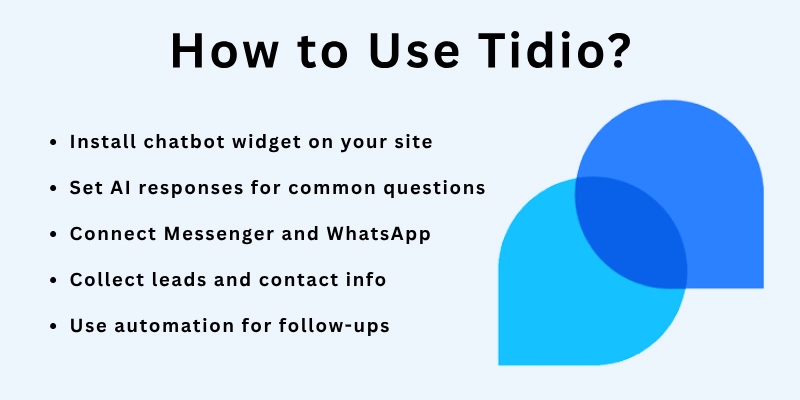
How to Use It:
- Install chatbot widget on your site
- Set AI responses for common questions
- Connect Messenger and WhatsApp
- Collect leads and contact info
- Use automation for follow-ups
8. ManyChat
ManyChat is a chatbot platform focused on social commerce and Messenger automation. It helps businesses engage customers on Facebook Messenger, Instagram, and SMS. ManyChat’s AI workflows can answer questions, recommend products, capture orders, and run campaigns, making it ideal for e-commerce businesses.
How to Use It:
- Create automated conversation flows
- Use keyword triggers
- Connect with Instagram, Messenger, SMS
- Recommend products automatically
- Run promotional campaigns
9. Ada
Ada is a no-code AI chatbot designed for enterprise customer support automation. Its bot can understand customer intent, respond conversationally, and escalate when needed. Ada integrates with support platforms, CRM systems, and self-service portals. It’s great for companies wanting powerful automation without developer resources.
How to Use It:
- Build intent-based chat paths
- Integrate with help desk tools
- Use analytics to refine responses
- Enable multilingual support
- Connect to backend systems
10. LivePerson
LivePerson’s AI chatbot platform focuses on messaging at scale across web, mobile, and social channels. Its conversational AI uses intent modeling and sentiment analysis to deliver personalized responses. It’s particularly strong in conversational commerce and customer care automation for mid-sized to large enterprises.
How to Use It:
- Deploy on multiple messaging channels
- Train AI on customer intents
- Use analytics for performance optimization
- Escalate to live agents when needed
- Personalize based on customer history
11. Crisp
Crisp is an integrated customer support platform with built-in AI chatbot features. Its chatbot can answer FAQs, auto-tag conversations, and manage inbound leads. Crisp also supports chat, email, chatbot, and CRM features in one dashboard, making it ideal for small and medium businesses.
How to Use It:
- Set up chatbot responses for FAQs
- Use auto-tagging to organize chats
- Connect email and chat channels
- Route leads to inbox
- Monitor engagement metrics
12. IBM Watson Assistant
IBM Watson Assistant is a robust enterprise chatbot with advanced natural language understanding. It can be deployed on websites, mobile apps, and support centers. Watson Assistant handles complex queries, integrates with backend systems, and supports personalized customer journeys. It’s ideal for large businesses and enterprises with sophisticated automation needs.
How to Use It:
- Train AI with business-specific intents
- Integrate with CRM and support systems
- Deploy across digital channels
- Use analytics for continuous improvement
- Connect to backend databases
Final Thoughts
So, guys, in this guide we have covered the best AI chatbots for business in great detail. Guys, AI chatbots are no longer just a “nice-to-have”; they are essential tools for businesses that want faster support, better engagement, and higher conversions.
The key is choosing the chatbot that fits your business goals: some focus on sales, some on customer support, and others on social engagement or automation across platforms. Start by identifying your main need, support, lead gen, or marketing, and deploy the chatbot that aligns best.
FAQs
Here are some of the most commonly asked questions about AI chatbots for business:
An AI chatbot is a software program that uses artificial intelligence to interact with customers in natural language, answering questions, providing information, and automating conversations.
Some tools offer free plans or trials, while advanced enterprise features require subscriptions. Costs vary by business size and usage.
AI chatbots are capable of handling a wide variety of routine tasks; however, human support is still preferable for issues that are complex or sensitive.
Yes, in order for them to perform well, they need to be trained with business frequently asked questions, intents, and conversation paths.
The majority of business AI chatbots do, in fact, integrate with customer relationship management (CRM) tools in order to personalize conversations and keep track of leads.
The messaging apps Messenger, Instagram, WhatsApp, and SMS channels are all supported by a variety of tools.
The ability to qualify leads, schedule meetings, showcase products, and guide users through the sales funnel are all capabilities that chatbots possess.
How accurate something is depends on the training data and the settings. For the best results, look over and improve your answers.
Yes, chatbots can handle basic customer support, get new leads, and make the customer experience better, even for small businesses.
Chatbots of the future will be able to have more natural conversations, show more empathy, and be more deeply connected to business systems. This will make personalization and automation even better.
- Be Respectful
- Stay Relevant
- Stay Positive
- True Feedback
- Encourage Discussion
- Avoid Spamming
- No Fake News
- Don't Copy-Paste
- No Personal Attacks
- Be Respectful
- Stay Relevant
- Stay Positive
- True Feedback
- Encourage Discussion
- Avoid Spamming
- No Fake News
- Don't Copy-Paste
- No Personal Attacks
