How AI Helps in A/B Testing: 15 Best Ways
Published: 28 May 2026
A/B testing is essential for businesses to understand what works best for their audience. Traditionally, testing involved manually creating versions and analyzing results, which was slow and often prone to error.
Today, AI improves A/B testing by analyzing data, predicting outcomes, and optimizing experiments automatically. This detailed guide explains how AI helps in A/B testing, the benefits it brings, and practical methods you can use.
Let us cover everything step by step to make your testing faster, smarter, and more effective.
How AI Helps in A/B Testing
Here are the 15 ways AI improves A/B testing for better business decisions and campaign optimization:
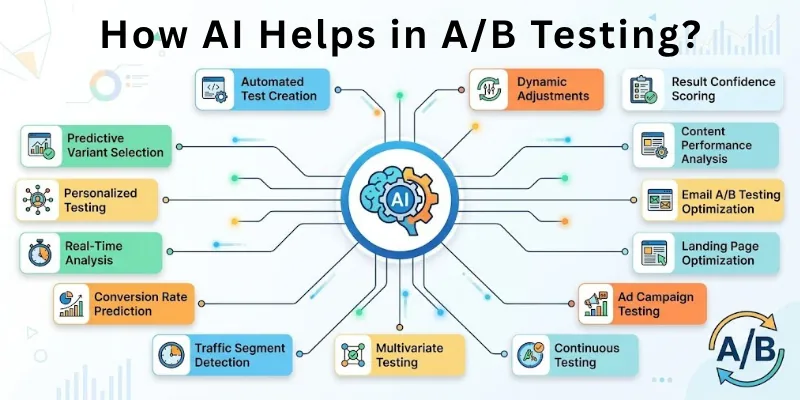
- Automated Test Creation
- Predictive Variant Selection
- Personalized Testing
- Real-Time Analysis
- Conversion Rate Prediction
- Traffic Segmentation
- Optimal Duration Detection
- Multivariate Testing
- Dynamic Adjustments
- Result Confidence Scoring
- Content Performance Analysis
- Email A/B Testing Optimization
- Landing Page Optimization
- Ad Campaign Testing
- Continuous Testing and Learning
Let us learn about each method in detail.
1. Automated Test Creation
Traditionally, marketers manually created multiple test versions. AI can automatically generate variants for testing. It considers different elements like headlines, images, and layouts. Testing becomes faster and easier. Human effort reduces. Teams can focus on strategy rather than repetitive tasks.
Prompts you can use:
- Generate multiple headline variations
- Create different CTA designs
- Test image variations automatically
- Suggest layout adjustments
- Produce content combinations for testing
2. Predictive Variant Selection
Earlier, choosing which version to test relied on guesswork. AI predicts which variants are more likely to perform well. This reduces wasted traffic on low-performing options. Businesses focus on high-potential variants. Testing becomes more efficient. Results are more accurate.
Prompts you can use:
- Predict top-performing variants
- Rank options based on historical data
- Allocate traffic to predicted winners
- Suggest new variations
- Optimize test outcomes
3. Personalized Testing
A/B tests used to be the same for all users. AI personalizes tests based on user segments. Each segment sees different variants suited to their preferences. Results are more actionable. Engagement improves. Marketing becomes targeted and efficient.
Prompts you can use:
- Segment users for testing
- Show personalized content
- Track performance per segment
- Adjust variants based on user behavior
- Optimize messages for each audience
4. Real-Time Analysis
Manual analysis required collecting results over time. AI monitors tests in real time. Immediate insights reveal which variants are performing best. Businesses can make quick adjustments. Decision-making becomes agile. Time to action reduces.
Prompts you can use:
- Track variant performance continuously
- Identify early winners
- Adjust campaigns in real time
- Detect anomalies quickly
- Generate instant reports
5. Conversion Rate Prediction
Conversion analysis was reactive previously. AI predicts which variants are likely to increase conversions. Teams focus on high-impact changes. Optimization is proactive. Conversion rates improve consistently. Decisions are data-driven.
Prompts you can use:
- Predict conversion potential
- Rank variants by expected impact
- Allocate resources effectively
- Suggest improvements
- Optimize user experience
6. Traffic Segmentation
Previously, all users were treated the same in tests. AI segments traffic based on behavior, demographics, and engagement. Each segment receives tailored variants. Insights become more accurate. Campaigns are targeted. ROI improves.
Prompts you can use:
- Divide traffic by user behavior
- Test variants per segment
- Monitor segment-specific results
- Adjust messaging for each group
- Improve test precision
7. Optimal Duration Detection
Tests often ran too long or too short. AI determines the optimal testing duration. Results reach statistical significance faster. Campaigns are adjusted quickly. Time is saved. Testing efficiency improves.
Prompts you can use:
- Calculate required sample size
- Suggest test duration
- Monitor real-time significance
- End test when ready
- Optimize testing schedule
8. Multivariate Testing
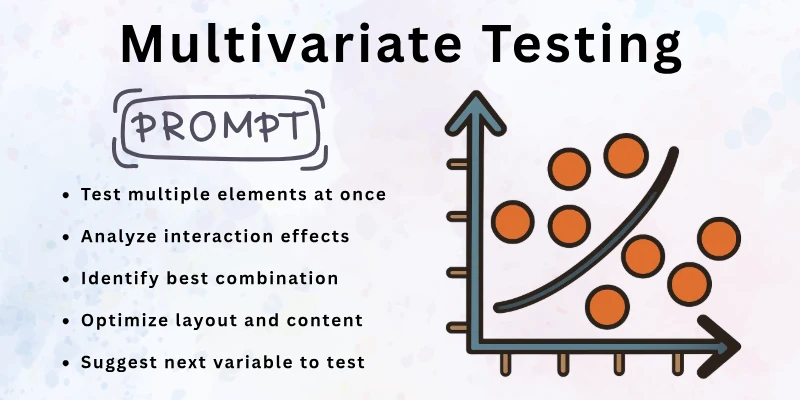
Manual multivariate tests were complex and hard to manage. AI can handle multiple variables simultaneously. Interactions between different elements are analyzed. Insights are richer. Testing complexity is reduced. Teams gain a deeper understanding of what drives performance.
Prompts you can use:
- Test multiple elements at once
- Analyze interaction effects
- Identify best combination
- Optimize layout and content
- Suggest next variable to test
9. Dynamic Adjustments
Previously, adjustments during tests were manual. AI adjusts traffic allocation dynamically based on performance. Winning variants get more exposure automatically. Tests become adaptive. Results are maximized. Resources are used efficiently.
Prompts you can use:
- Shift traffic to high-performing variants
- Reduce exposure of poor variants
- Optimize in-progress tests
- Monitor dynamic allocation
- Improve test results
10. Result Confidence Scoring
Interpreting test results was subjective. AI calculates confidence scores for each variant. Teams understand how likely the results are accurate. Decisions are more reliable. Risk of wrong conclusions reduces. Testing becomes more scientific.
Prompts you can use:
- Compute statistical confidence
- Compare variants objectively
- Highlight significant differences
- Guide decision-making
- Reduce uncertainty
11. Content Performance Analysis
Manual analysis of content effectiveness was time-consuming. AI evaluates which headlines, images, and copy perform best. Insights guide future content creation. Content strategies improve. Engagement increases. Teams work smarter.
Prompts you can use:
- Analyze text and media performance
- Rank high-impact content
- Suggest improvements
- Track engagement metrics
- Optimize future tests
12. Email A/B Testing Optimization
Email tests were previously scheduled manually. AI automates email A/B testing including subject lines, content, and send times. Engagement improves. Open and click rates increase. Campaigns become data-driven. Teams save time.
Prompts you can use:
- Generate subject line variants
- Test email content automatically
- Predict optimal send times
- Track engagement per variant
- Optimize follow-ups
13. Landing Page Optimization
Manual landing page tests were slow. AI tests layouts, CTAs, and forms automatically. Pages convert better based on data. Teams save time designing and testing. Conversion rate improves. Insights inform future pages.
Prompts you can use:
- Test multiple page layouts
- Analyze CTA performance
- Optimize forms automatically
- Track visitor engagement
- Improve page conversions
14. Ad Campaign Testing
Ad variations were tested manually and slowly. AI runs A/B tests for ad creatives, copy, and targeting automatically. Winning ads are identified quickly. ROI improves. Budget is used efficiently. Campaign effectiveness increases.
Prompts you can use:
- Test ad creatives automatically
- Track engagement metrics
- Optimize targeting
- Identify high-performing ads
- Adjust spend accordingly
15. Continuous Testing and Learning
Once set up, traditional tests ended after a period. AI continuously learns from data and suggests new variants. Testing becomes ongoing and adaptive. Performance improves over time. Teams gain constant insights. Decisions stay data-driven.
Prompts you can use:
- Monitor test results continuously
- Suggest new variants
- Learn from previous outcomes
- Update ongoing tests
- Maintain optimal performance
Best AI Tools for A/B Testing
Here are the 10 best AI tools for A/B testing.
- Optimizely – Advanced experimentation platform for websites and apps.
- VWO (Visual Website Optimizer) – AI-driven testing and conversion optimization.
- Google Optimize – Free and AI-assisted website testing tool.
- Adobe Target – AI-powered personalization and testing platform.
- Convert – Multivariate and A/B testing with AI insights.
- Unbounce Smart Traffic – AI optimizes landing pages automatically.
- Dynamic Yield – Personalization and testing platform for multiple channels.
- Freshmarketer – AI-based email and website testing tool.
- AB Tasty – AI-powered experimentation for web and apps.
- Kameleoon – AI-driven testing and personalization for conversions.
Final Note
In this guide, we explained how AI helps in A/B testing with practical examples and methods. We covered automation, personalization, predictive insights, and continuous learning. Each method ensures tests are more efficient and results are more reliable.
My personal advice is to start with small tests and expand gradually. Monitor results, learn from AI insights, and keep iterating. This ensures campaigns and websites perform at their best.
Thank you for reading. I hope this guide helps you implement smarter and faster A/B testing strategies.
FAQs
Here are some of the most commonly asked questions related to How AI helps in A/B testing:
AI A/B testing uses AI to automate, predict, and optimize experiments. Variants are tested efficiently and accurately. Teams get faster and clearer results. This reduces human error. Testing becomes smarter and more reliable.
AI analyzes large data sets and predicts outcomes. It identifies winning variants quickly. Errors from manual testing are minimized. Teams make decisions based on real data. Testing results are more trustworthy.
Yes, AI shows different variants to different user segments. Results become more actionable and meaningful. Engagement improves as users see relevant versions. Teams can optimize for each audience. Personalization increases conversion potential.
Yes, many AI tools are affordable and easy to use. Small teams can run effective experiments without extra staff. Campaign performance improves over time. Teams can scale testing gradually. Even beginners get clear insights.
Yes, AI automates creation, analysis, and adjustments. Teams focus on strategy instead of repetitive tasks. Testing cycles become faster. Insights appear in real time. Decisions are made with less effort.
AI provides insights in real time. Teams can make quick decisions based on data. Performance improves faster than traditional testing. Continuous learning enhances future tests. Results become actionable immediately.
Yes, AI handles multivariate testing efficiently. Interactions between elements are analyzed accurately. Insights are richer and more useful. Teams can optimize multiple parts at the same time. This saves time and improves performance.
Yes, AI predicts which variants are likely to convert. Teams focus on high-impact options. ROI increases as resources are used effectively. Predictions become more accurate over time. Campaign results improve consistently.
Yes, AI adjusts experiments automatically as data comes in. Teams do not need to wait for manual analysis. Tests stay optimized throughout the campaign. Performance improves steadily. Teams achieve better outcomes faster.
Costs vary depending on the tool and scale. Many platforms offer free or affordable plans. Small businesses can experiment without high investment. ROI usually exceeds cost. Testing becomes cost-effective and scalable.





- Be Respectful
- Stay Relevant
- Stay Positive
- True Feedback
- Encourage Discussion
- Avoid Spamming
- No Fake News
- Don't Copy-Paste
- No Personal Attacks
- Be Respectful
- Stay Relevant
- Stay Positive
- True Feedback
- Encourage Discussion
- Avoid Spamming
- No Fake News
- Don't Copy-Paste
- No Personal Attacks
