How to Avoid AI-Generated Misinformation Guide
Published: 20 May 2026
Artificial intelligence is transforming how we search, write, research, and create content. AI tools can generate articles, summaries, answers, and even news within seconds. However, while AI improves speed and productivity, it can sometimes produce incorrect, outdated, or misleading information. This happens because AI systems predict text based on patterns, not real-time understanding or verified truth.
In this complete guide, we will explain how to avoid AI-generated misinformation, the most effective safety practices, and how you can verify AI content before trusting or sharing it.
How to Avoid AI-Generated Misinformation
AI-generated misinformation can spread quickly if users do not verify content properly. Here are the most important ways to avoid it:
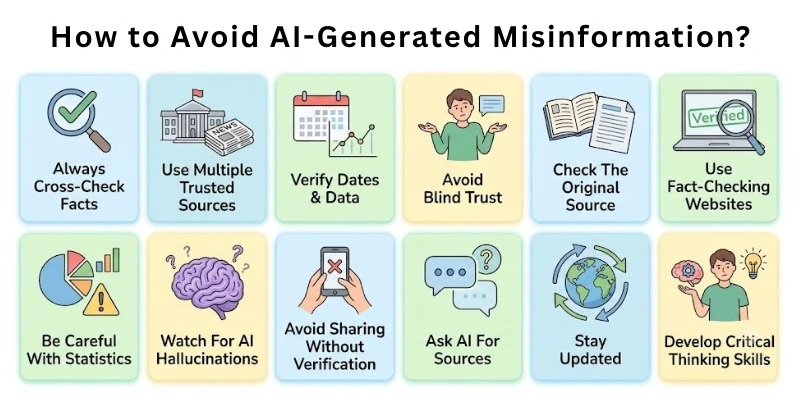
- Always Cross-Check Facts
- Use Multiple Trusted Sources
- Verify Dates And Data
- Avoid Blind Trust In Confident Language
- Check The Original Source
- Use Fact-Checking Websites
- Be Careful With Statistics
- Watch For AI Hallucinations
- Avoid Sharing Without Verification
- Ask AI For Sources
- Stay Updated With Current Information
- Develop Critical Thinking Skills
So, let us understand each method in detail.
1. Always Cross-Check Facts
AI tools can generate answers that sound correct but may contain factual errors. Cross-checking is the first and most important step to avoid misinformation. Always verify important details such as names, numbers, dates, and events.
How to Avoid Misinformation:
- Search the same information on reliable websites.
- Compare AI responses with official sources.
- Double-check scientific or medical claims.
- Confirm data before using it in research or publishing.
2. Use Multiple Trusted Sources
The risk of receiving incorrect information is increased when one relies on a single source. If you check a number of different trustworthy platforms, you will obtain a picture that is both clearer and more accurate.
How to Avoid Misinformation:
- Read information from at least two or three trusted websites.
- Prefer official government or educational domains.
- Compare expert opinions.
- Avoid depending on unknown blogs.
3. Verify Dates And Data
It is possible that AI will provide statistics or policy information that is no longer relevant. This can lead to confusion, particularly in subjects that are subject to rapid change, such as technology or investments.
How to Avoid Misinformation:
- Check the publication date of information.
- Confirm whether the data is recent.
- Look for the latest reports or studies.
- Update old numbers before using them.
4. Avoid Blind Trust In Confident Language
The tone of writing that is produced by artificial intelligence is frequently confident, even when the information being written is incorrect. The use of confident language does not necessarily guarantee that the information is accurate.
How to Avoid Misinformation:
- Question bold claims.
- Ask yourself if the information sounds realistic.
- Verify surprising or extreme statements.
- Look for supporting evidence.
5. Check The Original Source
When artificial intelligence summarizes information, it does not always make it clear where the information originated. Always make an effort to pinpoint the origin of the information you are obtaining.
How to Avoid Misinformation:
- Search for the original study or report.
- Confirm quotes from official interviews.
- Avoid using information without source clarity.
- Prefer primary sources over summaries.
6. Use Fact-Checking Websites
Platforms that can check facts are experts in determining whether or not information is misleading or false. They verify claims by using evidence and research conducted by experts.
How to Avoid Misinformation:
- Search suspicious claims on fact-check websites.
- Review expert analysis.
- Avoid spreading content marked as false.
- Use fact-check results before sharing online.
7. Be Careful With Statistics
AI may produce numbers that are incorrect, or statistics from different years may be mixed together. Both of these possibilities are possible. The spread of false information can be harmful to a person’s reputation.
How to Avoid Misinformation:
- Verify statistics from official reports.
- Confirm percentage values and research findings.
- Cross-check survey results.
- Avoid using numbers without confirmation.
8. Watch For AI Hallucinations
AI hallucinations happen when AI generates information that sounds real but is completely made up. This may include fake research papers, incorrect references, or nonexistent events.
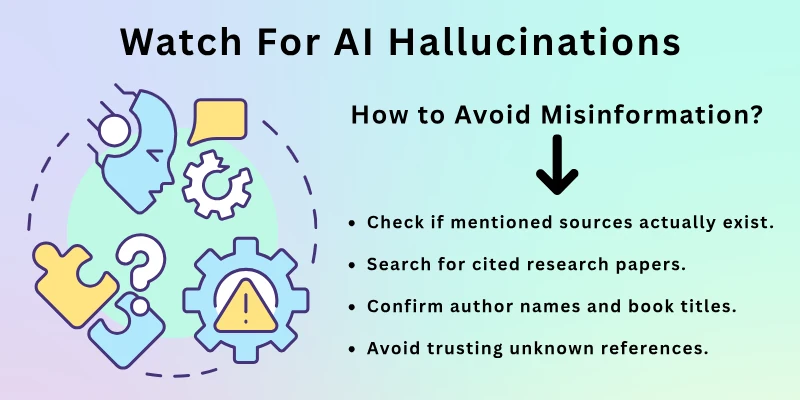
How to Avoid Misinformation:
- Check if mentioned sources actually exist.
- Search for cited research papers.
- Confirm author names and book titles.
- Avoid trusting unknown references.
9. Avoid Sharing Without Verification
Sharing content on social media or websites that has not been verified by artificial intelligence can quickly spread misinformation. Sharing in a responsible manner is essential.
How to Avoid Misinformation:
- Verify content before reposting.
- Do not forward viral content blindly.
- Confirm news from official media outlets.
- Pause and fact-check before clicking “share.”
10. Ask AI For Sources
It is possible to request that AI tools provide references or sources for the answers they provide. Even though it is not 100 percent accurate, this can assist you in verifying information.
How to Avoid Misinformation:
- Request citations or references.
- Verify each provided source manually.
- Check if links are real and accessible.
- Use cited material carefully.
11. Stay Updated With Current Information
The most recent updates might not always be incorporated into AI models. Keeping up with the news and official announcements is an effective way to reduce the likelihood of receiving false information.
How to Avoid Misinformation:
- Follow trusted news outlets.
- Monitor official government websites.
- Stay informed about current events.
- Update your knowledge regularly.
12. Develop Critical Thinking Skills
The ability to think critically is the most effective defense against the spread of false information. AI is merely a tool, and human judgment is still absolutely necessary.
How to Avoid Misinformation:
- Analyze information logically.
- Question unrealistic claims.
- Compare viewpoints from experts.
- Think before accepting information as true.
Future of AI And Misinformation Control
As AI technology improves, developers are working to reduce misinformation risks. Future systems will likely include stronger fact-checking mechanisms and improved transparency.
- AI tools will provide clearer source references.
- Real-time fact verification systems will improve accuracy.
- Bias detection algorithms will become stronger.
- Governments may introduce stricter AI regulations.
- Users will receive better digital literacy education.
The responsibility of avoiding misinformation will always be shared between technology and users.
Final Thoughts
In this guide, we have covered how to avoid AI-generated misinformation and explained practical strategies to verify and protect yourself from false content. AI is powerful, but it is not perfect. You must always verify important information before trusting or sharing it.
As an expert recommendation, treat AI as a helpful assistant, not a final authority. Cross-check facts, use trusted sources, and apply critical thinking in every situation. Responsible AI usage ensures that you benefit from technology without spreading misinformation.
FAQs
Now, let us review some frequently asked questions:
AI-generated misinformation refers to incorrect or misleading content created by artificial intelligence systems. It may include wrong facts, outdated data, or fabricated references. Users must verify such content before trusting it.
AI predicts responses based on patterns in training data. It does not truly understand facts like humans do. Because of this, it can generate errors or outdated information.
You should check official government websites, research papers, or trusted databases. Compare the numbers with multiple reliable sources. Always confirm the publication date.
Yes, AI can sometimes generate nonexistent references, which are called hallucinations. Always search for cited sources manually to confirm their existence.
It can happen, especially in complex or rapidly changing topics. However, responsible usage and fact-checking can reduce the risk significantly.
AI can help with research ideas and summaries, but you must verify all facts and references. Use original academic sources for final work.
If users share AI-generated content without verification, misinformation spreads quickly. Always fact-check before posting or forwarding content.
AI hallucinations occur when AI generates information that appears real but is completely false. This may include fake studies, incorrect names, or imaginary events.
Yes, incorrect data can damage credibility and lead to poor decisions. Businesses must verify AI-generated reports carefully before acting on them.
Developers are improving AI systems to reduce errors and increase transparency. However, users will always need to verify information and apply critical thinking skills.




- Be Respectful
- Stay Relevant
- Stay Positive
- True Feedback
- Encourage Discussion
- Avoid Spamming
- No Fake News
- Don't Copy-Paste
- No Personal Attacks
- Be Respectful
- Stay Relevant
- Stay Positive
- True Feedback
- Encourage Discussion
- Avoid Spamming
- No Fake News
- Don't Copy-Paste
- No Personal Attacks
