What is Reasoning in AI? Types, Benefits & Examples
Published: 22 Jul 2026
Artificial intelligence has transformed the way computers solve problems and support decision-making. Modern AI systems can understand language, recognize images, generate content, and answer questions, but many can also analyze information, compare different possibilities, and make logical decisions.
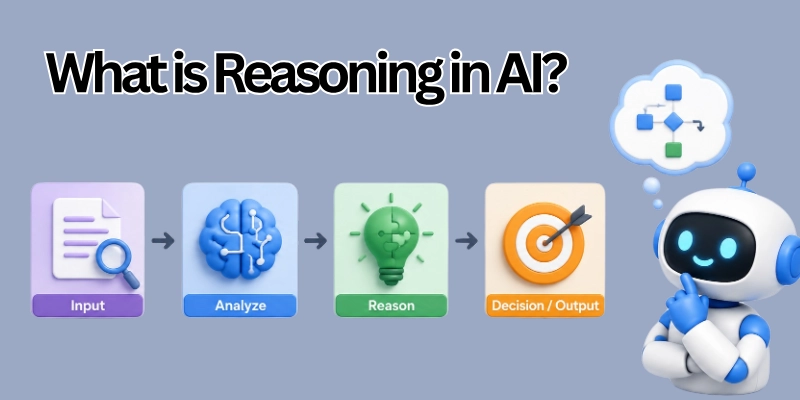
This ability, known as reasoning in AI, helps AI move beyond simple pattern recognition by connecting facts, solving problems step by step, and choosing the most suitable solution. As a result, reasoning AI is widely used in healthcare, business, research, software development, and many other industries to improve accuracy, automate complex tasks, and deliver more reliable outcomes.
In this article, we will discuss what is reasoning in AI in detail. You will also learn how it works, its types, benefits, applications, challenges, and future trends.
Reasoning in AI
Reasoning is one of the most important abilities of artificial intelligence. It allows AI systems to analyze information, identify relationships, evaluate different possibilities, and reach logical conclusions instead of relying only on memorized patterns.
Unlike traditional software that follows fixed instructions, reasoning-based AI can examine new situations and determine the most appropriate response based on available knowledge. This makes AI more flexible and useful when solving unfamiliar or complex problems.
Simple Definition: Reasoning in AI is the ability of an artificial intelligence system to think logically, analyze information, and make decisions or solve problems based on facts and knowledge.
Why Is Reasoning Important in AI?
Artificial intelligence would have limited capabilities without reasoning. AI could recognize patterns, but it would struggle to explain decisions, solve unfamiliar problems, or adapt to changing situations.
Reasoning allows AI to process information in a more intelligent way. Instead of producing answers based only on statistical predictions, it evaluates relationships between facts before generating a response.
The following points explain why reasoning plays such an important role in AI:
- It helps AI solve complex problems step by step.
- It improves decision-making accuracy.
- It enables AI to learn from available knowledge.
- It supports planning and logical thinking.
- It allows AI to adapt to new situations.
- It reduces mistakes in complicated tasks.
- It helps explain why a decision was made.
- It improves the reliability of AI systems.
As AI continues to evolve, reasoning has become one of the key features that separates modern intelligent systems from earlier machine learning models.
Types of Reasoning in AI
Artificial intelligence uses different reasoning methods depending on the problem it needs to solve. Each type has its own strengths and works best in specific situations.
Understanding these reasoning methods helps explain why different AI systems behave differently. Some focus on certainty, while others work with probabilities or incomplete information.
1. Deductive Reasoning
Deductive reasoning begins with general rules and applies them to specific situations. If the starting facts are correct, the conclusion will also be correct.
This approach is widely used in expert systems, rule-based AI, and knowledge-based applications where clear logical rules already exist.
The following characteristics describe deductive reasoning:
- Starts with known facts or rules.
- Produces logically certain conclusions.
- Works well in structured environments.
- Follows strict logical processes.
- Commonly used in expert systems.
Example:
- All employees must wear ID cards.
- Ahmed is an employee.
- Therefore, Ahmed must wear an ID card.
The AI reaches the conclusion by applying an existing rule.
2. Inductive Reasoning
Inductive reasoning works in the opposite direction. Instead of starting with rules, it studies many examples and identifies patterns to create general conclusions.
Machine learning models frequently use inductive reasoning because they learn from training data rather than fixed instructions.
Here are the main characteristics of inductive reasoning:
- Learns from observations.
- Identifies recurring patterns.
- Creates general predictions.
- Improves with larger datasets.
- Supports many machine learning models.
Example:
An AI system analyzes thousands of customer purchases and notices that people buying laptops often purchase wireless mice. It then recommends a mouse to future laptop buyers.
Although the prediction is not guaranteed, it is based on learned patterns.
3. Abductive Reasoning
Abductive reasoning focuses on finding the most likely explanation for available information. It is useful when complete information is not available.
Many AI applications use abductive reasoning because real-world problems often contain uncertainty.
The following situations commonly involve abductive reasoning:
- Medical diagnosis.
- Technical troubleshooting.
- Fraud detection.
- Customer support.
- Cybersecurity investigations.
Example:
A patient has a fever, cough, and fatigue. An AI healthcare system compares these symptoms with medical knowledge and suggests that influenza may be the most likely cause.
The conclusion is based on probability rather than certainty.
4. Analogical Reasoning
Analogical reasoning solves new problems by comparing them with similar situations encountered before.
This reasoning method helps AI transfer previous knowledge to unfamiliar tasks.
Below are several situations where analogical reasoning is valuable:
- Product recommendations.
- Educational AI systems.
- Legal research.
- Business decision support.
- Creative AI applications.
Example:
If an AI has successfully solved a network issue using one configuration, it may recommend a similar solution when another network experiences comparable symptoms.
5. Probabilistic Reasoning
Many real-world situations involve uncertainty. Probabilistic reasoning allows AI to estimate the likelihood of different outcomes instead of making absolute decisions.
Modern AI systems often combine statistical methods with reasoning to improve predictions.
The following factors make probabilistic reasoning valuable:
- Handles incomplete information.
- Estimates possible outcomes.
- Supports risk assessment.
- Improves forecasting.
- Helps manage uncertainty.
Example:
A fraud detection system may determine that a credit card transaction has a 97% probability of being fraudulent instead of declaring it fraudulent with complete certainty.
6. Commonsense Reasoning
Commonsense reasoning allows AI to apply everyday knowledge when solving problems or answering questions.
This remains one of the biggest challenges in artificial intelligence because human common sense includes countless facts that people rarely explain directly.
The following abilities rely on commonsense reasoning:
- Understanding everyday situations.
- Making practical decisions.
- Interpreting conversations.
- Identifying unrealistic information.
- Answering complex questions naturally.
Example:
If someone says they left an ice cream outside on a hot day, AI with commonsense reasoning understands that it will probably melt, even if this fact is not explicitly stated.
How Does Reasoning in AI Work?
Reasoning in AI combines data, knowledge, logic, and intelligent algorithms to reach useful conclusions. Instead of simply storing information, AI evaluates available evidence before making decisions.
Modern reasoning systems often combine symbolic AI, machine learning, knowledge graphs, large language models, and search algorithms. This hybrid approach helps AI solve increasingly complex problems.
The reasoning process usually follows several connected stages.
1. Collecting Information
Every reasoning process starts by gathering relevant information. AI cannot make logical decisions without accurate data.
Different AI systems collect information from different sources depending on their purpose.
The following sources commonly provide information for AI reasoning:
- User input.
- Databases.
- Sensors.
- Documents.
- Images.
- Videos.
- Internet resources.
- Enterprise knowledge bases.
The quality of reasoning depends heavily on the quality of this information.
2. Understanding the Input
After collecting information, AI analyzes the input to determine what the problem actually involves.
Natural language processing, computer vision, and data analysis techniques help AI understand different types of information.
Here are the key tasks performed during this stage:
- Identifying important facts.
- Removing irrelevant information.
- Understanding relationships.
- Recognizing patterns.
- Detecting the user’s goal.
This step creates a clear understanding before deeper reasoning begins.
3. Accessing Existing Knowledge
AI then combines new information with previously learned knowledge or stored facts.
Some systems use knowledge graphs, while others rely on trained neural networks or external databases.
The following resources often support this process:
- Knowledge graphs.
- Rule databases.
- Machine learning models.
- Enterprise documents.
- Domain-specific knowledge.
- Previous interactions.
This combination allows AI to answer questions that require both memory and reasoning.
4. Evaluating Possible Solutions
Once AI understands the problem, it compares multiple possible solutions before choosing the best one.
Different reasoning techniques may work together during this stage depending on the task.
The following activities help AI evaluate possible answers:
- Comparing available evidence.
- Applying logical rules.
- Estimating probabilities.
- Eliminating incorrect options.
- Ranking possible solutions.
This evaluation stage makes reasoning more reliable than simply selecting the first possible answer.
5. Generating the Final Decision
Finally, AI produces its answer, recommendation, prediction, or action based on the reasoning process.
Many modern AI systems can also explain parts of their reasoning, making their decisions easier for users to understand.
The following outcomes may result from this stage:
- Answering questions.
- Making recommendations.
- Solving mathematical problems.
- Diagnosing issues.
- Planning future actions.
- Supporting human decision-making.
As AI models continue to improve, this final stage becomes faster, more accurate, and better at handling complex real-world situations.
Examples of Reasoning in AI
Reasoning in AI becomes easier to understand when you see how it works in real-world situations. Every day, millions of people interact with AI systems that analyze information, compare possibilities, and make logical decisions before providing a response.
Modern AI models do much more than retrieve stored information. They evaluate context, recognize patterns, and apply reasoning techniques to solve problems more effectively. This ability allows AI to support industries ranging from healthcare and finance to education and manufacturing.
The following examples demonstrate how reasoning in AI works in practical situations.
1. Medical Diagnosis
Healthcare professionals increasingly use AI to assist with diagnosing diseases and recommending treatments. AI examines symptoms, medical history, laboratory reports, and imaging results before suggesting possible conditions.
The following tasks show how reasoning supports medical diagnosis:
- Compare patient symptoms with thousands of known diseases.
- Identify possible health risks.
- Recommend additional medical tests.
- Suggest potential treatment options for doctors.
- Prioritize urgent medical cases.
AI supports healthcare professionals by providing additional insights, but doctors still make the final medical decisions.
2. Fraud Detection
Banks and financial institutions use AI reasoning to identify suspicious transactions in real time. Instead of checking only one factor, AI evaluates multiple pieces of information before determining whether a transaction appears risky.
Below are some common activities AI performs during fraud detection:
- Analyze spending behavior.
- Compare current transactions with previous activity.
- Detect unusual purchasing locations.
- Evaluate transaction timing.
- Calculate the probability of fraud.
This reasoning process helps reduce financial losses while minimizing false alerts.
3. Customer Support Chatbots
Modern AI chatbots understand customer questions, identify user intent, and determine the most helpful response instead of matching simple keywords.
The following capabilities improve AI-powered customer service:
- Understand natural language questions.
- Ask follow-up questions when needed.
- Recommend relevant solutions.
- Guide customers through troubleshooting steps.
- Escalate complex issues to human agents.
Reasoning allows chatbots to provide more personalized and accurate assistance.
4. Autonomous Vehicles
Self-driving vehicles continuously analyze their surroundings before making driving decisions. They combine data from cameras, radar, lidar, GPS, and other sensors.
Here are several ways reasoning improves autonomous driving:
- Recognize road signs.
- Detect pedestrians and cyclists.
- Predict vehicle movements.
- Choose safe driving routes.
- Avoid potential collisions.
Reasoning enables vehicles to respond safely to changing traffic conditions.
5. AI Coding Assistants
AI coding assistants have become valuable tools for software developers. They do more than generate code because they also analyze programming logic and identify possible improvements.
The following tasks demonstrate their reasoning abilities:
- Understand programming requirements.
- Detect coding errors.
- Recommend optimized solutions.
- Explain complex code.
- Generate debugging suggestions.
This helps developers write cleaner and more efficient software.
6. Educational AI Systems
Many online learning platforms now use AI reasoning to personalize education. These systems monitor student progress and adjust lessons based on individual performance.
The following features support personalized learning:
- Identify knowledge gaps.
- Recommend practice exercises.
- Adjust lesson difficulty.
- Explain incorrect answers.
- Track learning progress.
Students receive learning experiences that better match their needs.
Technologies Behind AI Reasoning
AI reasoning depends on several technologies working together rather than a single algorithm. Modern AI systems combine symbolic logic, machine learning, neural networks, and knowledge management techniques to improve decision-making.
Each technology contributes a different capability that strengthens the overall reasoning process.
1. Machine Learning
Machine learning enables AI to learn patterns from data instead of relying only on manually written rules. As more data becomes available, models continue improving their predictions.
The following capabilities make machine learning essential for AI reasoning:
- Learn from historical data.
- Detect hidden patterns.
- Improve prediction accuracy.
- Adapt to changing information.
- Support automated decision-making.
Machine learning forms the foundation of many modern reasoning systems.
2. Large Language Models (LLMs)
Large Language Models have significantly advanced AI reasoning over the past few years. Models released in 2025 and 2026 can solve complex problems by combining language understanding with logical analysis.
The following strengths make LLMs powerful reasoning tools:
- Understand natural language.
- Analyze long documents.
- Solve coding problems.
- Perform mathematical reasoning.
- Generate detailed explanations.
Many AI assistants now use LLMs as their primary reasoning engine.
3. Knowledge Graphs
Knowledge graphs organize information into connected relationships. Instead of storing isolated facts, they show how different concepts relate to one another.
The following features improve reasoning accuracy:
- Connect related information.
- Organize structured knowledge.
- Support fact-based reasoning.
- Improve search results.
- Reduce inconsistent answers.
Knowledge graphs help AI understand context more effectively.
4. Neural Networks
Neural networks imitate certain aspects of the human brain by processing information through multiple connected layers.
Modern deep learning models use neural networks to recognize patterns that traditional programming cannot easily identify.
The following capabilities highlight their importance:
- Recognize images.
- Understand speech.
- Process natural language.
- Detect complex patterns.
- Improve prediction quality.
Neural networks are responsible for many recent AI breakthroughs.
5. Symbolic AI
Symbolic AI represents knowledge using logical rules and symbols. It was one of the earliest approaches to artificial intelligence and still remains useful in many industries.
Below are several situations where symbolic AI performs well:
- Rule-based expert systems.
- Legal reasoning.
- Medical decision support.
- Scientific research.
- Business policy automation.
Many modern AI systems combine symbolic reasoning with machine learning to achieve better results.
6. Search Algorithms
Reasoning often requires AI to examine multiple possible solutions before selecting the best one. Search algorithms help AI efficiently explore these possibilities.
The following applications frequently use search algorithms:
- Route planning.
- Game-playing AI.
- Robot navigation.
- Scheduling systems.
- Decision optimization.
Search algorithms help AI evaluate alternatives quickly and accurately.
Benefits of Reasoning in AI
Reasoning significantly improves the capabilities of artificial intelligence. Instead of making decisions based only on learned patterns, AI can evaluate evidence, compare options, and produce more reliable results.
Organizations across many industries now invest in reasoning-based AI because it improves both efficiency and decision quality.
Below are the key benefits of this approach:
- Better Decision-Making: AI evaluates multiple factors before selecting the most appropriate solution, leading to more informed decisions.
- Improved Problem Solving: Reasoning enables AI to solve complex tasks that require logical thinking rather than simple prediction.
- Higher Accuracy: By analyzing available evidence, AI reduces errors and produces more reliable outcomes.
- Faster Analysis: AI processes large amounts of information much faster than humans while maintaining consistent performance.
- Greater Automation: Businesses can automate more advanced workflows that previously required human judgment.
- Improved Customer Experience: Intelligent AI assistants provide more relevant, personalized, and accurate responses.
- Reduced Human Workload: AI handles repetitive analysis, allowing professionals to focus on strategic responsibilities.
- Consistent Decision Processes: AI applies the same reasoning principles every time, reducing inconsistencies.
- Better Risk Management: Organizations identify risks earlier by evaluating multiple data sources simultaneously.
- Continuous Improvement: Many AI systems improve their reasoning performance as they learn from new information.
Challenges of Reasoning in AI
Although AI reasoning has improved rapidly, it still faces several important challenges. Developers continue working to make reasoning systems more accurate, transparent, and trustworthy.
Understanding these limitations helps organizations use AI more responsibly.
The following challenges are worth understanding:
- Incomplete Information: AI may receive missing or inaccurate data, which can reduce reasoning quality.
- Bias in Training Data: Poor-quality or biased data can influence AI decisions and create unfair outcomes.
- Limited Commonsense Knowledge: AI still struggles with situations that humans solve using everyday experience.
- Complex Decision-Making: Some real-world problems involve uncertainty that remains difficult for AI to evaluate.
- Lack of Transparency: Advanced neural networks sometimes make decisions that are difficult to explain.
- High Computing Requirements: Advanced reasoning models require powerful hardware and significant computing resources.
- Privacy Concerns: AI systems often process sensitive personal or business information that requires strong security measures.
- Ethical Issues: Organizations must ensure AI reasoning remains fair, accountable, and responsible.
- Changing Environments: AI models require regular updates as industries, regulations, and user behavior evolve.
- Human Oversight: Many important decisions still require expert review rather than relying completely on AI.
Despite these challenges, ongoing research continues to improve AI reasoning every year.
Real-World Applications of Reasoning in AI
Reasoning has become one of the most valuable capabilities in modern artificial intelligence. Organizations across different industries now use reasoning-enabled AI to improve decision-making, increase efficiency, and solve complex problems.
As reasoning technology continues to mature, its range of applications continues to expand.
Here are some practical applications of this technology:
- Healthcare: AI assists doctors by analyzing symptoms, recommending diagnoses, interpreting medical images, and supporting treatment planning.
- Finance: Banks use reasoning AI for fraud detection, credit risk assessment, investment analysis, and regulatory compliance.
- Education: Intelligent tutoring systems personalize lessons, recommend learning materials, and monitor student progress.
- Customer Service: AI assistants understand customer questions, solve common problems, and provide personalized recommendations.
- Cybersecurity: AI analyzes network activity, identifies suspicious behavior, detects malware, and recommends security responses.
- Manufacturing: Smart factories use reasoning AI for predictive maintenance, quality control, and production optimization.
- Retail and E-commerce: AI recommends products, predicts customer preferences, manages inventory, and improves shopping experiences.
- Transportation: Autonomous vehicles and logistics companies use reasoning AI for route optimization, traffic analysis, and fleet management.
- Scientific Research: Researchers use AI to analyze large datasets, discover patterns, generate hypotheses, and accelerate innovation.
- Software Development: AI coding assistants help developers write, review, optimize, and debug software more efficiently.
Reasoning continues to transform industries by helping AI systems make smarter and more informed decisions in real-world environments.
Popular AI Reasoning Tools, Platforms, and Models (2026)
The rapid growth of reasoning AI has led to the development of powerful models and platforms that can solve complex problems, analyze information, and assist users with a wide range of tasks. Some focus on general-purpose reasoning, while others specialize in coding, research, business automation, or enterprise solutions.
Choosing the right platform depends on your goals, technical requirements, and budget.
Below are some of the most popular AI reasoning tools and models available in 2026.
- ChatGPT: Developed by OpenAI, ChatGPT supports advanced reasoning, coding, writing, research, data analysis, and business productivity. It can understand complex instructions and solve multi-step problems.
- Claude: Claude by Anthropic is known for strong reasoning, long-context understanding, document analysis, and safe AI responses. Many businesses use it for research, writing, and enterprise workflows.
- Google Gemini: Gemini combines reasoning with Google’s search capabilities, multimodal understanding, and productivity features. It works across Google Workspace applications and supports text, images, and code.
- Microsoft Copilot: Microsoft Copilot integrates reasoning capabilities into Windows, Microsoft 365, GitHub, and Azure services. It helps users automate tasks, summarize documents, and improve productivity.
- Grok: Developed by xAI, Grok focuses on conversational reasoning, coding assistance, and real-time information analysis. It is designed to answer complex questions while understanding context.
- DeepSeek: DeepSeek has become popular for programming, mathematics, and logical reasoning tasks. It provides strong performance while remaining cost-effective for many users.
- Meta Llama: Llama is an open-weight AI model that developers can customize for research, enterprise applications, and specialized reasoning tasks.
- IBM watsonx: IBM’s enterprise AI platform helps organizations build secure AI systems for business automation, data analysis, and decision support.
- Amazon Bedrock: Amazon Bedrock enables businesses to build AI applications using multiple foundation models while maintaining security and scalability.
- Perplexity AI: Perplexity AI combines reasoning with web search to provide research-focused answers supported by current information and source citations.
These platforms continue to improve as AI companies invest heavily in reasoning capabilities, larger context windows, and more reliable decision-making.
Future Trends of Reasoning in AI
Reasoning in AI continues to evolve rapidly. Researchers and technology companies are developing systems that can solve increasingly difficult problems while becoming more accurate, transparent, and efficient.
The coming years are expected to bring significant improvements across many industries.
Below are some important trends shaping the future.
- Smarter AI Agents: AI agents will complete complex tasks independently by planning multiple steps, using tools, and adapting to changing situations.
- Better Multimodal Reasoning: AI will combine text, images, audio, video, and sensor data to make more informed decisions.
- Improved Scientific Discovery: Researchers will use reasoning AI to accelerate drug development, material science, climate research, and medical innovation.
- More Explainable AI: Developers will build systems that clearly explain how AI reached a particular decision, increasing trust and transparency.
- Enterprise AI Growth: More businesses will integrate reasoning AI into customer service, finance, supply chain management, and daily operations.
- Hybrid AI Systems: Future AI will combine symbolic reasoning, machine learning, and knowledge graphs to improve accuracy and reliability.
- Personalized AI Assistants: AI assistants will better understand user preferences, remember context, and provide more customized recommendations.
- Stronger AI Governance: Governments and organizations will introduce additional regulations to ensure responsible AI development and deployment.
- Lower Computing Costs: More efficient AI models will reduce hardware requirements, making reasoning AI accessible to smaller businesses.
- Human-AI Collaboration: Rather than replacing people, reasoning AI will increasingly work alongside professionals to improve productivity and decision-making.
These developments will make AI reasoning more practical, trustworthy, and valuable across almost every industry.
Best Practices for Using Reasoning in AI
Reasoning AI produces the best results when users apply it carefully and responsibly. Following good practices improves both the quality and reliability of AI-generated outputs.
Whether you use AI for education, business, software development, or research, these recommendations can help you achieve better outcomes.
The following best practices can help improve results:
- Use High-Quality Data: Accurate and complete information leads to better reasoning and more reliable decisions.
- Write Clear Instructions: Well-defined prompts help AI understand the problem and produce more relevant answers.
- Verify Important Results: Always review AI-generated information before using it for business, legal, financial, or medical decisions.
- Combine Human Expertise with AI: Human judgment remains essential for interpreting complex situations and making final decisions.
- Protect Sensitive Information: Avoid sharing confidential personal or business data unless you are using secure and trusted AI platforms.
- Monitor AI Performance: Regularly evaluate AI outputs to identify errors, bias, or declining performance.
- Update AI Systems Frequently: New AI models often include improved reasoning capabilities, better accuracy, and enhanced security.
- Understand AI Limitations: AI can make mistakes or misunderstand context, so users should recognize its boundaries.
- Promote Responsible AI Use: Ensure AI systems follow ethical guidelines, respect privacy, and avoid unfair bias.
- Continue Learning About AI: AI technology evolves quickly, so staying informed helps users take advantage of new capabilities and best practices.
By following these recommendations, individuals and organizations can use reasoning AI more effectively while minimizing potential risks.
Conclusion
In this guide, we have covered what reasoning in AI is, including how it works, its types, benefits, challenges, real-world applications, and future trends. As AI continues to evolve, reasoning will play an even greater role in helping intelligent systems solve complex problems, make better decisions, and support industries such as healthcare, finance, education, and business with more accurate and reliable results.
Personal Recommendation: My recommendation is to learn the basics of reasoning in AI before exploring advanced AI technologies and models. A strong foundation will help you understand and use AI tools more effectively in both learning and professional work.
Thank you for taking the time to read this guide. We hope it has helped you understand how reasoning in AI works and why it plays such an important role in modern artificial intelligence.
💬 Feel free to share your thoughts, questions, or experiences in the comments section below. We would love to hear from you and continue the conversation! 😊
Frequently Asked Questions (FAQs)
Below are some of the most frequently asked questions about reasoning in AI.
Reasoning in AI is the ability of an artificial intelligence system to analyze information, think logically, and reach a conclusion before making a decision or providing an answer. Instead of relying only on memorized patterns, reasoning AI evaluates facts and relationships to solve problems more effectively. This makes modern AI systems more reliable for complex tasks.
Many industries now use reasoning AI to improve decision-making and automate complex tasks.
Some of the most common industries include:
- Healthcare.
- Finance.
- Education.
- Retail.
- Manufacturing.
- Cybersecurity.
- Transportation.
- Software development.
The number of applications continues to grow as AI technology advances.
Reasoning AI depends on several technologies working together to process information and solve problems efficiently.
The following technologies play major roles:
- Machine learning.
- Large Language Models.
- Neural networks.
- Knowledge graphs.
- Symbolic AI.
- Search algorithms.
Combining these technologies allows AI systems to produce more accurate and intelligent results.
Reasoning AI still faces several limitations despite recent advancements. Challenges include handling incomplete information, reducing bias, improving transparency, protecting privacy, and understanding everyday common sense. Researchers continue working to overcome these issues through better models and responsible AI practices.
Several AI models released or updated in recent years demonstrate strong reasoning capabilities. Popular examples include ChatGPT, Claude, Google Gemini, Microsoft Copilot, Grok, DeepSeek, Meta Llama, and IBM watsonx. These platforms continue improving their reasoning performance through ongoing research and model updates.
The future of reasoning in AI looks very promising. Researchers are building systems that can solve increasingly complex problems while becoming more transparent, efficient, and reliable.
The following developments are expected in the coming years:
- Smarter AI agents.
- Better multimodal reasoning.
- Improved explainable AI.
- Faster enterprise adoption.
- Stronger human-AI collaboration.
These advancements will make reasoning AI more valuable across business, education, healthcare, scientific research, and many other industries.






- Be Respectful
- Stay Relevant
- Stay Positive
- True Feedback
- Encourage Discussion
- Avoid Spamming
- No Fake News
- Don't Copy-Paste
- No Personal Attacks
- Be Respectful
- Stay Relevant
- Stay Positive
- True Feedback
- Encourage Discussion
- Avoid Spamming
- No Fake News
- Don't Copy-Paste
- No Personal Attacks
