How AI Helps in Content Planning: Complete Practical Guide
Published: 4 May 2026
Content planning has become more complex as audiences expect useful and relevant information. Earlier, creators planned content using guesses, trends, or copied ideas. This often caused inconsistency and low engagement.
Today, AI studies data, audience behavior, and search intent before planning content. This detailed guide explains how AI helps in content planning in a practical and easy way.
Let us cover everything step by step so you can plan content with clarity and confidence.
How AI Helps in Content Planning
Here are the 15 proven ways AI improves content planning for creators, marketers, and businesses.
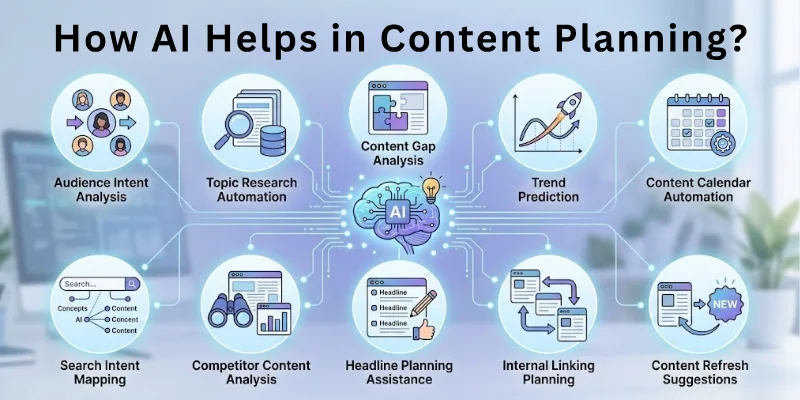
- Audience Intent Analysis
- Topic Research Automation
- Keyword Opportunity Identification
- Content Gap Analysis
- Trend Prediction
- Content Calendar Automation
- Search Intent Mapping
- Competitor Content Analysis
- Headline Planning Assistance
- Content Format Recommendation
- Publishing Time Optimization
- Content Performance Prediction
- Internal Linking Planning
- Content Refresh Suggestions
- Long Term Content Strategy Building
Let us learn about each method in detail.
1. Audience Intent Analysis
Traditionally, content creators assumed what the audience wanted to read. This approach often failed to match real needs. AI now analyzes searches, clicks, comments, and behavior patterns. It understands what users are actually looking for. Content ideas become more accurate and helpful. Planning improves from the start.
Prompts you can use:
- Analyze audience search behavior
- Identify common user questions
- Detect content intent patterns
- Match topics with audience needs
- Improve relevance of content ideas
2. Topic Research Automation
Earlier, topic research required manual searching and brainstorming. This process was slow and limited. AI scans large data sources quickly. It suggests relevant and high interest topics. Planning becomes faster and broader. Writers save time.
Prompts you can use:
- Generate topic ideas automatically
- Analyze popular content themes
- Suggest related subtopics
- Identify evergreen topics
- Speed up research process
3. Keyword Opportunity Identification
Keyword research was based on basic tools and guesswork. Many opportunities were missed. AI finds keywords based on intent, difficulty, and trends. It highlights keywords worth targeting. Content planning becomes strategic. SEO improves.
Prompts you can use:
- Find low competition keywords
- Identify long tail keyword ideas
- Analyze keyword intent
- Predict keyword value
- Improve topic prioritization
4. Content Gap Analysis
In the past, creators were unaware of the content they were lacking. AI contrasts your content with that of rivals. It identifies opportunities and gaps. You address questions that remain unanswered. The content gets more comprehensive.
Prompts you can use:
- Compare competitor content
- Identify missing topics
- Find unanswered questions
- Improve content coverage
- Plan new articles
5. Trend Prediction
Conventional trend monitoring depended on social media monitoring. It was a slow method. AI examines data in real time from various sources. It anticipates future trends in advance. Planners of content stay ahead of the game. Engagement rises.
Prompts you can use:
- Predict content trends
- Analyze rising topics
- Monitor audience interest shifts
- Plan timely content
- Stay ahead of competitors
6. Content Calendar Automation
Manual content calendars needed to be updated frequently. Content schedules are automatically created by AI. It takes priorities and workload into account. Making plans keeps things organized. Teams maintain consistency.
Prompts you can use:
- Create automated content calendars
- Schedule content intelligently
- Balance content workload
- Plan posting frequency
- Maintain consistency
7. Search Intent Mapping
Before, content frequently failed to meet the search intent. Artificial intelligence maps keywords to different types of intent. Users’ goals are aligned with the content. Positions are advancing. Value is found by readers.
Prompts you can use:
- Map keywords to intent
- Identify informational intent
- Plan transactional content
- Improve SEO alignment
- Increase relevance
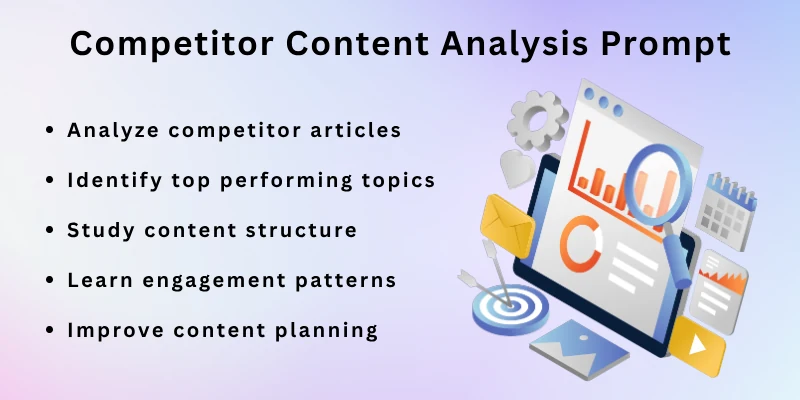
8. Competitor Content Analysis
The manual research on competitors was a time-consuming process. Competitor content is analyzed by AI on a massive scale. It brings to light what achieves success. Planning gains a sense of awareness. The quality of the content betters.
Prompts you can use:
- Analyze competitor articles
- Identify top performing topics
- Study content structure
- Learn engagement patterns
- Improve content planning
9. Headline Planning Assistance
The sole basis for the creation of headlines was creative thinking. AI examines data pertaining to headline performance. Strong ideas for headlines are suggested by it. The potential for clicks increases. The process of planning is driven by data.
Prompts you can use:
- Generate headline ideas
- Analyze headline performance
- Improve click potential
- Match headlines with intent
- Optimize titles
10. Content Format Recommendation
In the past, planners used a single format for every subject. AI suggests formats according to audience preferences. Guides, videos, and blogs are carefully selected. Participation increases. Planning becomes adaptable.
Prompts you can use:
- Recommend best content formats
- Match topics to formats
- Improve user engagement
- Diversify content types
- Increase retention
11. Publishing Time Optimization
A content publication was made on the basis of assumptions. Artificial intelligence studies when audiences are engaged. The optimal times for publication are suggested. There is an increase in reach. The level of engagement rises.
Prompts you can use:
- Analyze audience activity time
- Suggest best publishing hours
- Optimize posting schedule
- Improve content reach
- Increase engagement
12. Content Performance Prediction
A few weeks had passed before planners were able to evaluate performance. The success of content is predicted by AI before it is published. At an early stage, weak ideas are improved. There is an improvement in planning. Risk is decreased.
Prompts you can use:
- Predict content performance
- Evaluate topic potential
- Improve weak ideas
- Reduce planning risk
- Optimize strategy
13. Internal Linking Planning
Following the publication, manual additions of internal links were made. Early planning of internal links is done by AI. The structure of the site is improved. SEO improves, as well. Flow of users is improved.
Prompts you can use:
- Plan internal linking structure
- Suggest relevant links
- Improve site navigation
- Strengthen SEO
- Enhance user experience
14. Content Refresh Suggestions
Sometimes, older content was disregarded. Pages that are no longer relevant are identified by AI. It suggests alterations and enhancements to be made. Content is kept up to date. Positions are advancing.
Prompts you can use:
- Identify outdated content
- Suggest updates
- Improve existing articles
- Refresh old topics
- Maintain relevance
15. Long Term Content Strategy Building
Planning had previously been centered on short-term objectives. Through the use of data, AI develops long-term strategies. The content is aligned with the goals of the business. Planning maintains a fixed focus. The rate of growth stabilises.
Prompts you can use:
- Build long term content plans
- Align content with goals
- Forecast content needs
- Improve planning consistency
- Support growth strategy
Best AI Tools for Content Planning
Here are the 10 best AI tools for content planning.
- ChatGPT for content ideas
- Surfer SEO for content planning
- Clearscope for topic research
- Frase for intent analysis
- MarketMuse for content strategy
- Jasper for planning assistance
- Semrush AI tools for research
- Ahrefs AI insights for gaps
- Notion AI for planning workflows
- Trello AI for content calendars
Final Note
In this guide, we explained How AI helps in content planning using practical methods. We covered research, strategy, and optimization. Each method shows how AI improves clarity and saves time.
My personal advice is to use AI as a planning assistant, not a replacement. Always add human insight. Balance data with creativity.
Thank you for reading. I hope this guide helps you plan content with confidence.
FAQs
Here are some of the most commonly asked questions related to how AI helps in content planning:
AI content planning uses data to organize and plan content ideas. It studies audience interests and trending topics. Planning becomes structured and clear. Teams know what to create next. This makes content creation more efficient and focused.
AI analyzes audience behavior and search trends. It suggests relevant topics that users care about. Content becomes more useful and engaging. Teams save time brainstorming. It also helps avoid creating content that gets ignored.
Yes, AI tools are simple to use. Beginners can plan content easily. Guidance and suggestions stay clear. No advanced skills are needed. Even small teams can start immediately without extra training.
AI supports content strategists but does not replace them. Human judgment is still important. AI improves efficiency. Teams make better decisions faster. Strategists focus on creativity and strategy while AI handles research.
Yes, AI aligns content with search intent. It helps select the right keywords. SEO performance improves. Content reaches the right audience. AI also suggests internal linking and metadata improvements.
AI works quickly with available data. Content plans are ready faster. Teams save time. Decisions become more informed. This allows faster execution of marketing campaigns.
Many tools offer free or affordable options. Small teams can use AI easily. The cost is manageable. ROI often justifies the expense. Teams can scale use as their content needs grow.
Yes, AI helps build long-term strategies. It uses performance data to guide decisions. Planning stays focused and consistent. Teams avoid random posting. It also predicts what topics will trend next.
Yes, AI identifies outdated pages. It suggests updates and improvements. Content stays relevant. Traffic and engagement improve. This also helps maintain authority in search results.
Yes, AI helps maintain content schedules. Publishing stays regular. Audience trust grows. Consistent content improves results. It ensures your brand remains visible and active online.






- Be Respectful
- Stay Relevant
- Stay Positive
- True Feedback
- Encourage Discussion
- Avoid Spamming
- No Fake News
- Don't Copy-Paste
- No Personal Attacks
- Be Respectful
- Stay Relevant
- Stay Positive
- True Feedback
- Encourage Discussion
- Avoid Spamming
- No Fake News
- Don't Copy-Paste
- No Personal Attacks
