How To Use AI For Product Descriptions: Simple Prompts Guide
Published: 8 May 2026
Writing product descriptions is crucial for e-commerce success, but doing it manually can be time-consuming and inconsistent. Traditionally, businesses relied on human writers to create descriptions for each product, which often took hours and led to variations in style.
Today, AI can generate high-quality, consistent, and engaging product descriptions quickly. This guide explains how to use AI for product descriptions, its benefits, and practical methods to optimize your product listings.
Let’s explore step by step so you can save time and boost conversions.
How to Use AI for Product Descriptions
Here are the 15 ways AI can help create effective and compelling product descriptions:
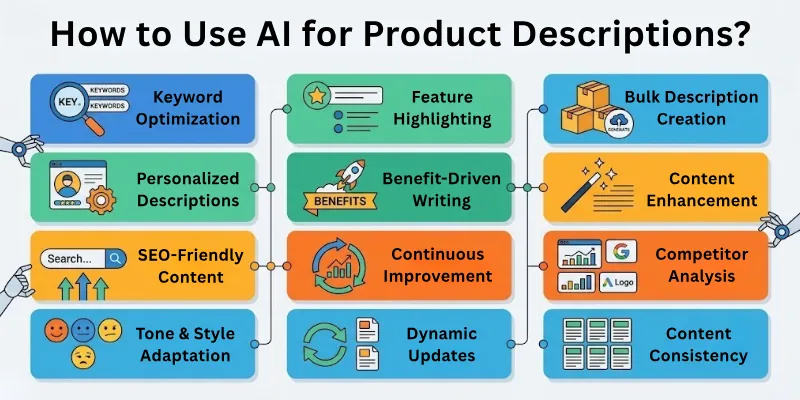
- Keyword Optimization
- Automated Description Generation
- Personalized Descriptions
- SEO-Friendly Content
- Tone and Style Adaptation
- Feature Highlighting
- Benefit-Driven Writing
- Product Comparison Descriptions
- Dynamic Updates
- Bulk Description Creation
- Localization and Language Translation
- Content Enhancement
- Competitor Analysis
- Content Consistency
- Continuous Improvement and Learning
Let us learn about each method in detail.
1. Keyword Optimization
Traditional descriptions often missed target keywords or overused them. AI analyzes search trends and suggests relevant keywords. Each description is optimized for search engines. Visibility improves. Customers find products more easily. Rankings on search platforms increase.
Prompts you can use:
- Identify top keywords for products
- Suggest placement in descriptions
- Optimize for search engines
- Balance keyword density
- Improve product discoverability
2. Automated Description Generation
Writing each product manually is slow. AI generates descriptions automatically using product data. Time spent creating listings decreases. Descriptions remain consistent in style and tone. Teams focus on marketing instead of repetitive writing. Productivity improves.
Prompts you can use:
- Generate descriptions from product details
- Include specifications automatically
- Suggest titles and meta descriptions
- Create multiple description variants
- Maintain consistent style
3. Personalized Descriptions
Earlier, all products had generic descriptions. AI personalizes descriptions based on customer behavior or demographics. Each audience sees content tailored to their interests. Engagement increases. Conversions improve. Shopping experience feels more personal.
Prompts you can use:
- Customize descriptions for segments
- Highlight relevant features
- Adjust tone per audience
- Suggest upsells or related products
- Track performance per personalized variant
4. SEO-Friendly Content
Manual content often ignored SEO best practices. AI ensures descriptions include headings, meta tags, and target keywords. Content ranks better in search engines. Organic traffic improves. Click-through rates increase. Discoverability expands.
Prompts you can use:
- Optimize meta title and description
- Suggest headings for content
- Include long-tail keywords
- Improve readability for SEAI/li>
- Generate structured product content
5. Tone and Style Adaptation
Descriptions previously varied by writer skill. AI adapts tone and style consistently. Formal, casual, or persuasive styles can be applied. Brand voice remains consistent. Customers enjoy a uniform shopping experience. Trust and professionalism increase.
Prompts you can use:
- Adjust tone to brand voice
- Choose persuasive or informative style
- Maintain consistent style across products
- Test different style variations
- Enhance readability
6. Feature Highlighting
Manual descriptions sometimes overlooked key features. AI extracts main features automatically. Highlights are clear and structured. Customers understand product value quickly. Decision-making improves. Conversions increase.
Prompts you can use:
- Extract product specifications
- Highlight unique features
- Create bullet points
- Emphasize differentiators
- Improve clarity
7. Benefit-Driven Writing
Traditional descriptions focused on features only. AI converts features into benefits for customers. Descriptions answer “what’s in it for me?” quickly. Engagement improves. Products appeal more effectively. Sales increase.
Prompts you can use:
- Convert features to benefits
- Highlight customer advantages
- Suggest use cases
- Emphasize value proposition
- Enhance persuasive language
8. Product Comparison Descriptions
Manual comparisons were time-consuming. AI generates comparison content between similar products. Customers understand differences clearly. Decision-making is faster. Browsers convert more efficiently. Trust builds through transparency.
Prompts you can use:
- Compare features and prices
- Highlight pros and cons
- Suggest suitable alternatives
- Provide clear differentiation
- Improve conversion decisions
9. Dynamic Updates
Previously, descriptions remained static until manually updated. AI can update descriptions automatically based on stock, pricing, or features. Information remains accurate. Customers see current details. Reduces errors. Inventory management is more efficient.
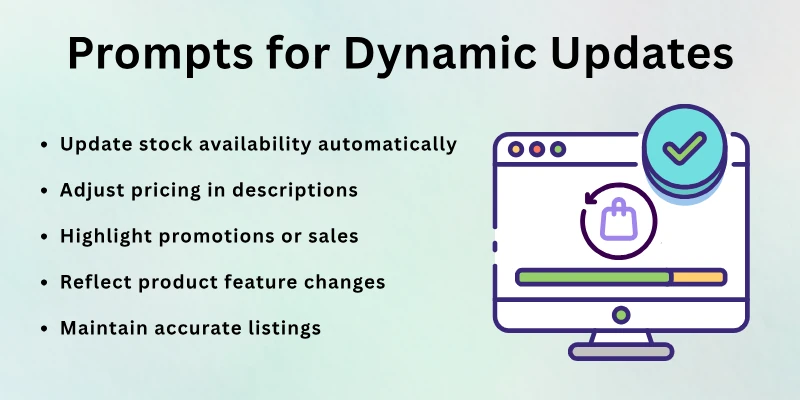
Prompts you can use:
- Update stock availability automatically
- Adjust pricing in descriptions
- Highlight promotions or sales
- Reflect product feature changes
- Maintain accurate listings
10. Bulk Description Creation
Creating hundreds of listings manually is impractical. AI generates product descriptions in bulk. Time and effort reduce significantly. Consistency remains intact. Teams can launch products faster. Scale operations efficiently.
Prompts you can use:
- Generate descriptions for multiple products
- Apply templates across SKUs
- Maintain brand consistency
- Adjust tone per category
- Automate repetitive tasks
11. Localization and Language Translation
Manual translation of descriptions was slow and inconsistent. AI translates content into multiple languages instantly. Tone and context are maintained. Global reach improves. Customers receive accurate information. Multilingual SEO benefits.
Prompts you can use:
- Translate descriptions automatically
- Adapt to cultural context
- Maintain style and tone
- Optimize for local SEAI/li>
- Reach international customers
12. Content Enhancement
Older descriptions lacked richness and detail. AI enhances content by adding adjectives, storytelling elements, or FAQs. Descriptions become more engaging. Readers spend more time on pages. Conversion likelihood increases. Content quality improves.
Prompts you can use:
- Add descriptive language
- Suggest storytelling elements
- Include FAQs
- Improve readability
- Enhance product appeal
13. Competitor Analysis
Previously, businesses had limited insight into competitors’ descriptions. AI analyzes competitor content for ideas and optimization. Descriptions outperform competitors. Market positioning improves. Strategy becomes data-driven. Competitive advantage increases.
Prompts you can use:
- Analyze competitor product descriptions
- Suggest improvements based on competitors
- Identify keyword gaps
- Optimize for higher engagement
- Benchmark content quality
14. Content Consistency
Manual writing often led to inconsistent style across products. AI ensures uniform voice, structure, and tone across all descriptions. Brand identity strengthens. Professionalism is maintained. Customer trust improves. Shopping experience is seamless.
Prompts you can use:
- Standardize format for all descriptions
- Maintain tone and style
- Apply brand guidelines
- Generate templates
- Ensure consistency across categories
15. Continuous Improvement and Learning
Once written, descriptions rarely changed without manual updates. AI learns from user behavior and engagement to improve descriptions over time. Content becomes more effective. CTR and conversion rates improve. Strategies evolve with audience preferences. Results are optimized continuously.
Prompts you can use:
- Track description performance
- Suggest updates for low-engagement products
- Analyze clicks and sales
- Improve copy based on user data
- Continuously optimize content
Best AI Tools for Product Descriptions
Here are the 10 best AI tools for creating product descriptions:
- Jasper AI – Generates high-quality product descriptions automatically.
- Copy.ai – AI-powered copywriting for e-commerce listings.
- Writesonic – Creates SEO-friendly product descriptions efficiently.
- Rytr – Automated content generation with multiple tones.
- Hypotenuse AI – Tailored product description generation for online stores.
- Anyword – Predictive copywriting for product listings.
- Scalenut – AI-based content creation for e-commerce.
- ContentBot – Generates bulk product descriptions quickly.
- INK – SEO-optimized AI content for products.
- TextCortex – AI writing assistant for product pages.
Final Note
In this guide, we explained how to use AI for product descriptions with practical methods and strategies. We covered keyword optimization, personalization, SEO, content enhancement, and continuous improvement. Each method helps save time, improve consistency, and boost conversions.
My personal advice is to start with your best-selling products first, test AI-generated descriptions, and gradually expand. Combine AI insights with human creativity to create engaging and persuasive listings.
Thank you for reading. I hope this guide helps you enhance your product listings and improve e-commerce performance.
FAQs
Here are some of the most commonly asked questions related to How to use AI for product descriptions:
AI for product descriptions helps create text for products automatically. It studies features, keywords, and customer interests. Descriptions become clear, engaging, and relevant. Teams save time writing manually. Product listings stay professional and consistent.
AI writes descriptions based on data and trends. It highlights key benefits and features. Content becomes more appealing to customers. Accuracy and relevance improve. Listings attract more attention and clicks.
Yes, AI can create descriptions for different audiences. Text can be adapted for regions or customer segments. Engagement increases as customers see relevant messages. Sales conversion often improves. Personalization makes products feel tailored.
Yes, many AI tools are affordable and easy to use. Small teams can generate product descriptions quickly. Productivity improves without hiring extra staff. Even beginners can start immediately. Listings stay consistent across platforms.
Yes, AI generates text instantly. Teams no longer spend hours writing manually. Multiple products can be described in minutes. Time saved can be used for marketing or strategy. Efficiency improves overall workflow.
Yes, AI includes relevant keywords automatically. This improves search visibility. Listings rank higher in search results. Traffic and clicks increase. SEO becomes easier and more effective.
Yes, AI can create descriptions for hundreds or thousands of products. Consistency is maintained across listings. Teams avoid errors and duplicates. Scaling becomes simple and fast. Catalog updates stay uniform.
Many tools offer free or low-cost plans. Even small businesses can afford AI solutions. ROI is positive as content creation is faster. Quality stays high without extra hiring. Tools grow with your catalog.
Yes, clear and persuasive descriptions increase buyer confidence. Customers understand the product better. Engagement and clicks rise. Conversion rates often improve significantly. AI ensures descriptions appeal to target buyers.
Yes, AI can generate platform-specific text. Descriptions fit e-commerce sites, marketplaces, or social media. Teams save time formatting content for each channel. Messaging stays consistent and effective. Cross-platform marketing becomes easier.




- Be Respectful
- Stay Relevant
- Stay Positive
- True Feedback
- Encourage Discussion
- Avoid Spamming
- No Fake News
- Don't Copy-Paste
- No Personal Attacks
- Be Respectful
- Stay Relevant
- Stay Positive
- True Feedback
- Encourage Discussion
- Avoid Spamming
- No Fake News
- Don't Copy-Paste
- No Personal Attacks
