Data Science Vs. Artificial Intelligence – Key Differences
Published: 26 Jul 2026
Have you ever wondered whether data science and artificial intelligence are actually the same thing? Many students, job seekers, and business owners ask this question because both fields often appear together in technology discussions.
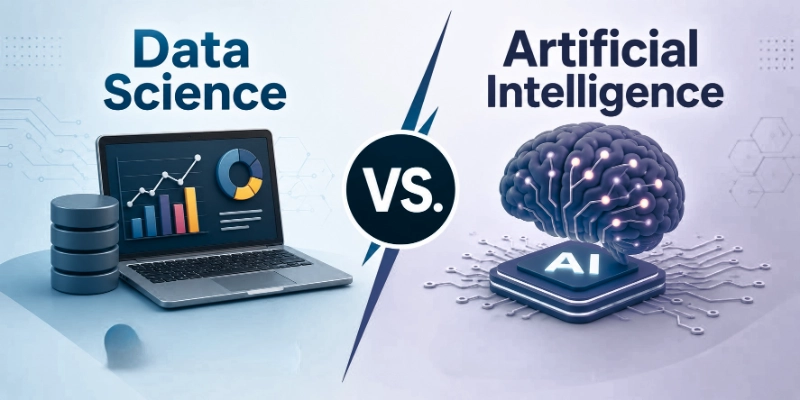
From my experience teaching and using these technologies, I have seen that the confusion usually starts when people hear about machine learning, automation, and predictive models. Understanding data science vs artificial intelligence becomes much easier once you know the main purpose of each field.
In this article, we will discuss data science vs artificial intelligence in detail.
We will also explain the key differences, similarities, career paths, and practical uses of both fields in simple terms.
What Is Data Science?
Data science helps people turn raw data into useful information. It combines different methods to collect, organize, analyze, and understand data so businesses and organizations can make better decisions.
Definition: Data science is the process of collecting, analyzing, and interpreting data to discover patterns, solve problems, and support better decision-making.
Main Goals
The main goal of data science is to find valuable insights from data. These insights help businesses improve performance, reduce risks, and make smarter decisions. It also enables organizations to make confident decisions based on accurate and meaningful data.
- Identify trends and patterns in data
- Solve business and technical problems
- Support data-driven decision making
- Predict future outcomes using historical data
- Improve products and services
- Increase operational efficiency
- Reduce costs and business risks
- Help organizations understand customer behavior
Core Components
Data science combines several important areas that work together throughout the data analysis process. Each component plays a key role in turning raw data into meaningful insights.
Below are the core components that make data science effective and reliable.
- Data collection
- Data cleaning and preparation
- Data analysis
- Statistics and probability
- Machine learning
- Data visualization
- Model building and evaluation
- Business intelligence
Common Data Science Tasks
Data scientists perform many tasks before they reach useful conclusions. These tasks ensure the data is accurate, reliable, and ready for analysis.
- Collect data from different sources
- Clean and organize datasets
- Analyze structured and unstructured data
- Create predictive models
- Visualize data using charts and dashboards
- Identify patterns and trends
- Generate reports for stakeholders
- Support business decision making
Popular Data Science Tools
Data scientists use different tools to collect, analyze, and visualize data. The right tool depends on the project, data type, and business requirements.
Below are some of the most popular data science tools used by professionals across different industries.
- Python
- R
- SQL
- Jupyter Notebook
- Apache Spark
- Tableau
- Power BI
- Microsoft Excel
- Pandas
- NumPy
- Scikit-learn
- TensorFlow
What Is Artificial Intelligence?
Artificial intelligence is one of the most important technologies today. It helps machines perform tasks that usually require human intelligence, such as learning, problem-solving, understanding language, and making decisions.
Definition: Artificial intelligence is a branch of computer science that develops systems capable of learning, reasoning, solving problems, and performing tasks that normally require human intelligence.
Main Goals
The main goal of artificial intelligence is to create systems that can perform tasks intelligently with little or no human intervention. It also helps businesses automate processes, improve accuracy, and make faster decisions.
Below are the main goals of artificial intelligence.
- Automate repetitive tasks.
- Improve decision-making
- Learn from data and experience
- Solve complex problems
- Understand and process human language
- Recognize images, speech, and patterns
- Increase productivity and efficiency
- Support innovation
Types of AI
Artificial intelligence includes different types based on its capabilities and functions. Each type is designed to perform specific tasks and supports different real-world applications.
Below are the main types of artificial intelligence.
- Narrow AI
- General AI
- Reactive AI
- Limited Memory AI
- Theory of Mind AI
- Self-aware AI
Core Technologies
Artificial intelligence depends on several technologies that work together to build intelligent systems. These technologies help AI learn from data, recognize patterns, and perform different tasks efficiently.
Below are the core technologies that power artificial intelligence.
- Machine learning
- Deep learning
- Natural language processing (NLP)
- Computer vision
- Robotics
- Speech recognition
- Expert systems
- Reinforcement learning
Popular AI Tools and Frameworks
Developers and businesses use different AI tools and frameworks to build, train, and deploy intelligent applications. The right choice depends on the project requirements, programming language, and deployment platform.
Below are some of the most popular AI tools and frameworks used by AI professionals worldwide.
- TensorFlow
- PyTorch
- Keras
- Scikit-learn
- OpenAI API
- Hugging Face Transformers
- LangChain
- Google Vertex AI
- Microsoft Azure AI
- IBM Watson
- OpenCV
- Apache MXNet
Data Science vs Artificial Intelligence at a Glance
Data science and artificial intelligence are closely related fields, but they serve different purposes. The table below gives a quick comparison of data science vs artificial intelligence.
| Feature | Data Science | Artificial Intelligence |
| Definition | Analyzes data for insights | Builds intelligent systems |
| Primary Goal | Support better decisions | Automate intelligent tasks |
| Scope | Data analysis and prediction | Intelligent systems and automation |
| Input | Structured and unstructured data | Data, text, images, audio, and video |
| Output | Reports, insights, and predictions | Decisions, actions, and automation |
| Programming Languages | Python, R, SQL | Python, Java, C++ |
| Required Skills | Statistics, SQL, data analysis | Machine learning, deep learning, programming |
| Algorithms | Regression, clustering, classification | Neural networks, reinforcement learning |
| Data Usage | Analyzes data | Learns from data |
| Automation Level | Partial automation | High automation |
| Decision Making | Supports human decisions | Makes automated decisions |
| Learning Methods | Statistical analysis and ML | ML, deep learning, reinforcement learning |
| Career Roles | Data Scientist, Data Analyst | AI Engineer, ML Engineer |
| Industries | Finance, healthcare, retail | Healthcare, robotics, automotive |
| Salary Potential | High | Very high |
| Difficulty Level | Moderate to high | High** |
Key Differences Between Data Science and Artificial Intelligence
Although data science and artificial intelligence are closely connected, they are not the same. Each field has its own purpose, technologies, and applications. The following differences will help you understand data science vs artificial intelligence more clearly.
Purpose
The purpose of each field determines how it solves problems and delivers value. While both work with data, they have different end goals.
- Data Science: Analyzes data to solve problems and support decision-making.
- Artificial Intelligence: Creates intelligent systems that automate tasks and make decisions.
Focus Area
Data science and artificial intelligence concentrate on different areas of technology. Understanding their focus helps explain how they complement each other.
- Data Science: Focuses on data collection, analysis, visualization, and prediction.
- Artificial Intelligence: Focuses on machine intelligence, automation, and human-like behavior.
Technologies Used
Each field relies on a different set of technologies and tools to complete its tasks. The choice of technology depends on the project’s objectives.
- Data Science: SQL, Python, R, Tableau, Power BI, Pandas, and NumPy.
- Artificial Intelligence: TensorFlow, PyTorch, Keras, OpenCV, Hugging Face, and LangChain.
Programming Skills
Programming is an essential skill in both fields, but the languages and level of expertise may vary. Learning the right language depends on your career path.
- Data Science: Mainly uses Python, R, and SQL.
- Artificial Intelligence: Mainly uses Python, Java, C++, and JavaScript.
Mathematics Requirements
Mathematics forms the foundation of both data science and artificial intelligence. However, AI usually requires more advanced mathematical concepts.
- Data Science: Focuses on statistics, probability, and linear algebra.
- Artificial Intelligence: Requires statistics, linear algebra, calculus, and optimization.
Data Dependency
Neither field can function effectively without data. The difference lies in how each field uses that data to achieve its goals.
- Data Science: Uses data to discover insights and build predictive models.
- Artificial Intelligence: Uses data to train intelligent models that learn and improve.
Machine Learning Usage
Machine learning plays an important role in both fields, but its purpose is different. It supports data science while serving as a core part of artificial intelligence.
- Data Science: Uses machine learning as one of many data analysis techniques.
- Artificial Intelligence: Uses machine learning to build intelligent systems that learn automatically.
Business Objectives
Businesses use data science and artificial intelligence to solve different challenges. Each field contributes to business growth in its own way.
- Data Science: Helps organizations make better decisions through data analysis.
- Artificial Intelligence: Helps organizations automate processes and improve efficiency.
End Results
The final output of each field reflects its main objective. Although both create value, the results they deliver are different.
- Data Science: Produces reports, dashboards, insights, and predictions.
- Artificial Intelligence: Produces intelligent applications, chatbots, recommendation systems, and automated solutions.
Similarities Between Data Science and Artificial Intelligence
Data science and artificial intelligence have different goals, but they also share many common features. Both fields rely on modern technologies to solve problems, improve efficiency, and help organizations make better decisions.
Both Use Data
Data is the foundation of both data science and artificial intelligence. Without quality data, neither field can produce accurate and reliable results.
- Both collect and process large amounts of data.
- Both use structured and unstructured data.
- Both depend on data quality for better outcomes.
Both Use Machine Learning
Machine learning plays an important role in both fields. It helps identify patterns, make predictions, and improve system performance over time.
- Both use machine learning algorithms.
- Both build predictive models.
- Both improve accuracy through training data.
Python Ecosystem
Python is the most popular programming language for both data science and artificial intelligence. Its simple syntax and rich libraries make development faster and easier.
- Both widely use Python.
- Both rely on libraries such as NumPy, Pandas, and Scikit-learn.
- Both support open-source development.
Problem-Solving
Both fields focus on solving real-world challenges across different industries. They help organizations make smarter and faster decisions.
- Both solve complex business problems.
- Both improve decision-making.
- Both support innovation and growth.
Automation
Automation is a common goal of both data science and artificial intelligence. They reduce manual work and improve overall efficiency.
- Both automate repetitive tasks.
- Both increase productivity.
- Both reduce human effort and errors.
Business Value
Organizations use both technologies to gain a competitive advantage. They help improve operations, customer experiences, and business performance.
- Both improve business efficiency.
- Both support better customer experiences.
- Both help reduce operational costs.
Cloud Platforms
Cloud platforms make it easier to build, train, and deploy data science and AI solutions. They also provide scalable computing resources for large projects.
- Both use cloud computing services.
- Both support scalable data processing.
- Both integrate with platforms such as AWS, Microsoft Azure, and Google Cloud.
How Data Science and Artificial Intelligence Work Together
Data science and artificial intelligence are not competing fields. Instead, they work together to build intelligent systems that solve real-world problems. Data science prepares and analyzes the data, while artificial intelligence uses that data to learn, make predictions, and automate decisions.
The workflow below shows how data science vs artificial intelligence connects in a typical AI project.
Step 1: Data Collection
Every AI project begins with collecting relevant data from different sources. The quality and quantity of data directly affect the performance of the final AI model.
- Gather data from databases, websites, sensors, applications, or APIs.
- Collect both structured and unstructured data.
⬇️
Step 2: Data Cleaning
Raw data often contains missing values, duplicate records, and errors. Data scientists clean and prepare the data before using it for analysis.
- Remove duplicate and incorrect records.
- Handle missing values and standardize the data.
⬇️
Step 3: Data Analysis
Once the data is clean, data scientists analyze it to identify useful patterns and relationships. This step helps understand the data before building AI models.
- Explore trends and patterns.
- Generate insights for better decision-making.
⬇️
Step 4: Feature Engineering
Feature engineering improves the quality of the data used for training AI models. Better features often lead to better model performance.
- Select important variables.
- Create new features from existing data.
- Remove unnecessary information.
⬇️
Step 5: Machine Learning
Machine learning algorithms learn from the prepared data. They identify patterns and build models capable of making predictions.
- Train machine learning models.
- Test and optimize model performance.
⬇️
Step 6: AI Model
After training, the machine learning model becomes part of an AI system. The AI model can now perform intelligent tasks using new data.
- Recognize patterns automatically.
- Make predictions and recommendations.
- Support intelligent decision-making.
⬇️
Step 7: Deployment
The final AI model is deployed into real-world applications where users or businesses can benefit from it. The model continues to learn and improve as it receives new data.
- Integrate the model into websites, apps, or business systems.
- Monitor performance and update the model regularly.
Workflow Summary
Data Collection
⬇️
Data Cleaning
⬇️
Data Analysis
⬇️
Feature Engineering
⬇️
Machine Learning
⬇️
AI Model
⬇️
Deployment
This workflow shows that data science provides the foundation by preparing and analyzing data, while artificial intelligence uses that prepared data to create intelligent systems that can learn, predict, and automate tasks.
Real-World Examples
Data science and artificial intelligence are part of many technologies that people use every day. From online shopping to healthcare, both fields work together to improve accuracy, automate tasks, and deliver better user experiences.
Below are some real-world examples that show how data science and artificial intelligence work together.
- Netflix Recommendations: Analyze your viewing history to recommend movies and TV shows that match your interests.
- Amazon Product Suggestions: Study customer behavior and purchase history to recommend relevant products.
- Fraud Detection: Monitor financial transactions to identify suspicious activities and prevent fraud in real time.
- Healthcare Diagnosis: Help doctors analyze medical data and detect diseases more accurately and quickly.
- Self-Driving Cars: Process data from cameras and sensors to recognize roads, traffic signs, and nearby vehicles.
- ChatGPT: Understand user questions and generate human-like responses using advanced AI models trained on large datasets.
- Predictive Maintenance: Analyze machine and equipment data to predict failures before they happen, reducing downtime and maintenance costs.
Applications of Data Science
Data science helps organizations analyze large amounts of data to improve decision-making and solve business challenges. Today, almost every industry uses data science to increase efficiency, reduce costs, and gain valuable insights.
Below are some of the most common applications of data science across different industries.
- Finance: Detects fraud, assesses financial risks, and predicts market trends.
- Marketing: Analyzes customer behavior to improve campaigns and increase sales.
- Healthcare: Supports disease prediction, patient care, and medical research.
- Retail: Optimizes inventory management and delivers personalized shopping experiences.
- Manufacturing: Improves production efficiency and predicts equipment failures.
- Sports Analytics: Evaluates player performance and helps teams develop winning strategies.
- Government: Analyzes public data to improve services and support policy decisions.
Applications of Artificial Intelligence
Artificial intelligence powers many modern technologies that people use every day. It helps automate tasks, improve accuracy, and provide faster and smarter solutions across different industries.
Below are some of the most common applications of artificial intelligence in the real world.
- Chatbots: Answer customer questions and provide instant support.
- Image Recognition: Identifies objects, faces, and images with high accuracy.
- Speech Recognition: Converts spoken language into text or voice commands.
- Robotics: Automates physical tasks in factories, warehouses, and healthcare.
- Autonomous Vehicles: Helps self-driving cars detect roads, traffic, and obstacles.
- Cybersecurity: Detects cyber threats and protects systems from attacks.
- Healthcare: Assists doctors in diagnosing diseases and improving patient care.
- Smart Assistants: Powers virtual assistants like Siri, Alexa, and Google Assistant.
Skills Required for Data Science
A successful data scientist needs a combination of technical knowledge and analytical thinking. Developing these skills helps you work with data efficiently and solve real-world business problems.
The following skills build a strong foundation for a successful career in data science.
- Python
- SQL
- Statistics
- Probability
- Data Visualization
- Machine Learning
- Communication
Skills Required for Artificial Intelligence
Artificial intelligence requires strong programming skills along with a solid understanding of advanced AI concepts. Learning these skills helps you build intelligent systems and solve complex problems.
The following skills are essential for becoming an artificial intelligence professional.
- Python
- Deep Learning
- Neural Networks
- Natural Language Processing (NLP)
- Computer Vision
- Reinforcement Learning
- Mathematics
Career Opportunities
Data science and artificial intelligence offer some of the fastest-growing career opportunities in the technology industry. As more organizations adopt data-driven strategies and AI-powered solutions, the demand for skilled professionals continues to increase across different sectors.
Data Science Careers
Data science offers a wide range of career paths for professionals who enjoy working with data and solving business problems. These roles focus on collecting, analyzing, and interpreting data to help organizations make informed decisions.
Below are some of the most popular career options in data science.
- Data Scientist: Analyzes complex datasets and builds predictive models to solve business problems.
- Data Analyst: Collects, organizes, and analyzes data to generate meaningful business insights.
- Business Analyst: Uses data to identify business needs and recommend effective solutions.
- Analytics Engineer: Builds and manages data pipelines that support reporting and analytics.
- BI Developer: Creates dashboards and business intelligence reports for better decision-making.
AI Careers
Artificial intelligence provides exciting career opportunities for professionals interested in intelligent systems and automation. These roles focus on designing, developing, and improving AI-powered applications across different industries.
Here are some of the top career options available in artificial intelligence.
- AI Engineer: Develops intelligent applications that automate tasks and solve complex problems.
- Machine Learning Engineer: Builds and deploys machine learning models for real-world applications.
- NLP Engineer: Creates systems that understand, process, and generate human language.
- Computer Vision Engineer: Develops AI solutions that analyze images and videos.
- Robotics Engineer: Designs intelligent robots that perform automated physical tasks.
Which Is Easier to Learn?
Both data science and artificial intelligence require dedication and continuous learning. However, the difficulty level depends on your background, learning goals, and the skills you already have.
Below are the key factors that can help you decide which field is easier to learn.
- Learning Curve: Data science has a gentler learning curve, while artificial intelligence is more advanced.
- Coding: Both require programming skills, but AI usually involves more complex coding.
- Mathematics: Data science focuses mainly on statistics and probability, while AI requires additional knowledge of calculus and linear algebra.
- Time Investment: Artificial intelligence generally takes more time to master because it covers advanced concepts like deep learning and neural networks.
- Beginner Friendliness: Data science is often a better starting point for beginners before moving into artificial intelligence.
Which One Should You Choose?
Choosing between data science and artificial intelligence depends on your interests, career goals, and the type of work you want to do. Both fields offer excellent opportunities, but each one is suitable for different learners and professionals.
The following points can help you decide which option is the best fit for you.
- Choose Data Science if: You enjoy analyzing data, finding insights, and helping businesses make better decisions.
- Choose Artificial Intelligence if: You want to build intelligent systems, automate tasks, and work with advanced AI technologies.
- Choose Both if: You want a broader skill set and plan to work on data-driven AI solutions or advanced technology projects.
Common Myths About Data Science and Artificial Intelligence
Many people misunderstand data science and artificial intelligence because these terms are often used together. Knowing the facts behind these common myths can help you better understand how both fields actually work.
Below are some of the most common myths about AI and data science.
- AI will replace data scientists.
- They are the same field
- AI doesn’t need data
- Data Science is only statistics
- Only mathematicians can learn them
Future of Data Science and Artificial Intelligence
Data science and artificial intelligence continue to evolve as new technologies reshape the way people work and solve problems. In the coming years, both fields will play an even bigger role in business, healthcare, education, finance, and many other industries.
Below are some of the key trends shaping the future of data science and artificial intelligence.
- Generative AI: Will create content, write code, generate images, and improve business productivity.
- AI Agents: Will perform complex tasks, make decisions, and complete multi-step workflows with minimal human input.
- Automation: Will handle more repetitive processes, allowing people to focus on higher-value work.
- Explainable AI: Will make AI decisions more transparent and easier for people to understand and trust.
- Data Governance: Will ensure data remains secure, accurate, private, and compliant with regulations.
- Human-AI Collaboration: Will combine human expertise with AI capabilities to improve decision-making and innovation.
Conclusion
In this guide, we have covered data science vs artificial intelligence. We explored their definitions, key differences, similarities, applications, required skills, career opportunities, and future trends. We also explained how these two fields work together and how each one supports modern technology in different ways.
Whether you choose data science, artificial intelligence, or both depends on your interests and career goals. Learning the fundamentals first and building practical skills step by step will help you succeed in either field.
My Recommendation
If you are just starting your journey, I recommend learning data science first because it builds a strong foundation for understanding artificial intelligence. Once you become comfortable with data analysis and machine learning, moving into AI becomes much easier.
Thank you for taking the time to read this guide. I hope it helped you better understand the difference between data science and artificial intelligence and made your next learning step clearer.
💬 Have a question or want to share your thoughts? We’d love to hear from you! Drop your feedback in the comments below and join the conversation. 😊
FAQs
Here are the answers to some common questions about data science vs artificial intelligence.
If you are new to technology, data science is usually easier to start with. It focuses on data analysis, statistics, and visualization before moving into advanced AI concepts. Many learners study data science first and then explore artificial intelligence later.
The main difference is their purpose. Below are the key points:
- Data science focuses on analyzing data and finding useful insights.
- Artificial intelligence focuses on building systems that can learn and perform intelligent tasks.
- Both fields often work together on the same projects.
Both fields offer excellent salaries, but AI roles often pay slightly more because they require advanced technical skills. Salary also depends on your experience, location, industry, and job role. Skilled professionals in either field have strong earning potential.
Yes, you can, but learning data science first gives you a stronger foundation. It helps you understand data, statistics, and machine learning concepts that AI relies on. This makes learning advanced AI topics much easier.
Python is the most popular language for both fields because it is easy to learn and has many useful libraries. Here are the languages commonly used:
- Python for data analysis and AI development.
- SQL for working with databases.
- R for statistical analysis.
- Java or C++ for some AI applications.
Machine learning belongs to both fields. Data scientists use it to analyze data and make predictions, while AI engineers use it to build intelligent systems. It acts as a bridge between data science and artificial intelligence.
Your choice depends on your interests and long-term goals. Consider the following:
- Choose Data Scientist if you enjoy analyzing data and solving business problems.
- Choose AI Engineer if you enjoy programming and building intelligent applications.
- Learn both if you want broader career opportunities.
Yes, both require some mathematical knowledge, but the level is different. Data science mainly uses statistics and probability, while artificial intelligence also involves linear algebra and calculus. Beginners can learn these concepts step by step.
Yes, they work together in many real-world projects. Data science prepares and analyzes the data, while artificial intelligence uses that data to train intelligent models. This combination powers technologies such as recommendation systems, fraud detection, and self-driving cars.
Many free and paid resources are available online. Below are some popular options:
- Online courses for data science and artificial intelligence.
- Python programming tutorials.
- Machine learning practice projects.
- Official documentation for TensorFlow, PyTorch, and Scikit-learn.
- Hands-on projects to build real-world experience.






- Be Respectful
- Stay Relevant
- Stay Positive
- True Feedback
- Encourage Discussion
- Avoid Spamming
- No Fake News
- Don't Copy-Paste
- No Personal Attacks
- Be Respectful
- Stay Relevant
- Stay Positive
- True Feedback
- Encourage Discussion
- Avoid Spamming
- No Fake News
- Don't Copy-Paste
- No Personal Attacks
