How to Use AI in Digital Marketing
Published: 16 Jul 2026
Businesses now use artificial intelligence across almost every part of digital marketing. From content creation and email campaigns to customer support and advertising, AI helps marketers complete tasks faster and make better decisions. Many companies also use AI to understand customer behavior and improve marketing results.
Many businesses use AI to streamline marketing activities, but success depends on using it correctly. I have watched marketers boost efficiency and achieve better results by applying AI where it delivers the most value.
In this article, we will discuss how to use AI in digital marketing in detail. We will also explore practical strategies, tools, and real-world examples that can help you improve your marketing efforts.
What Is AI in Digital Marketing?
Artificial intelligence (AI) in digital marketing refers to the use of smart software and machine learning technologies to automate tasks, analyze data, and improve marketing performance. Businesses use AI to better understand customer behavior, create personalized experiences, and make faster decisions based on real-time insights. In 2026, AI has become an important part of modern marketing because it helps companies work more efficiently and improve their return on investment (ROI).
Key points about AI in digital marketing:
- Automates repetitive tasks such as email marketing, reporting, and social media scheduling.
- Analyzes large amounts of customer data quickly and accurately.
- Helps marketers create content, ad copy, and marketing campaigns faster.
- Improves audience targeting through predictive analytics and customer insights.
- Delivers personalized recommendations based on user behavior and preferences.
- Optimizes paid advertising campaigns to improve conversions and reduce costs.
- Supports customer service through AI chatbots and virtual assistants.
- Provides real-time performance tracking and marketing insights.
- Helps businesses identify trends and market opportunities more effectively.
- Allows marketing teams to focus more on strategy and creativity instead of manual work.
How to Use AI in Digital Marketing: Step-by-Step
AI can help marketers improve efficiency, understand customers better, and make smarter decisions. By using AI strategically in different areas of digital marketing, businesses can save time and achieve better results. The following steps explain how marketers can use AI throughout their digital marketing efforts.
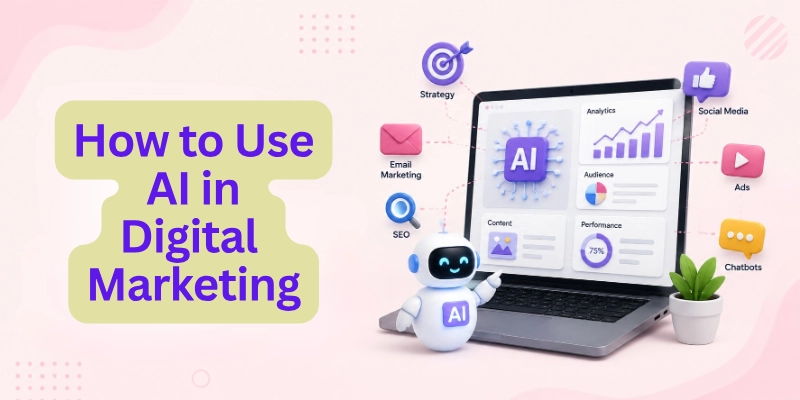
Step 1: Use AI for Market Research
Market research is the foundation of every successful marketing strategy. AI helps businesses collect and analyze large amounts of data quickly, making it easier to understand the market and identify new opportunities.
The following are the key ways AI supports market research:
- Competitor Analysis: AI can analyze competitor websites, content, keywords, advertisements, and marketing strategies to uncover strengths, weaknesses, and opportunities.
- Audience Research: AI helps businesses understand customer interests, behaviors, preferences, and buying patterns to create more targeted marketing campaigns.
- Trend Identification: AI monitors search trends, industry developments, and online conversations to identify emerging topics and market opportunities before competitors.
Step 2: Use AI for Keyword Research
Keyword research helps marketers understand what their target audience is searching for online. AI simplifies this process by analyzing search data, identifying valuable keyword opportunities, and organizing keywords based on user intent.
Here is how AI improves the keyword research process:
- Finding High-Intent Keywords: AI can identify keywords that indicate strong purchase or action intent, helping businesses attract more qualified traffic.
- Discovering Long-Tail Keywords: AI uncovers specific search phrases with lower competition and higher relevance, making it easier to target niche audiences.
- Keyword Clustering: AI groups related keywords into relevant topics, helping marketers create comprehensive content and improve SEO performance.
Step 3: Use AI for Content Planning
Content planning helps marketers create the right content at the right time for the right audience. AI makes this process faster and more organized by generating ideas, structuring publishing schedules, and analyzing user behavior. This allows businesses to create content that matches audience needs and marketing goals.
These points show how AI supports effective content planning:
- Topic Generation: AI can suggest relevant content ideas based on industry trends, audience interests, competitor content, and popular search queries.
- Content Calendar Creation: AI helps marketers organize content schedules by recommending publishing dates, content formats, and topics for consistent content marketing.
- Search Intent Analysis: AI analyzes search behavior to determine what users are looking for, helping marketers create content that aligns with informational, navigational, commercial, or transactional intent.
Step 4: Use AI for Content Creation
Creating high-quality content consistently can be time-consuming. AI helps marketers speed up the content creation process by generating drafts, improving content quality, and assisting with different content formats while maintaining productivity.
The following are the key ways AI supports content creation:
- Blog Posts: AI can generate blog outlines, introductions, content sections, and article drafts based on selected topics and keywords.
- Product Descriptions: AI helps create clear, informative, and SEO-friendly product descriptions that highlight key features and benefits.
- Landing Pages: AI assists in writing compelling headlines, persuasive content, and strong calls to action that encourage conversions.
- Ad Copy: AI can generate multiple ad variations for search engines and social media platforms, helping marketers test and optimize campaigns.
- Video Scripts: AI helps create structured and engaging scripts for marketing videos, tutorials, product demonstrations, and social media content.
Step 5: Use AI for SEO Optimization
SEO optimization helps websites improve their visibility in search engine results and attract more organic traffic. AI simplifies SEO by analyzing data, identifying optimization opportunities, and providing recommendations that help marketers improve their search rankings.
These points explain how AI actively enhances SEO optimization strategies:
- On-Page SEO: AI can analyze web pages and suggest improvements for titles, meta descriptions, headings, keyword placement, and overall content structure.
- Content Optimization: AI helps improve content quality by recommending relevant keywords, readability enhancements, and topic coverage based on top-ranking pages.
- Internal Linking Suggestions: AI identifies related pages on a website and recommends internal links that improve site structure, user experience, and SEO performance.
- Content Gap Analysis: AI compares your content with competitor content to identify missing topics, keywords, and opportunities for creating more comprehensive resources.
- SERP Analysis: AI analyzes search engine results pages to uncover ranking factors, competitor strategies, and content patterns that influence search visibility.
Step 6: Use AI for Email Marketing
Email marketing remains one of the most effective digital marketing channels, and AI helps marketers improve engagement, personalization, and campaign performance. By analyzing customer data and behavior, AI enables businesses to deliver more relevant email experiences.
The following are the key ways AI supports email marketing:
- Email Subject Lines: AI can generate attention-grabbing subject lines designed to increase open rates and improve email engagement.
- Personalized Email Campaigns: AI helps create customized email content based on customer preferences, behavior, and past interactions.
- Audience Segmentation: AI analyzes subscriber data and automatically groups users into relevant segments for more targeted communication.
- Automated Email Sequences: AI helps build and optimize email workflows that automatically send messages based on user actions, interests, and stages in the customer journey.
Step 7: Use AI for Social Media Marketing
Social media marketing becomes more effective when marketers understand audience behavior and post the right content at the right time. AI helps manage social media tasks by creating content ideas, improving engagement, and analyzing performance data to increase reach and visibility.
Here is how AI contributes to better social media marketing performance:
- Content Creation: AI helps generate post ideas, visuals, and content formats that match audience interests and platform trends.
- Caption Generation: AI creates engaging and optimized captions that improve user interaction and boost post performance.
- Content Scheduling: AI recommends the best posting times and automates scheduling to maintain consistency across platforms.
- Engagement Analysis: AI tracks likes, comments, shares, and user interactions to measure content performance and audience response.
- Trend Monitoring: AI identifies trending topics, hashtags, and viral content patterns to help brands stay relevant.
Step 8: Use AI for PPC and Paid Advertising
Paid advertising requires precise targeting, budget control, and continuous optimization. AI improves PPC performance by analyzing campaign data, predicting user behavior, and optimizing ads in real time for better results.
The following are the key ways AI supports PPC and paid advertising:
- Ad Copy Generation: AI creates multiple variations of ad copy designed to attract attention and improve click-through rates.
- Audience Targeting: AI analyzes user data to identify high-value audiences and improve ad targeting accuracy.
- Smart Bidding: AI automatically adjusts bids based on competition, conversion probability, and campaign goals.
- Budget Optimization: AI distributes ad spend across campaigns to maximize return on investment and reduce wasted budget.
- A/B Testing: AI runs and analyzes multiple ad variations to identify the best-performing creatives and strategies.
Step 9: Use AI for Customer Support
Customer support plays a key role in building trust and improving customer satisfaction. AI helps businesses respond faster, handle large volumes of queries, and provide consistent support across different channels, which improves overall customer experience.
Below are the key methods AI uses to enhance customer support:
- AI Chatbots: AI-powered chatbots handle common customer questions instantly and provide 24/7 support without human delay.
- Automated Responses: AI generates quick replies for frequently asked questions, helping reduce response time and workload on support teams.
- Lead Qualification: AI evaluates incoming inquiries and identifies high-quality leads based on behavior, interest, and engagement.
- Customer Journey Assistance: AI guides users at different stages of their journey by providing relevant information, recommendations, and support.
Step 10: Use AI for Analytics and Reporting
Analytics and reporting help marketers understand what is working and what needs improvement. AI makes this process more accurate and efficient by processing large datasets, identifying patterns, and providing actionable insights for better decision-making.
Here are the primary ways AI enhances analytics and reporting:
- Performance Tracking: AI monitors campaign performance in real time and tracks key metrics such as clicks, impressions, and engagement.
- Predictive Analytics: AI forecasts future trends and customer behavior based on historical data to support better planning.
- Conversion Analysis: AI analyzes user actions to understand what drives conversions and identifies drop-off points in the funnel.
- Campaign Insights: AI provides clear insights into campaign performance, helping marketers optimize strategies and improve ROI.
Common Mistakes to Avoid When Using AI in Digital Marketing
AI can improve speed and efficiency in digital marketing, but incorrect usage can reduce quality and harm results. Many marketers make avoidable mistakes that limit the full potential of AI tools. Understanding these issues helps you use AI in a more balanced and effective way.
The following are the most common mistakes marketers should avoid when working with AI in digital marketing:
- Publishing AI Content Without Editing: Using AI-generated content without review can lead to errors, poor readability, and low-quality output that affects brand credibility.
- Ignoring Brand Voice: AI content often feels generic, so failing to adjust tone and style can make your messaging inconsistent and less engaging.
- Over-Automating Customer Interactions: Relying too much on automation can reduce human connection and negatively impact customer trust and satisfaction.
- Relying on AI for Strategy Alone: AI can support decisions, but depending only on it for strategy can lead to weak planning without human insight and creativity.
- Neglecting Data Privacy and Compliance: Improper handling of customer data through AI tools can create legal risks and damage brand reputation.
Future of AI in Digital Marketing
AI is rapidly reshaping the digital marketing landscape by introducing smarter systems that can analyze data, predict user behavior, and automate complex tasks. As technology continues to evolve, businesses are shifting toward more advanced AI-driven strategies to stay competitive and deliver better customer experiences.
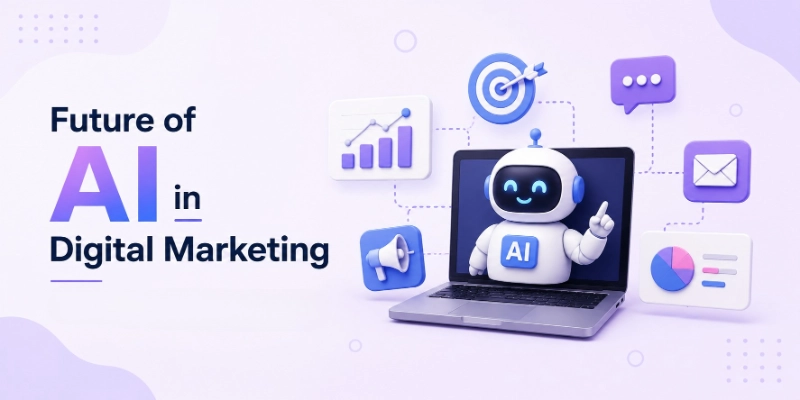
The following are the key trends shaping the future of AI in digital marketing:
- Predictive Marketing: AI uses historical data and user behavior patterns to forecast future actions, helping marketers create more targeted and effective campaigns.
- AI Agents and Automation: AI-powered agents can manage marketing tasks independently, from running campaigns to optimizing performance without constant human input.
- Hyper-Personalization: AI delivers highly customized content, offers, and recommendations based on individual user preferences and real-time behavior.
- Voice Search and Conversational AI: AI enables users to interact through voice commands and chat-based systems, improving accessibility and user engagement.
- Generative AI for Marketing: AI creates high-quality content such as ads, blogs, visuals, and videos, helping marketers scale content production efficiently.
Conclusion
In this guide, we have covered how to use AI in digital marketing. We explored how AI is transforming modern marketing by improving research, content creation, SEO, advertising, email campaigns, and customer engagement. Each step shows how marketers can apply AI in real situations to save time and achieve better results.
Overall, AI works best when it supports human creativity instead of replacing it. I personally recommend using AI as a helper for daily marketing tasks while keeping full control over strategy and brand voice.
Thank you for reading this guide, and I hope it helped you understand the topic clearly. Wishing you the best on your journey with AI-powered marketing.
If you found this helpful, feel free to share your thoughts in the comments below. 💬✨
FAQs
Below are the most frequently asked questions about AI in digital marketing:
AI in digital marketing refers to using smart technologies to improve marketing tasks like content creation, targeting, and analytics. It helps businesses understand customer behavior and make faster decisions. This leads to better performance and higher ROI.
- AI studies customer data
- It predicts user behavior
- It improves campaign decisions
This helps marketers build stronger and more focused strategies. As a result, marketing becomes more efficient and result-driven.
Beginners can start with AI tools for content writing, SEO, and social media management. These tools are easy to use and save a lot of time. They help you learn faster and work more efficiently.
Yes, AI improves SEO by finding keywords, analyzing competitors, and optimizing content. It also helps with content structure and internal linking. This increases the chances of ranking higher on Google.
AI helps create posts, write captions, and analyze engagement data. It also suggests trending topics and best posting times. This improves reach and audience interaction on platforms.
AI personalizes emails based on user behavior and preferences. It can also generate subject lines and automate email sequences. This increases open rates and improves conversions.
AI improves ad targeting, bidding strategies, and budget optimization. It also creates multiple ad copies for testing. This helps reduce costs and increase ROI.
AI can produce low-quality or generic content if not reviewed properly. It may also raise privacy concerns if data is not handled carefully. Overuse of AI can reduce human creativity and originality.
- Writing blogs and articles
- Creating ad copy and captions
- Generating video scripts:
AI speeds up the content creation process. However, human editing is still important for quality.
AI will focus more on predictive analytics and automation. It will make marketing more personalized and data-driven. Businesses will rely on AI to make smarter decisions in real time.





- Be Respectful
- Stay Relevant
- Stay Positive
- True Feedback
- Encourage Discussion
- Avoid Spamming
- No Fake News
- Don't Copy-Paste
- No Personal Attacks
- Be Respectful
- Stay Relevant
- Stay Positive
- True Feedback
- Encourage Discussion
- Avoid Spamming
- No Fake News
- Don't Copy-Paste
- No Personal Attacks
