History of Artificial Intelligence – Evolution of Modern Technology
Published: 13 Jul 2026
Have you ever wondered how computers learned to answer questions, recognize faces, or even create content like humans? Many people use AI tools daily, but most still feel confused about how artificial intelligence actually started and why it became so powerful in such a short time.
The History of Artificial Intelligence explains the complete journey from early ideas and research to the smart systems people use today. As someone who regularly studies technology trends and educational content, I have noticed that understanding AI history makes modern technology much easier to understand.
In this article, we will discuss the history of artificial intelligence in detail. We will also look at the key events, famous researchers, and important breakthroughs that shaped the AI world.
1. Early Ideas Before Artificial Intelligence
The idea of artificial intelligence did not start with computers. It began long ago when people imagined machines that could think and act like humans. These early thoughts appeared in myths, philosophy, and simple mechanical inventions.
Before modern AI was developed, early civilizations and thinkers explored concepts of logic, reasoning, and automated machines. These ideas later became the foundation for today’s artificial intelligence.
Ancient Myths and Mechanical Concepts
The idea of artificial intelligence is very old. Long before computers existed, people in Greek, Chinese, Egyptian, and Indian myths imagined intelligent machines and artificial beings that could help or protect humans.
One famous example is Talos, a giant bronze robot from Greek mythology. Later, during the Middle Ages and the Renaissance, inventors built early mechanical machines called automata that could move automatically and copy human or animal actions, inspiring the development of modern AI.
Some important early mechanical inventions included:
- Mechanical clocks with moving figures
- Robotic birds and animals created by inventors
- Water-powered machines in ancient Greece and the Islamic world
- Leonardo da Vinci’s mechanical knight in the 15th century
These early inventions helped people imagine a future where machines could perform human-like tasks.
Philosophical Foundations of AI
Philosophy played an important role in the development of artificial intelligence. Ancient Greek philosophers like Aristotle studied logic and reasoning and believed that human thinking follows clear patterns.
Later, philosophers such as René Descartes and Thomas Hobbes suggested that human reasoning could work like a machine using rules and calculations. These ideas later became the foundation of modern AI.
Later, philosophers continued exploring questions such as:
- Can machines think like humans?
- Is intelligence based on logic and reasoning?
- Can human knowledge be represented using symbols and rules?
These philosophical discussions inspired scientists to create systems that could imitate human intelligence.
Important contributions from philosophers include:
- Aristotle’s work on formal logic
- René Descartes’ ideas about human reasoning
- Thomas Hobbes’ theory that thinking is a form of computation
- Gottfried Wilhelm Leibniz’s dream of a “universal language” for reasoning
These ideas became essential in the creation of modern AI systems.
Mathematical Foundations
Mathematics played a major role in the birth of artificial intelligence. AI systems depend on logic, algorithms, probability, and computation to solve problems and make decisions.
Boolean Logic
In the 19th century, mathematician George Boole developed Boolean logic, a system based on true and false values. This system became the foundation of digital computers and modern programming.
Boolean logic uses operations such as:
- AND
- OR
- NOT
These logical operations allow computers to process information and make decisions.
Algorithms
An algorithm is a step-by-step method used to solve a problem. Algorithms are one of the most important parts of AI because they help machines process data and perform tasks automatically.
The word “algorithm” comes from the Persian mathematician Al-Khwarizmi, whose work greatly influenced mathematics and computer science.
Today, AI uses advanced algorithms for:
- Language translation
- Image recognition
- Recommendation systems
- Self-driving cars
Probability and Computation Theories
Probability theory helped artificial intelligence systems deal with uncertainty and make predictions instead of giving only fixed answers.
In the 20th century, scientists like Alan Turing and Claude Shannon made important contributions to computation theory, and Turing’s idea of a universal machine later became the foundation of modern computers.
Important mathematical developments included:
- Boolean algebra by George Boole
- Probability theory for decision-making
- Alan Turing’s computation theory
- Claude Shannon’s information theory
These mathematical foundations made it possible to develop intelligent computer systems and modern artificial intelligence.
2. Birth of Artificial Intelligence
The birth of artificial intelligence started in the 20th century when scientists began studying how machines could think and solve problems like humans. Important theories and conferences helped AI become a new field of science.
Alan Turing and the Foundation of AI
Alan Turing is known as the father of modern AI and computer science. His ideas created the basic foundation for intelligent machines.
Who was Alan Turing?
- British mathematician and computer scientist
- Born in 1912
- Helped break German codes in World War II
- Introduced important computing ideas
Turing Machine Concept
- Proposed in 1936
- A machine that follows step-by-step instructions
- Became the foundation of modern computers and algorithms
The Turing Test
- Introduced in 1950
- Tests whether a machine can behave like a human
- Still important in AI studies today
The Dartmouth Conference (1956)
The Dartmouth Conference officially introduced artificial intelligence as a field of study.
How the Term “Artificial Intelligence” Was Created
- The term “Artificial Intelligence” was introduced in 1956
- Created by John McCarthy
- Used for machines that can perform intelligent tasks
Key Researchers Involved
- John McCarthy
- Marvin Minsky
- Claude Shannon
- Herbert Simon
- Allen Newell
Importance of the Conference
- Started AI as an academic field
- Encouraged AI research and development
- Inspired future AI technologies
Early Optimism About AI
After the Dartmouth Conference, scientists believed AI would quickly become highly advanced.
Expectations from Scientists
- Machines would think like humans
- Computers would solve complex problems
- AI would improve science and industry
Government Funding and Research Growth
- Governments funded AI projects
- Universities opened AI research labs
- AI research grew rapidly in the 1950s and 1960s
Get smarter responses, upload files and images, and more.
3. The First AI Programs and Systems
After the birth of artificial intelligence, researchers started creating the first AI programs and systems. These early inventions helped scientists understand how machines could solve problems, communicate, and make decisions like humans.
Logic Theorist
One of the first successful AI programs was Logic Theorist, developed in 1956 by Allen Newell and Herbert Simon. It was designed to solve logical problems automatically.
First AI Problem-Solving Program
- Created in 1956
- Developed by Allen Newell and Herbert Simon
- Solved mathematical and logical problems
- Worked like human reasoning
- Considered the first AI problem-solving program
Importance in AI History
- Proved that machines could think logically
- Started research in automated reasoning
- Became an important milestone in AI development
- Inspired future intelligent systems
ELIZA Chatbot
As AI research progressed, scientists developed programs that could communicate with humans. ELIZA became one of the earliest chatbots in AI history.
Early Natural Language Processing
- Developed by Joseph Weizenbaum in the 1960s
- Could understand and reply to simple text messages
- Used pattern-matching techniques
- One of the first natural language processing programs
Human-Computer Interaction
- Allowed humans to chat with computers
- Simulated conversation like a therapist
- Showed how machines could interact with people
- Inspired modern chatbots and virtual assistants
SHRDLU and Early Language Understanding
Researchers later focused on helping machines understand human language and commands. SHRDLU became an important system in this area.
Understanding Commands and Language
- Developed in the early 1970s
- Could understand simple English commands
- Responded to user instructions correctly
- Improved AI language understanding research
AI in Virtual Environments
- Worked inside a virtual blocks world
- Could move and arrange objects through commands
- Demonstrated communication between humans and machines
- Helped develop future language-based AI systems
Expert Systems
During the 1970s and 1980s, expert systems became one of the most successful AI technologies. These systems were designed to make decisions like human experts.
What are Expert Systems?
- AI programs that use expert knowledge
- Solve problems in specific fields
- Make decisions using rules and databases
- Used in medicine, business, and science
Real-World Business Applications
- Helped companies make better decisions
- Used in healthcare and banking industries
- Improved efficiency and problem-solving
- Reduced human workload in specialized tasks
MYCIN and DENDRAL Examples
- MYCIN helped doctors diagnose infections
- DENDRAL assisted scientists in chemical analysis
- Both were early successful expert systems
- Showed practical uses of AI in real life
4. The AI Winters
After the early growth of artificial intelligence, researchers faced many difficulties. AI systems could not achieve the results people expected, which caused disappointment and reduced support for AI research. These difficult periods are known as AI Winters.
What Is an AI Winter?
AI Winter refers to a period when interest and funding in artificial intelligence decreased because AI systems were not performing successfully.
Definition and Meaning
During these periods, many people lost confidence in AI technology because progress was slower than expected.
- A period of reduced interest in AI
- AI projects failed to meet expectations
- Research funding was reduced
- Many AI programs were stopped
- Scientists became more careful about AI predictions
First AI Winter (1970s)
The first AI Winter started in the 1970s when early AI systems could not solve complex real-world problems effectively.
Lack of Computing Power
One major problem was that computers at that time were not powerful enough to support advanced AI systems.
- Computers were slow and expensive
- Machines had limited memory and processing power
- AI systems could only perform simple tasks
- Technology was not advanced enough for intelligent machines
High Expectations and Poor Results
At the same time, researchers had made very high promises about AI, but the actual results were disappointing.
- Scientists predicted rapid AI development
- AI programs failed to perform as expected
- Governments became disappointed with AI research
- Funding for AI projects was greatly reduced
Second AI Winter (1980s–1990s)
After some improvement in AI research, another slowdown happened during the late 1980s and early 1990s.
Decline of Expert Systems
This AI Winter was mainly caused by the failure of expert systems, which became difficult and costly to maintain.
- Expert systems were expensive to manage
- They could not adapt to new situations easily
- Some systems produced inaccurate results
- Businesses lost trust in AI technology
Funding Cuts and Research Slowdown
As confidence in AI decreased again, many organizations reduced their support for AI research.
- Companies reduced AI investments
- Many AI research labs were closed
- Research progress became slower
- Interest in AI decreased around the world
Lessons Learned from AI Winters
Although AI winters slowed AI development, they also taught researchers valuable lessons for the future.
Realistic Expectations
Scientists learned that AI development requires time, research, and realistic goals.
- Researchers avoided unrealistic promises
- AI development became more practical
- Scientists focused on achievable goals
Importance of Data and Computing
Researchers also realized that advanced AI needs strong computing systems and large amounts of data.
- Powerful computers are important for AI
- Large datasets improve AI performance
- Better algorithms increased AI accuracy
- These improvements later helped modern AI grow successfully
5. Rise of Machine Learning
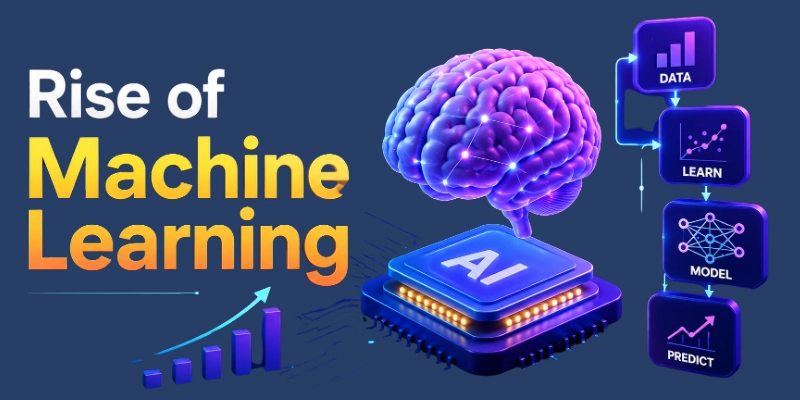
After the AI winters, researchers started focusing on a new approach called machine learning. Instead of programming every rule manually, machines were trained to learn from data and improve their performance automatically.
Transition from Rule-Based AI to Machine Learning
Earlier AI systems mainly depended on fixed rules created by programmers. Later, machine learning changed AI by allowing systems to learn from experience and data.
Difference Between Old AI and Machine Learning
Traditional AI followed predefined instructions, while machine learning systems could improve through training and experience.
- Rule-based AI used fixed instructions and rules
- Machine learning systems learn patterns from data
- Old AI could not adapt easily to new situations
- Machine learning became more flexible and accurate
Learning from Data
Machine learning introduced the idea that computers could learn automatically without being fully programmed.
- AI systems learn by analyzing data
- More data improves system performance
- Machines can recognize patterns and make decisions
- Learning models improve over time through training
Growth of Data and Computing Power
The rapid growth of the internet and modern hardware helped machine learning develop more quickly and effectively.
Internet Expansion
As the internet expanded, huge amounts of digital data became available for training AI systems.
- The internet created massive amounts of data
- Social media and websites generated useful information
- AI systems gained access to real-world data
- More data improved machine learning accuracy
Better Processors and GPUs
At the same time, advanced computer processors made AI training much faster and more powerful.
- Modern processors increased computing speed
- GPUs helped process large datasets efficiently
- Faster hardware improved AI performance
- Complex AI models became possible to train
Important Machine Learning Algorithms
As machine learning grew, researchers developed different algorithms to solve specific problems and improve AI systems.
Decision Trees
One important algorithm used a tree-like structure to make decisions and predictions.
- Used for classification and decision-making
- Easy to understand and apply
- Works by following different conditions and outcomes
- Commonly used in business and data analysis
Neural Networks
Researchers also developed neural networks inspired by the human brain.
- Designed to simulate brain-like learning
- Used for image and speech recognition
- Can process large amounts of complex data
- Became the foundation of deep learning
Support Vector Machines
Another useful algorithm focused on separating and classifying data accurately.
- Used for classification problems
- Helps identify patterns in data
- Effective for text and image analysis
- Popular in early machine learning research
Role of Big Data in AI Development
Big data became one of the most important factors in the success of modern artificial intelligence.
Data-Driven Learning
AI systems improved because they could learn from very large datasets collected from different sources.
- AI systems depend heavily on data
- Large datasets improve learning quality
- Data helps machines recognize patterns better
- AI became more intelligent through continuous learning
Faster and More Accurate Predictions
With more data and stronger computing systems, AI became faster and more accurate in making predictions.
- AI systems can analyze information quickly
- Predictions became more accurate and reliable
- Machine learning improved decision-making
- Modern AI applications became more effective in real-world tasks
6. Deep Learning Revolution
As artificial intelligence continued to develop, deep learning became one of the most advanced and powerful technologies in AI. It helped machines process complex data, recognize patterns, and perform tasks with greater accuracy.
What Is Deep Learning?
Deep learning is a modern branch of machine learning that uses neural networks to learn from large amounts of data.
Basics of Deep Neural Networks
Deep learning systems are based on neural networks that work similarly to the human brain.
- Uses multiple layers of neural networks
- Processes large and complex datasets
- Learns patterns automatically from data
- Improves performance through training
- Used in modern AI applications
Breakthroughs in AI
Deep learning led to major breakthroughs in different AI fields and improved the ability of machines to understand images, speech, and languages.
Image Recognition
AI systems became highly successful in identifying and analyzing images.
- AI can recognize objects, faces, and patterns
- Used in medical imaging and security systems
- Improved accuracy in photo and video analysis
- Helped develop facial recognition technology
Speech Recognition
AI also improved the ability of computers to understand spoken language.
- Machines can convert speech into text
- Used in voice assistants and smart devices
- Improved communication between humans and computers
- Increased accuracy in voice recognition systems
Language Translation
Deep learning made language translation faster and more accurate.
- AI can translate multiple languages automatically
- Used in online translation services
- Improved communication across different countries
- Helped businesses and education worldwide
Famous AI Achievements
As AI technology became more powerful, several historic achievements demonstrated the capabilities of intelligent systems.
IBM Deep Blue Defeating Garry Kasparov
One major milestone happened when an AI system defeated a world chess champion.
- IBM Deep Blue defeated Garry Kasparov in 1997
- First computer to beat a world chess champion
- Showed the power of AI in strategic thinking
- Became an important event in AI history
AlphaGo Defeating Lee Sedol
Later, AI achieved another historic success in the complex game of Go.
- AlphaGo defeated Lee Sedol in 2016
- Developed by Google DeepMind
- Demonstrated advanced deep learning abilities
- Proved AI could handle highly complex problems
Self-Driving Car Advancements
AI also contributed greatly to the development of autonomous vehicles.
- Self-driving cars use AI for navigation
- AI helps detect roads, signs, and obstacles
- Improves safety and driving efficiency
- Major companies continue developing autonomous vehicles
Impact of GPUs and Cloud Computing
The growth of deep learning became possible because of powerful hardware and cloud computing technologies.
Faster Training Models
Modern GPUs helped AI systems process data and train models much faster.
- GPUs increased computing speed
- AI models could train on large datasets quickly
- Reduced time required for deep learning tasks
- Improved AI research and development
Scalable AI Systems
Cloud computing allowed AI systems to become larger and more accessible.
- Cloud platforms provide powerful computing resources
- AI systems can scale easily for large projects
- Businesses can use AI services online
- Helped expand AI applications worldwide
Timeline of Artificial Intelligence
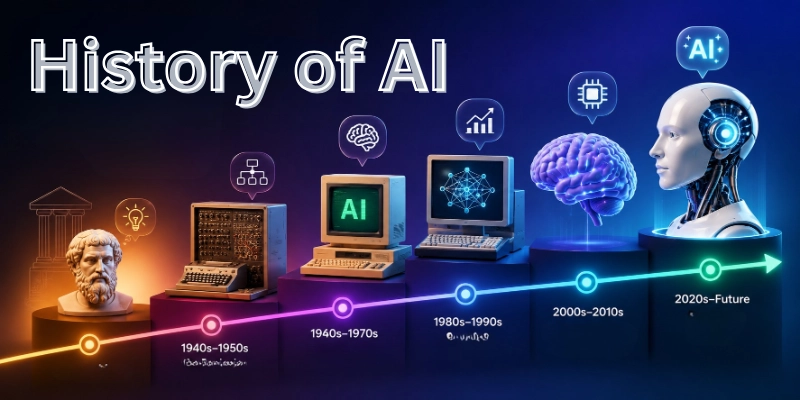
The history of artificial intelligence has developed gradually over different decades. Each period introduced new technologies, achievements, and challenges that shaped modern AI.
- 1950s – Beginning of AI Research
Scientists introduced the idea of intelligent machines and started AI research. - 1960s – Early AI Programs
Researchers created early AI programs like ELIZA and SHRDLU. - 1970s – First AI Winter
AI progress slowed because systems failed to meet expectations. - 1980s – Rise of Expert Systems
Businesses started using expert systems for decision-making and problem-solving. - 1990s – Growth of Machine Learning
Machine learning improved AI performance by helping systems learn from data. - 2000s – Data-Driven AI Development
Internet growth and large datasets made AI systems more effective. - 2010s – Deep Learning Revolution
Deep learning improved image recognition, speech recognition, and language processing. - 2020s – Expansion of Generative AI
Advanced chatbots, AI image generators, and large language models became popular.
Key People in the History of Artificial Intelligence
Artificial intelligence developed through the work of many scientists and researchers. Their ideas and discoveries helped shape AI from its early foundations to modern advancements.
- Alan Turing: Alan Turing introduced the idea of intelligent machines and helped create the foundation of modern computing.
- John McCarthy: John McCarthy coined the term “artificial intelligence” and played a major role in early AI research.
- Marvin Minsky: Marvin Minsky helped develop AI theory and co-founded the AI laboratory at MIT.
- Geoffrey Hinton: Geoffrey Hinton became known as a pioneer of deep learning and neural networks.
- Yann LeCun: Yann LeCun made important contributions to convolutional neural networks and computer vision.
- Fei-Fei Li: Fei-Fei Li advanced AI research in computer vision and created the ImageNet project.
- Demis Hassabis: Demis Hassabis co-founded DeepMind and helped develop advanced AI systems like AlphaGo.
Challenges and Ethical Concerns in AI History
Artificial intelligence has brought many benefits, but it has also created several challenges and ethical concerns. Some important concerns are the following:
- Bias and Fairness: AI systems can sometimes give unfair results because of biased data.
- Privacy Issues: AI collects and uses large amounts of personal data, which can affect privacy.
- Job Automation Concerns: Automation may replace some human jobs and change the future of work.
- AI Safety and Control: Experts worry about keeping AI systems safe and under human control.
- Responsible AI Development: Developers must create AI systems that are ethical, safe, and trustworthy.
Conclusion
In this guide, we have covered the history of artificial intelligence. We discussed how AI started from ancient ideas and philosophical thinking and later developed through important discoveries in mathematics, computer science, and machine learning. We also explored major milestones, famous researchers, and the growth of modern AI technologies.
Today, artificial intelligence continues to shape the future in areas like healthcare, education, business, and communication. At the same time, AI also brings challenges such as privacy, fairness, and job automation, which makes responsible AI development very important for the future.
Personal Recommendation: I recommend learning the history of AI because it helps you understand how modern technology has evolved over time. It also gives a better understanding of both the opportunities and challenges that AI may bring in the future.
Thank you for reading this guide. I hope you found it helpful and easy to understand.
💬✨ Feel free to share your thoughts and experiences in the comments below. We would love to hear your opinion!
FAQs
Below are some frequently asked questions about the history of artificial intelligence. These FAQs can help beginners understand AI concepts, development, and future trends more clearly.
The history of artificial intelligence explains how AI developed from ancient ideas and myths into modern computer technology. AI research officially started in the 1950s when scientists began creating intelligent machines. Today, AI is used in chatbots, robotics, healthcare, education, and many other industries.
John McCarthy is known as the father of artificial intelligence because he introduced the term “artificial intelligence” in 1956. He also organized the famous Dartmouth Conference, which became the starting point of AI research. His work helped shape modern AI development.
The following points explain the importance of Alan Turing in AI history:
- He introduced the idea of intelligent machines
- He created the concept of the Turing test.
- His work became the foundation of modern computers
His research strongly influenced artificial intelligence and computer science.
One of the earliest AI programs was ELIZA, created in the 1960s. It could communicate with users through simple text conversations and copy human-like responses. Although basic, it became an important step in natural language processing and chatbot development.
AI Winter refers to periods when AI research slowed down because systems failed to meet expectations. Funding and public interest decreased during these years. These challenges later pushed researchers to improve machine learning and data-driven AI systems.
Machine learning changed AI by allowing systems to learn from data instead of following only fixed rules. This made AI more accurate, flexible, and useful for complex tasks. Modern AI applications like recommendation systems and speech recognition depend heavily on machine learning.
Some major milestones in AI evolution are the following:
- The start of AI research in the 1950s
- Development of expert systems in the 1980s
- Growth of machine learning in the 1990s
- Deep learning breakthroughs in the 2010s
- Rise of generative AI in the 2020s
These milestones helped shape modern artificial intelligence technology.
Deep learning uses neural networks to help AI understand patterns in large amounts of data. It improved image recognition, speech recognition, and language translation systems. Modern tools like AI chatbots and image generators use deep learning technology.
Artificial intelligence still faces challenges related to privacy, fairness, bias, and job automation. Experts also focus on AI safety and responsible AI development. Solving these issues is important for building trustworthy AI systems.
The future of artificial intelligence looks very advanced because AI is growing quickly in healthcare, business, education, and robotics. AI may improve productivity, automation, and decision-making in many industries. At the same time, responsible use of AI will remain important for society and human safety.






- Be Respectful
- Stay Relevant
- Stay Positive
- True Feedback
- Encourage Discussion
- Avoid Spamming
- No Fake News
- Don't Copy-Paste
- No Personal Attacks
- Be Respectful
- Stay Relevant
- Stay Positive
- True Feedback
- Encourage Discussion
- Avoid Spamming
- No Fake News
- Don't Copy-Paste
- No Personal Attacks
