How AI Helps in Email Marketing Campaigns: Complete Guide
Published: 9 May 2026
Email marketing remains one of the most effective ways to reach customers. Traditionally, campaigns relied on generic lists and manual segmentation. Open rates and conversions were often low due to irrelevant content.
Today, AI studies user behavior, engagement, and preferences to improve email marketing results. This detailed guide explains how AI helps in email marketing campaigns in a practical and actionable way.
Let us cover all methods step by step so you can run more personalized and effective campaigns.
How AI Helps in Email Marketing Campaigns
Here are the 15 proven ways AI improves email marketing campaigns for businesses and marketers:
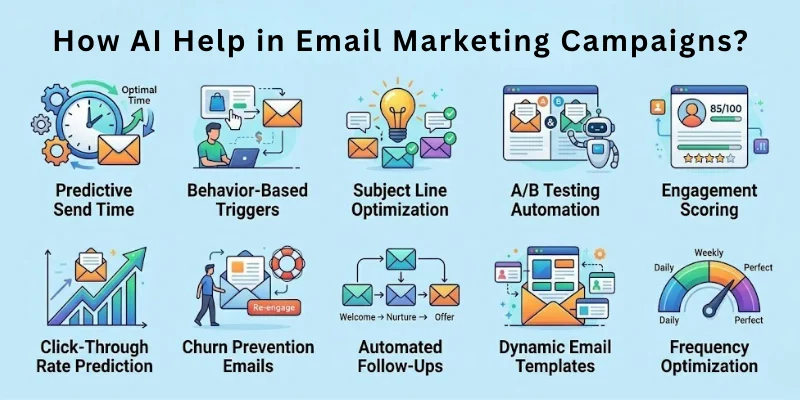
- Email List Segmentation
- Predictive Send Time
- Personalized Content Recommendations
- Behavior-Based Triggers
- Subject Line Optimization
- A/B Testing Automation
- Engagement Scoring
- Click-Through Rate Prediction
- Churn Prevention Emails
- Automated Follow-Ups
- Dynamic Email Templates
- Frequency Optimization
- Campaign Performance Analysis
- Customer Lifetime Value Targeting
- Continuous Campaign Improvement
Let us learn about each method in detail.
1. Email List Segmentation
Earlier, segmentation was done manually using basic demographics. This often led to generic emails and low engagement. AI analyzes behavior, purchase history, and interests. It segments users precisely. Emails become more relevant to each group. Campaign effectiveness improves.
Prompts you can use:
- Segment users by behavior
- Identify high-value customers
- Group by engagement levels
- Create interest-based segments
- Improve targeting accuracy
2. Predictive Send Time
Emails were sent at fixed times earlier. AI predicts the best time to send emails for each user. Open rates increase as emails arrive when users are active. Engagement improves naturally. Campaign performance becomes consistent.
Prompts you can use:
- Analyze user activity patterns
- Predict optimal send time
- Schedule emails dynamically
- Improve open rates
- Increase engagement
3. Personalized Content Recommendations
Traditional emails had static content for everyone. AI recommends content based on user behavior and interests. Each recipient sees relevant offers and articles. Engagement increases. Customers feel valued. Conversions improve.
Prompts you can use:
- Suggest content per user behavior
- Recommend products dynamically
- Personalize email sections
- Improve click-through rates
- Increase relevance
4. Behavior-Based Triggers
Earlier, automated triggers were simple or rare. AI triggers emails based on behavior like cart abandonment, browsing, or clicks. Emails reach users at the right moment. Timely interaction increases conversions. Customers receive personalized attention.
Prompts you can use:
- Trigger emails on cart abandonment
- Send follow-ups after clicks
- Target based on browsing patterns
- Automate behavior-driven emails
- Enhance timely engagement
5. Subject Line Optimization
Traditional subject lines were guesswork. AI analyzes past performance and predicts high-performing phrases. Subject lines become more engaging. Open rates increase. Emails attract attention effectively.
Prompts you can use:
- Generate optimized subject lines
- Analyze past performance
- Improve click potential
- Test multiple variations
- Increase open rates
6. A/B Testing Automation
Manual A/B testing required time and effort. AI runs multiple tests automatically. It identifies winning variations quickly. Campaigns improve faster. Data-driven decisions reduce guesswork. Efficiency increases.
Prompts you can use:
- Test subject lines automatically
- Compare email content versions
- Identify top-performing emails
- Improve conversion rates
- Reduce testing time
7. Engagement Scoring
Engagement scoring was previously done using simple metrics. AI calculates scores based on opens, clicks, and interaction patterns. High and low engagement users are identified. Campaigns focus on valuable recipients. Results improve consistently.
Prompts you can use:
- Score user engagement
- Rank recipients by activity
- Target high-engagement users
- Re-engage low engagement users
- Monitor trends over time
8. Click-Through Rate Prediction
Estimating clicks manually was inaccurate. AI predicts CTR based on user data and behavior. Teams prioritize high-potential recipients. Content and timing are optimized. Clicks increase naturally. Campaign efficiency rises.
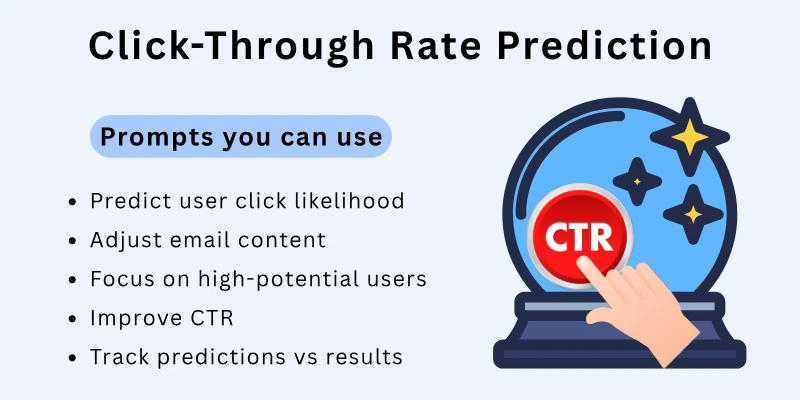
Prompts you can use:
- Predict user click likelihood
- Adjust email content
- Focus on high-potential users
- Improve CTR
- Track predictions vs results
9. Churn Prevention Emails
In the past, companies responded to churn after it occurred. AI preemptively identifies users who are at risk. Campaigns use tailored offers to target them. Churn decreases. Retention gets better. Loyalty grows stronger.
Prompts you can use:
- Identify users at risk of unsubscribing
- Send targeted retention emails
- Recommend personalized offers
- Re-engage inactive users
- Monitor retention impact
10. Automated Follow-Ups
Email follow-ups were either inconsistent or done by hand. Follow-ups are automatically scheduled and sent by AI. User behavior is matched by timing. Engagement rises. Opportunities are not lost. Clients feel taken care of.
Prompts you can use:
- Schedule automatic follow-ups
- Trigger after specific actions
- Personalize follow-up content
- Maintain consistent communication
- Increase response rates
11. Dynamic Email Templates
Emails were difficult to modify and were static. AI creates dynamic templates with user-specific content changes. Layouts change according to user preferences. Emails are intimate. Participation increases. Conversions increase.
Prompts you can use:
- Create adaptable templates
- Customize sections dynamically
- Match content with user behavior
- Test template performance
- Enhance email experience
12. Frequency Optimization
The frequency of sending was either fixed or assumed. AI evaluates engagement to recommend the best frequency for each user. There is no overwhelm among users. Open rates rise. There is constant engagement. Campaign weariness decreases.
Prompts you can use:
- Analyze user tolerance
- Adjust sending frequency
- Avoid over-sending
- Improve email effectiveness
- Monitor engagement response
13. Campaign Performance Analysis
Earlier, performance analysis was manual and slow. AI monitors metrics in real time. Reports highlight trends and improvement areas. Teams make informed decisions. Campaign adjustments are faster. Efficiency increases.
Prompts you can use:
- Track opens, clicks, conversions
- Identify top-performing emails
- Suggest improvements
- Compare campaign results
- Optimize future campaigns
14. Customer Lifetime Value Targeting
Targeting based only on recent behavior ignored potential value. AI calculates CLV and prioritizes high-value users. Emails focus on customers with long-term potential. ROI improves. Marketing resources are used efficiently. Campaigns become strategic.
Prompts you can use:
- Predict customer lifetime value
- Segment high-value users
- Target campaigns strategically
- Focus on long-term engagement
- Allocate budget wisely
15. Continuous Campaign Improvement
Email campaigns were static after launch. AI continuously learns from data and adjusts strategies. Campaigns evolve with audience behavior. Performance improves over time. Insights inform future campaigns. Success becomes consistent.
Prompts you can use:
- Analyze campaign data continuously
- Adjust strategies automatically
- Learn from user interactions
- Optimize content and timing
- Maintain high performance
Best AI Tools for Email Marketing Campaigns
Here are the 10 best AI tools for email marketing campaigns:
- Mailchimp AI for automated campaigns
- HubSpot AI for personalization
- Salesforce Einstein for email optimization
- ActiveCampaign AI for segmentation
- Sendinblue AI for predictive send times
- Moosend AI for content recommendations
- Klaviyo AI for behavior-based emails
- Iterable AI for dynamic campaigns
- Constant Contact AI for automation
- GetResponse AI for performance insights
Final Note
In this guide, we explained how AI helps in email marketing campaigns using practical and proven methods. We covered personalization, automation, optimization, and continuous improvement. Each method shows how AI improves engagement and ROI.
My personal advice is to start small, test campaigns, and gradually expand AI-driven strategies. Balance data-driven insights with human creativity for best results.
Thank you for reading. I hope this guide helps you run more effective and profitable email marketing campaigns.
FAQs
Here are some of the most commonly asked questions related to How AI helps in email marketing campaigns:
AI email marketing uses data and user behavior to optimize campaigns. Emails become more personalized and relevant. Engagement improves significantly. Teams can create smarter campaigns with less effort. Results are measurable and actionable.
AI predicts the best send time and subject lines. Emails reach users when they are most active. Open rates increase naturally. Teams save time on manual testing. Campaigns perform better overall.
Yes, AI recommends content based on user actions and preferences. Emails feel personal to each recipient. Engagement and click-through rates grow. Customers respond better to tailored messages. Personalization improves brand trust.
Yes, many AI email tools are affordable and easy to use. Small teams can run effective campaigns without extra staff. ROI improves as campaigns become more efficient. Businesses can compete with larger companies. Tools often include simple dashboards.
Yes, AI identifies at-risk subscribers. It sends retention emails before users leave. Personalized messages keep users engaged. Churn reduces over time. This helps maintain a loyal email list.
Some improvements appear immediately. Continuous learning enhances performance gradually. Campaigns get better over time. Teams see measurable impact on open rates and clicks. Patience improves long-term success.
Costs vary depending on the tool and plan. Many tools offer free or affordable options. Benefits usually outweigh the cost. ROI improves as campaigns perform better. Small teams can start with minimal investment.
Yes, AI schedules and sends emails automatically. Users receive timely messages without manual effort. Engagement and responses increase. Teams focus on strategy instead of repetitive tasks. Automation ensures consistency.
Yes, AI analyzes user behavior to suggest the best sending frequency. Over-sending is avoided. Engagement stays steady. Users are less likely to unsubscribe. Campaigns feel relevant without overwhelming users.
AI targets high-value users and optimizes campaigns automatically. Resources are used efficiently. ROI improves consistently over time. Campaigns convert more leads into sales. Businesses get better results from the same effort.


- Be Respectful
- Stay Relevant
- Stay Positive
- True Feedback
- Encourage Discussion
- Avoid Spamming
- No Fake News
- Don't Copy-Paste
- No Personal Attacks
- Be Respectful
- Stay Relevant
- Stay Positive
- True Feedback
- Encourage Discussion
- Avoid Spamming
- No Fake News
- Don't Copy-Paste
- No Personal Attacks
