How AI Helps in Customer Feedback Analysis With 10 Smart Ways
Published: 6 Jun 2026
In the traditional way, analyzing customer feedback always feels confusing and time-consuming for me. Reading thousands of reviews, emails, surveys, and comments manually often leads to missed insights and human errors.
This is where artificial intelligence changes everything by making feedback analysis faster, smarter, and more accurate. In this guide, I will clearly explain how AI helps in customer feedback analysis and how I personally see it transforming the way businesses understand their customers.
So, let’s get in!
How AI Helps in Customer Feedback Analysis
Here are the ways AI in customer feedback analysis:
- Automated Sentiment Detection
- Real-Time Feedback Processing
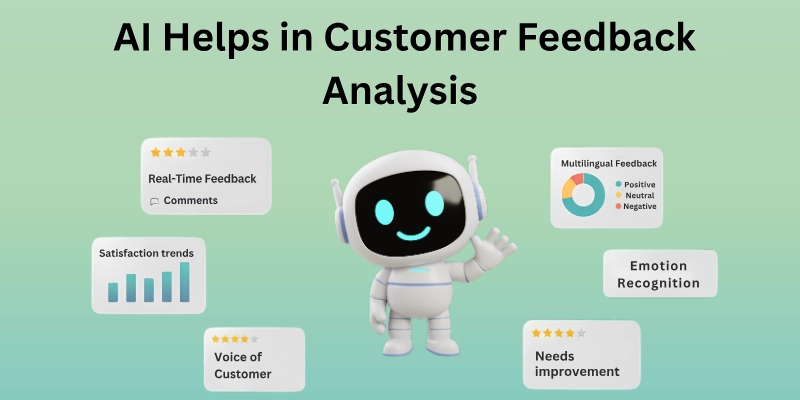
- Emotion Recognition in Customer Responses
- Text Categorization at Scale
- Trend Identification from Large Data
- Voice of Customer Analysis
- Predictive Customer Insights
- Multilingual Feedback Understanding
- Spam and Fake Review Detection
- Actionable Insight Generation
Let us cover all in detail.
1. Automated Sentiment Detection
I use AI to automatically understand whether customer feedback is positive, negative, or neutral without reading each message myself. AI models scan words, phrases, and sentence structure to identify sentiment patterns accurately. This saves time and reduces emotional bias from manual analysis. It also helps me respond faster to unhappy customers before issues grow bigger.
Tools used for this purpose:
- Natural language processing systems
- Machine learning sentiment classifiers
- Text polarity analysis tools
2. Real-Time Feedback Processing
AI allows me to analyze customer feedback the moment it is submitted. Instead of waiting days or weeks, insights appear instantly. This helps me act quickly on complaints, suggestions, or praise. Real-time processing improves customer satisfaction and decision-making speed.
Tools used for this purpose:
- Streaming data analysis engines
- Real-time AI dashboards
- Automated feedback monitoring tools
3. Emotion Recognition in Customer Responses
AI goes deeper than simple sentiment by identifying emotions like frustration, happiness, or confusion. I find this useful because emotions reveal hidden customer pain points. Emotion recognition helps me understand how customers truly feel beyond basic words. It improves empathy in my customer support strategy.
Tools used for this purpose:
- Emotion detection algorithms
- Deep learning language models
- Behavioral text analysis tools
4. Text Categorization at Scale
In situations where a large amount of feedback is received, artificial intelligence will automatically organize it into categories such as pricing, support, or product quality. There is no longer a requirement for me to manually tag responses. Through categorization, data can be organized and analyzed with greater ease. Additionally, it assists teams in quickening their focus on particular problem areas.
Tools used for this purpose:
- AI text classification systems
- Topic modeling tools
- Automated tagging software
5. Trend Identification from Large Data
Using AI, I am able to recognize recurring patterns and trends in the feedback provided by customers over time. This highlights some of the most common complaints or growing needs of customers. This insight contributes to the development of better products and the planning of better services. Due to the influx of data, manual methods frequently fail to recognize these trends.
Tools used for this purpose:
- Data mining algorithms
- Trend analysis engines
- Pattern recognition models
6. Voice of Customer Analysis
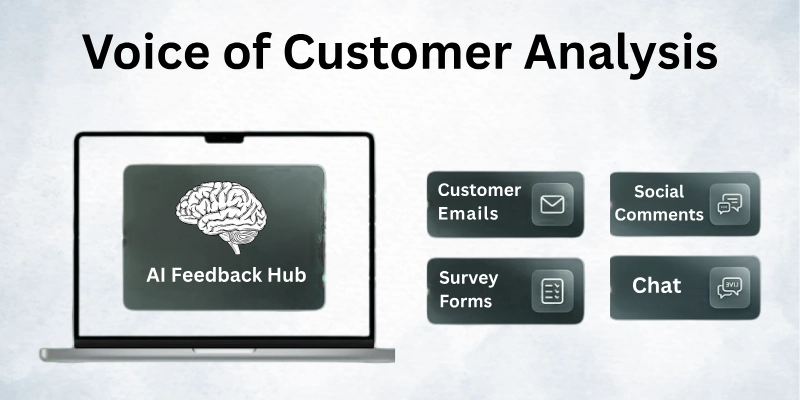
Feedback is gathered by artificial intelligence from a variety of sources, including chat logs, emails, surveys, and social media. One location provides me with a comprehensive view of the opinions of customers. Strategic decisions are improved as a result of this unified view. Additionally, it guarantees that no feedback source is overlooked.
Tools used for this purpose:
- Voice of customer platforms
- Omnichannel AI analytics tools
- Feedback aggregation systems
7. Predictive Customer Insights
Using historical feedback patterns, artificial intelligence can forecast future customer behavior. I make use of these insights in order to improve loyalty and prevent customer churn. Using predictive analysis, I am able to avoid being reactive and instead remain proactive. It enables more intelligent planning for the long term.
Tools used for this purpose:
- Predictive analytics models
- Customer behavior forecasting tools
- AI recommendation engines
8. Multilingual Feedback Understanding
AI understands customer feedback written in different languages. I do not need manual translation for global audiences. This ensures equal attention to all customers. Multilingual analysis improves inclusivity and global customer experience.
Tools used for this purpose:
- Language translation AI models
- Multilingual NLP systems
- Cross-language text analysis tools
9. Spam and Fake Review Detection
Artificial intelligence is able to automatically identify fake reviews and spam feedback. When the data quality is high, I have more faith in the insights. It is possible to improve decision accuracy by removing fake content. This safeguards the reputation of the brand as well as the trust of the customers.
Tools used for this purpose:
- Anomaly detection systems
- Fraud detection algorithms
- Review authenticity analysis tools
10. Actionable Insight Generation
AI is able to transform unprocessed feedback into actionable points. I am not only provided with data, but also with suggestions. The ability to take immediate steps toward improvement is facilitated by this. Understandings that can be put into action bridge the gap between analysis and implementation.
Tools used for this purpose:
- AI insight generation engines
- Decision support systems
- Automated reporting tools
Why AI-Driven Feedback Analysis Matters Today
When it comes to understanding customer opinions, AI leads to improvements in accuracy, speed, and depth. In order to maintain my competitive edge and maintain a focus on the customer, I rely on it. This process transforms feedback into strategic assets. Companies that do not use AI run the risk of falling behind in terms of customer experience.
Conclusion
In this guide, I have clearly explained how AI helps in customer feedback analysis by sharing practical methods and real-life use cases that I personally find effective.
My advice is to start small, focus on one feedback channel, and learn from the insights before expanding further. AI delivers the best value when it aligns with clear business goals and genuine customer needs. If you want to improve customer experience and make smarter decisions, now is the right time to adopt AI-driven feedback analysis.
Start using AI tools today and turn customer opinions into meaningful actions. Now, let us move on to the FAQs related to this topic.
FAQs: AI in Customer Feedback Analysis
Here are some of the most commonly asked questions related to how AI helps in customer feedback analysis:
AI can analyze thousands of customer responses in minutes, which is not possible manually. I find it more accurate because it removes human bias and fatigue. It also ensures no feedback is ignored. This helps businesses make faster and smarter decisions.
Yes, AI can detect emotions by studying words, tone, and sentence patterns. I use it to identify feelings like frustration, happiness, or confusion. This helps me understand what customers truly feel. Emotional insights improve customer support quality.
Yes, AI is very helpful for small businesses as well. I see many affordable tools designed for limited budgets. These tools help small teams analyze feedback without extra staff. AI helps them grow faster and smarter.
No, AI does not replace humans but supports better decisions. I still review insights before taking action. AI highlights patterns and problems clearly. Human judgment remains important for final decisions.
Yes, AI can collect feedback from emails, surveys, websites, and social media. I like how it combines all data into one view. This gives a complete picture of customer opinions. It saves time and improves accuracy.
AI sentiment analysis is highly accurate when trained on good data. I notice better results as the system learns over time. Regular updates improve accuracy further. It performs much better than manual guessing.
Most AI tools follow strong security and privacy standards. I always recommend choosing trusted and compliant platforms. Businesses should check data policies carefully. Secure tools protect customer trust.
Some results appear immediately after setup. I usually see quick insights from real-time feedback analysis. Deeper trends take time as data grows. AI improves continuously with more feedback.





- Be Respectful
- Stay Relevant
- Stay Positive
- True Feedback
- Encourage Discussion
- Avoid Spamming
- No Fake News
- Don't Copy-Paste
- No Personal Attacks
- Be Respectful
- Stay Relevant
- Stay Positive
- True Feedback
- Encourage Discussion
- Avoid Spamming
- No Fake News
- Don't Copy-Paste
- No Personal Attacks
