How AI Helps in Lead Generation: 15 Smart Ways to Get Better Leads
Published: 2 May 2026
Artificial intelligence is changing how businesses find, attract, and convert customers. Earlier, lead generation depended on manual work, cold outreach, and basic tracking tools. These methods took time and often missed serious buyers.
Today, AI analyzes behavior, understands intent, and helps businesses act at the right time. This detailed guide explains how AI helps in lead generation with practical methods and real use cases.
Let us cover everything in detail so you can use AI confidently and grow faster.
How AI Helps in Lead Generation
Here are the 15 proven ways AI improves lead generation for businesses of all sizes.
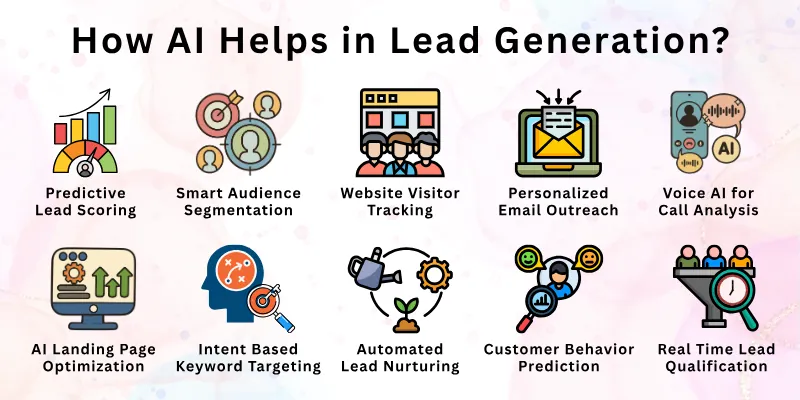
- Predictive Lead Scoring
- Smart Audience Segmentation
- AI Chatbots for Lead Capture
- Website Visitor Tracking
- Personalized Email Outreach
- Social Media Lead Identification
- AI Powered CRM Automation
- Content Based Lead Attraction
- Voice AI for Call Analysis
- AI Landing Page Optimization
- Intent Based Keyword Targeting
- Automated Lead Nurturing
- AI Based Form Optimization
- Customer Behavior Prediction
- Real Time Lead Qualification
Let us learn about each method in detail.
1. Predictive Lead Scoring
Traditionally, sales teams ranked leads using simple rules like company size or job role. This approach depended heavily on guesswork and personal judgment. Many high quality leads were ignored, while low intent users received attention. AI changes this by studying past conversions, user actions, and engagement patterns. It assigns scores based on real data instead of assumptions.
Prompts you can use:
- Analyze past converted leads and find common patterns
- Score new leads based on behavior and engagement
- Predict which leads have high buying intent
- Rank leads for sales priority
- Suggest next action for top scored leads
2. Smart Audience Segmentation
Earlier, marketers grouped audiences by age, gender, or location only. These segments were broad and often inaccurate. AI now studies browsing behavior, interests, clicks, and past actions. It creates smaller and more accurate audience groups. These segments update automatically when behavior changes. This leads to better targeting and higher response rates.
Prompts you can use:
- Segment users based on website activity
- Group leads by intent level
- Create dynamic audience lists
- Identify hidden interest groups
- Update segments in real time
3. AI Chatbots for Lead Capture
In the past, websites used static contact forms that many visitors ignored. There was no real interaction or instant response. AI chatbots now start conversations as soon as a visitor lands on the site. They answer questions and guide users smoothly. Chatbots collect lead details without pressure. This increases lead capture without manual effort.
Prompts you can use:
- Greet visitors automatically
- Ask qualifying questions politely
- Collect email and contact details
- Route hot leads to sales team
- Save chat data to CRM
4. Website Visitor Tracking
Earlier, businesses could not understand what anonymous visitors wanted. They only saw page views and traffic numbers. AI now tracks behavior like time spent, pages visited, and return visits. It identifies interest signals early. Sales teams know when a visitor is ready. This improves lead timing and engagement.
Prompts you can use:
- Track visitor activity across pages
- Identify repeat visitors
- Detect high intent behavior
- Alert sales teams in real time
- Personalize website experience
5. Personalized Email Outreach
Traditional email campaigns sent the same message to everyone. This caused low open and reply rates. AI personalizes email content based on user behavior and preferences. It also chooses the best sending time. Messages feel more relevant and human. This improves engagement and lead response.
Prompts you can use:
- Generate personalized email content
- Optimize subject lines
- Predict best sending time
- Customize offers per user
- Improve open and reply rates
6. Social Media Lead Identification
Earlier, marketers manually searched social platforms for potential leads. This process was slow and inconsistent. AI scans posts, comments, and discussions automatically. It identifies users showing interest or problems related to your service. This creates new lead opportunities. Outreach becomes faster and more relevant.
Prompts you can use:
- Monitor brand and keyword mentions
- Identify buying signals in comments
- Find leads by interest
- Track competitor audiences
- Suggest outreach messages
7. AI Powered CRM Automation
Managing CRM data manually often caused errors and missed follow ups. Important details were forgotten or delayed. AI now updates lead records automatically. It logs emails, calls, and reminders. Sales teams stay organized without extra effort. This improves follow up consistency.
Prompts you can use:
- Auto update lead profiles
- Log emails and calls
- Set follow up reminders
- Predict deal progress
- Clean duplicate records
8. Content Based Lead Attraction
Earlier, content creation relied on intuition and trends. Many topics failed to attract the right audience. AI analyzes search behavior and user intent. It suggests topics people actually want. Content becomes more relevant. This attracts qualified leads naturally.
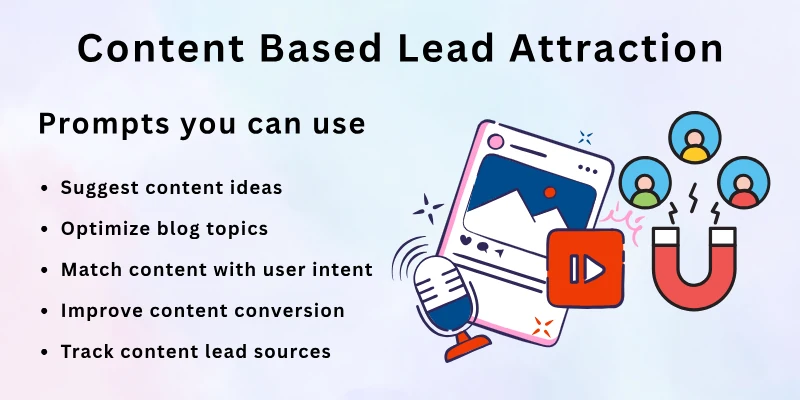
Prompts you can use:
- Suggest content ideas
- Optimize blog topics
- Match content with user intent
- Improve content conversion
- Track content lead sources
9. Voice AI for Call Analysis
Sales call reviews were traditionally manual and time consuming. Managers could review only a few calls. AI now analyzes every call automatically. It detects intent, tone, and objections. Teams improve scripts quickly. Performance improves faster.
Prompts you can use:
- Analyze sales calls
- Detect buyer intent
- Identify objections
- Suggest better responses
- Score call quality
10. AI Landing Page Optimization
Earlier, testing landing pages took weeks and manual analysis. AI now runs tests continuously. It improves layouts, copy, and forms automatically. Changes happen faster. Conversion rates increase steadily.
Prompts you can use:
- Test landing page layouts
- Optimize call to action text
- Improve form design
- Analyze bounce rates
- Suggest improvements
11. Intent Based Keyword Targeting
Keyword research was once based on volume only. Many clicks came from users not ready to buy. AI now identifies intent focused keywords. Ads target users closer to decision. This improves lead quality. Ad spend becomes efficient.
Prompts you can use:
- Identify high intent keywords
- Optimize ad targeting
- Predict keyword performance
- Reduce wasted ad spend
- Improve lead relevance
12. Automated Lead Nurturing
Manual follow ups were inconsistent and slow. Many leads lost interest over time. AI now sends messages based on behavior and timing. It adapts communication automatically. Leads stay engaged. Conversions improve.
Prompts you can use:
- Create lead nurturing workflows
- Send behavior based emails
- Adjust messages automatically
- Track engagement levels
- Improve conversion journey
13. AI Based Form Optimization
Traditional forms asked the same questions to everyone. Many users abandoned them. AI optimizes forms dynamically. It predicts required fields. Forms become shorter and easier. Submission rates increase.
Prompts you can use:
- Reduce unnecessary form fields
- Predict user intent
- Improve form completion
- Test form layouts
- Increase submissions
14. Customer Behavior Prediction
The teams had previously reacted after the leads had taken action. A number of opportunities were lost. AI is able to forecast future behavior by analyzing data patterns. Teams take action sooner. When marketing takes a proactive nature. The outcomes are getting better.
Prompts you can use:
- Predict next user action
- Identify churn risk
- Suggest upsell timing
- Forecast lead value
- Improve targeting strategy
15. Real Time Lead Qualification
The manual qualification of leads could take from hours to days. The sales teams lost their momentum. AI instantly qualifies leads based on the data they provide. Directs the route to the appropriate team. Response time is getting better. The productivity of sales is increasing.
Prompts you can use:
- Qualify leads instantly
- Assign lead status
- Route leads correctly
- Notify sales teams
- Reduce response time
Best AI Tools for Lead Generation
Here are the 10 best AI tools for lead generation.
- HubSpot AI for smart CRM insights
- Salesforce Einstein for predictive scoring
- Drift for AI chat lead capture
- Intercom for conversational marketing
- Zoho CRM AI for automation
- Jasper for lead focused content
- Clearbit for data enrichment
- Apollo AI for prospecting
- Chatfuel for chatbot leads
- Pipedrive AI for sales tracking
Final Note
In this guide, we covered How AI helps in lead generation using practical and proven methods. We explored strategies, tools, and real examples. Each method shows how AI improves accuracy and saves time.
My personal advice is to start with one AI tool and master it. Focus on quality leads, not volume. Consistency and testing bring the best results.
Thank you for reading. I hope this guide helps you grow with clarity and confidence.
FAQs
Here are some of the most commonly asked questions related to How to Use AI to Manage Files.
AI studies how users behave on websites, emails, and ads. It checks clicks, time spent, and interest level. Based on this data, it selects only serious prospects. This helps sales teams focus on better leads.
Yes, small businesses can use AI easily. Many tools come with simple dashboards and low pricing. AI saves time by handling repetitive tasks. This helps small teams grow faster.
AI scans user actions on websites and social platforms. It identifies people who show interest in products or services. AI then collects and organizes this data. Businesses get ready to contact leads quickly.
Yes, AI helps warm up cold leads. It sends personalized emails and follow ups. AI tracks responses and adjusts messages. This increases the chance of conversion.
Manual scoring depends on guesswork. AI uses real data and user behavior. It ranks leads based on interest and intent. This makes lead scoring more accurate.
AI automates lead sorting and follow ups. Sales teams no longer handle repetitive work. They focus only on qualified leads. This improves productivity.
Yes, AI personalizes messages for each user. It uses browsing and interaction data. Users receive relevant offers and content. This improves engagement.
AI works very well for B2B businesses. It tracks company behavior and decision maker actions. AI helps identify buying signals. Sales teams close deals faster.
Some results appear within days. AI improves accuracy over time. The more data it gets, the better it performs. Long term results stay stronger.
Most AI tools follow data protection rules. They use encryption and security systems. Businesses should choose trusted tools. This keeps customer data safe.




- Be Respectful
- Stay Relevant
- Stay Positive
- True Feedback
- Encourage Discussion
- Avoid Spamming
- No Fake News
- Don't Copy-Paste
- No Personal Attacks
- Be Respectful
- Stay Relevant
- Stay Positive
- True Feedback
- Encourage Discussion
- Avoid Spamming
- No Fake News
- Don't Copy-Paste
- No Personal Attacks
