AI in Digital Marketing – Guide to Smarter Growth
Published: 21 Jun 2026
Why does AI in digital marketing feel like it is taking over everything from content to ads? Many marketers notice that campaigns now adjust themselves without much manual work.
AI in digital marketing uses machine learning and data analysis to make decisions faster than traditional methods. It helps brands understand what customers want and when they want it, which improves engagement and conversions.
In this article, we will discuss AI in digital marketing in detail and clear up how it actually works in real campaigns. We will also break down its benefits, tools, and practical use cases in simple terms.
What is AI in Digital Marketing?
Artificial Intelligence (AI) in digital marketing refers to the use of intelligent systems to analyze data, automate tasks, and improve marketing decisions. It helps businesses understand customer behavior, deliver personalized content, and run more effective campaigns.
Simple Explanation of AI in Marketing
AI in marketing means using smart computer systems to make marketing easier and more effective. It helps brands understand what customers want and shows them the right ads, messages, or products at the right time.
Key Technologies Involved
AI in digital marketing works through several advanced technologies:
- Machine Learning: Helps systems learn from data and improve marketing predictions over time
- Natural Language Processing (NLP): Understands human language for chatbots, reviews, and customer communication
- Predictive Analytics: Analyzes past data to predict future customer behavior and trends
How AI Works in Digital Marketing
Artificial intelligence plays a major role in modern digital marketing by helping businesses understand customer needs, improve campaigns, and automate repetitive tasks. AI systems collect and process large amounts of data from websites, social media platforms, search engines, and customer interactions to identify patterns and trends.
By using advanced algorithms and machine learning models, AI can make faster and smarter marketing decisions. It helps marketers create personalized experiences, improve customer engagement, and increase conversion rates with greater accuracy and efficiency.
The following are the key ways AI works in digital marketing:
- Data Collection and Analysis: AI gathers data from multiple sources and analyzes customer preferences, browsing habits, and online activities to generate useful marketing insights.
- Customer Behavior Prediction: AI predicts customer actions and buying behavior by studying past interactions, allowing businesses to target the right audience at the right time.
- Automation and Decision-Making Systems: AI automates tasks such as email marketing, chatbot responses, campaign management, and audience segmentation while making real-time decisions based on data.
- AI-Driven Content and Ad Optimization: AI improves content performance and advertising campaigns by analyzing engagement metrics, testing different versions, and delivering personalized ads to users.
Benefits of AI in Digital Marketing
Artificial Intelligence offers several advantages that help businesses improve their marketing performance and customer experience. By automating complex processes and analyzing large amounts of data, AI allows marketers to make smarter and faster decisions.
The following are some major benefits of AI in digital marketing:
- Better Personalization at Scale: AI delivers personalized recommendations, emails, and advertisements to individual users based on their interests, behavior, and online activity.
- Improved ROI on Ads: AI analyzes campaign performance and optimizes ad spending to target the most relevant audience, helping businesses achieve higher returns on investment.
- Faster Content Creation and Optimization: AI tools assist in generating content ideas, improving headlines, optimizing keywords, and analyzing content performance more quickly and efficiently.
- Smarter Customer Segmentation: AI groups customers based on demographics, preferences, and behavior patterns, allowing marketers to create highly targeted campaigns.
- Real-Time Decision-Making: AI processes live data instantly and helps businesses adjust marketing strategies, bids, and campaigns in real time for better results.
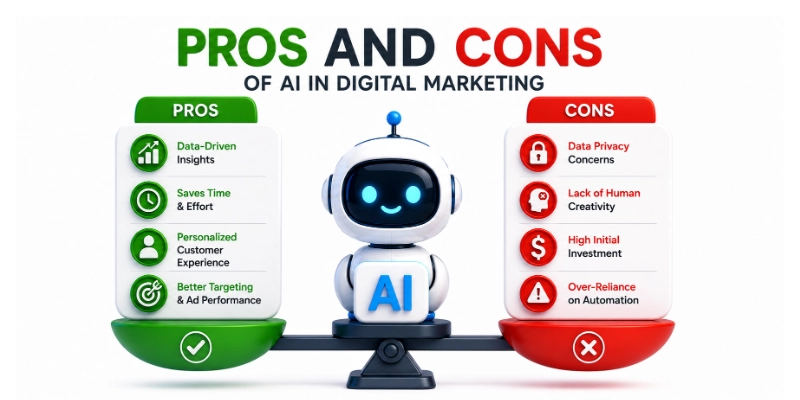
Challenges and Limitations of AI in Digital Marketing
While AI has transformed digital marketing and improved efficiency, it also comes with several challenges and limitations. Businesses need to balance automation with human insight to avoid potential risks and ensure ethical use of data and technology.
The following are some key challenges and limitations of AI in digital marketing:
- Data Privacy Concerns: AI relies heavily on user data, which raises issues related to privacy, data security, and compliance with regulations.
- Over-Automation Risks: Excessive automation can reduce human control and may lead to less personalized or irrelevant customer experiences.
- Lack of Human Creativity: AI can generate and optimize content, but it still struggles to match human creativity, emotion, and storytelling.
- Bias in Algorithms: AI systems can sometimes reflect biased data, leading to unfair targeting or inaccurate predictions.
- Tool Dependency: Over-reliance on AI tools can reduce strategic thinking and make businesses dependent on technology for decision-making.
Major Use Cases of AI in Digital Marketing
Artificial intelligence is widely used across different areas of digital marketing to improve efficiency, personalization, and campaign performance. From content creation to customer support, AI helps businesses automate tasks and make data-driven decisions more effectively.
AI-powered tools also help marketers understand customer behavior, optimize marketing strategies, and deliver better user experiences. The following are some major use cases of AI in digital marketing:
1. AI in Content Creation and SEO
AI has transformed content marketing by helping businesses create high-quality content faster and optimize it for search engines. It supports marketers in finding relevant topics, improving keyword strategies, and enhancing content performance.
The following are common uses of AI in content creation and SEO:
- Blog Writing, Keyword Clustering, and Topic Generation: AI tools help generate blog ideas, organize related keywords into clusters, and create content outlines based on user search intent.
- AI Tools for SEO Optimization: AI improves SEO by analyzing search trends, optimizing on-page elements, suggesting keywords, and identifying opportunities to improve rankings.
2. AI in Social Media Marketing
AI helps businesses manage social media campaigns more efficiently by automating tasks and analyzing audience engagement patterns. It allows brands to create better content strategies and improve social media performance.
The following are key applications of AI in social media marketing:
- Automated Posting: AI tools schedule and publish posts automatically at the most effective times for audience engagement.
- Trend Prediction: AI analyzes social media data to identify trending topics, hashtags, and audience interests before they become popular.
- Engagement Optimization: AI tracks user interactions and recommends strategies to improve likes, shares, comments, and overall engagement.
3. AI in Email Marketing
AI enhances email marketing campaigns by delivering personalized experiences and improving email performance. It helps marketers understand subscriber behavior and optimize communication strategies.
The following are important uses of AI in email marketing:
- Personalization: AI customizes email content, recommendations, and offers based on customer preferences and past interactions.
- Send-Time Optimization: AI identifies the best time to send emails to individual users for higher open and click-through rates.
- Subject Line Testing: AI analyzes and tests subject lines to determine which versions generate better engagement and response rates.
4. AI in Paid Advertising (PPC)
AI plays a major role in improving paid advertising campaigns by automating bidding strategies and optimizing ad targeting. It helps businesses maximize ad performance while reducing wasted spending.
The following are major AI applications in PPC advertising:
- Smart Bidding Systems: AI automatically adjusts bids in real time to improve conversions and achieve campaign goals more efficiently.
- Audience Targeting: AI identifies and targets the most relevant audience segments based on user behavior, interests, and demographics.
- Ad Creative Optimization: AI tests different ad formats, headlines, and visuals to determine which combinations perform best.
5. AI in Customer Experience (Chatbots & Assistants)
AI-powered chatbots and virtual assistants improve customer support by providing quick and automated responses. They help businesses offer better customer service while reducing manual workload.
The following are common uses of AI in customer experience:
- 24/7 Chatbots: AI chatbots provide instant support to customers at any time of the day without human intervention.
- Conversational AI: AI systems understand natural language and engage in human-like conversations to assist users more effectively.
- Customer Support Automation: AI automates repetitive support tasks such as answering FAQs, tracking orders, and resolving common customer issues.
AI Tools Used in Digital Marketing
AI-powered tools have become an essential part of modern digital marketing strategies. Businesses use these tools to automate tasks, improve customer targeting, optimize campaigns, and create high-quality content more efficiently.
From SEO and analytics to advertising and customer relationship management, AI tools help marketers save time and make data-driven decisions.
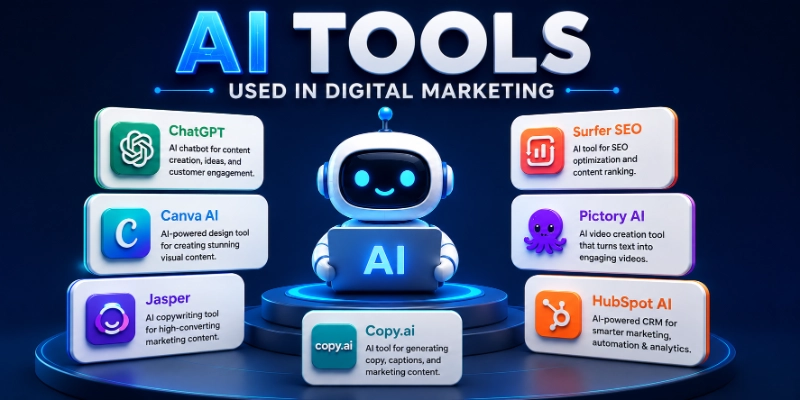
The following are some of the most widely used AI tools in digital marketing:
Content Generation Tools
AI content tools help marketers create blog posts, social media captions, email copy, product descriptions, and marketing content quickly and efficiently. These tools also assist with idea generation, grammar improvement, and content optimization.
Popular content generation tools include:
- ChatGPT
- Jasper AI
- Copy.ai
- Writesonic
SEO Tools
AI-powered SEO tools help businesses improve search engine rankings by analyzing keywords, competitor strategies, backlinks, and content performance. They also provide recommendations for on-page optimization and technical SEO improvements.
Common AI SEO tools include:
- Semrush
- Ahrefs
- Surfer SEO
- Frase
Analytics Platforms
AI analytics platforms help marketers track website performance, customer behavior, conversion rates, and campaign effectiveness. These tools provide real-time insights and predictive analytics for smarter decision-making.
Widely used analytics platforms include:
- Google Analytics
- HubSpot Analytics
- Mixpanel
- Hotjar
Ad Automation Tools
AI advertising tools automate bidding strategies, audience targeting, and ad optimization to improve campaign performance and return on investment. They help marketers run more efficient PPC and social media advertising campaigns.
Popular AI ad automation tools include:
- Google Ads Smart Bidding
- Meta Ads Manager
- Adzooma
- Revealbot
CRM AI Integrations
AI-powered CRM systems help businesses manage customer relationships more effectively by automating lead scoring, customer segmentation, follow-ups, and personalized communication.
Leading CRM platforms with AI integrations include:
- Salesforce Einstein
- HubSpot CRM
- Zoho CRM AI
- Microsoft Dynamics 365 AI
AI-Driven Digital Marketing Strategies That Work
AI-driven digital marketing strategies help businesses improve targeting, personalization, and overall campaign performance through data and automation. These strategies allow marketers to make smarter decisions, enhance customer engagement, and achieve better results more efficiently.
Below are some effective AI-driven digital marketing strategies used by modern businesses:
Data-First Marketing Approach
The following are the main advantages of a data-first marketing approach:
- Helps businesses collect and analyze customer data from multiple channels
- Improves audience targeting and campaign performance
- Supports smarter and data-driven marketing decisions
- Enhances customer experience through real-time insights
Hyper-Personalization Strategy
The following are the key benefits of hyper-personalization:
- Delivers personalized content based on customer behavior
- Improves customer engagement and user experience
- Increases conversion rates with targeted messaging
- Builds stronger customer loyalty and retention
Predictive Marketing Funnels
The following are the major uses of predictive marketing funnels:
- Predicts customer behavior and buying intent
- Helps identify high-quality leads more effectively
- Improves conversion and retention strategies
- Supports better planning through future trend analysis
AI-Powered Content Clustering
The following are the main benefits of AI-powered content clustering:
- Organizes related keywords and topics efficiently
- Improves SEO performance and topical authority
- Enhances internal linking structure
- Simplifies content planning and scalability
Automation + Human Hybrid Workflows
The following are the advantages of combining AI automation with human expertise:
- Automates repetitive marketing tasks and workflows
- Saves time and improves overall productivity
- Maintains human creativity and brand voice
- Helps businesses scale marketing operations more effectively
Real-World Examples of AI in Marketing
These are some common ways. AI is applied in digital marketing campaigns:
- E-commerce Personalization Examples: AI recommends products based on customer browsing history, interests, and past purchases.
- Netflix / Amazon-Style Recommendation Logic: AI analyzes user behavior to suggest relevant movies, shows, or products automatically.
- AI-Powered Ad Campaigns: AI optimizes ads by targeting the right audience, adjusting bids, and improving campaign performance in real time.
- Small Business AI Use Cases: Small businesses use AI for chatbots, email automation, social media scheduling, and customer support.
- AI in Email Marketing Automation: AI personalizes email content, optimizes send times, and improves open and click-through rates.
- AI in Social Media Analytics: AI tracks engagement, predicts trends, and helps brands create more effective social media strategies.
Future of AI in Digital Marketing
As AI technology continues to grow, digital marketing is becoming smarter, faster, and more personalized. Here are some major future trends marketers should know about:
- AI-powered search and answer engines are reducing traditional website clicks by giving direct answers to users.
- Generative marketing systems are helping businesses create content, ads, and campaigns faster than before.
- Predictive content strategies are improving personalization by understanding customer behavior in advance.
- AI and human collaboration is becoming the future model where automation and creativity work together.
- Marketers should prepare by learning AI tools, improving data skills, and focusing on high-quality content.
Conclusion
In this guide, we have covered AI in digital marketing. We discussed how AI works, its major benefits, challenges, tools, and real-world applications in modern marketing strategies. We also explored how businesses use AI for content creation, SEO, advertising, customer experience, and campaign optimization.
AI is continuously transforming digital marketing by making campaigns smarter, faster, and more personalized. As technology continues to evolve, marketers who learn to combine AI tools with human creativity will have a stronger advantage in reaching their audience and improving business growth.
Personal Recommendation: I recommend using AI as a support tool rather than relying on it completely for every marketing task.
Combining AI automation with human creativity can help businesses achieve better and more authentic results.
Thank you for reading this guide. I hope this article helped you better understand the role of AI in digital marketing.
FAQs
The following are some frequently asked questions about AI in digital marketing. These questions can help beginners better understand how AI tools, strategies, and technologies work in modern marketing.
The main purpose of AI in digital marketing is to automate marketing tasks, analyze customer data, and improve campaign performance. It helps businesses deliver personalized experiences and make faster decisions. AI also increases efficiency by reducing manual work in areas like SEO, advertising, and customer support.
AI improves SEO strategies in several important ways:
- It helps find high-ranking keywords and search trends
- It analyzes competitors and content performance
- It supports content optimization for better Google rankings
These features make AI SEO tools useful for improving website visibility and organic traffic.
Yes, small businesses can easily use AI marketing tools to improve their online presence. Many AI tools are affordable and beginner-friendly for tasks like email marketing, social media scheduling, and chatbot support. These tools help small businesses save time and compete more effectively in digital marketing.
Here are some popular AI tools used in digital marketing today:
- ChatGPT for content writing and idea generation
- Semrush and Ahrefs for SEO optimization
- HubSpot and Salesforce for CRM automation
These AI-powered marketing tools help businesses improve productivity and campaign performance.
AI is not fully replacing digital marketers because human creativity and strategy are still very important. AI mainly helps automate repetitive tasks and provides data-driven insights. Marketers who learn AI skills can work more efficiently and stay competitive in the industry.
AI helps social media marketing by improving content planning and audience engagement:
- It schedules posts automatically at the best times
- It predicts trending topics and hashtags
- It analyzes engagement data for better performance
This makes social media campaigns more effective and easier to manage.
AI in digital marketing also comes with some challenges such as data privacy concerns and over-automation. Sometimes AI-generated content may lack human emotion or creativity. Businesses should balance AI automation with human review to avoid mistakes and maintain quality.
AI improves paid advertising campaigns by analyzing audience behavior and optimizing ads in real time. It helps marketers reduce wasted ad spending and target the right customers more accurately. AI-powered PPC tools also improve conversions through smart bidding and ad optimization.
Yes, AI content generation tools can create blog posts, product descriptions, ad copy, and email content automatically:
- They speed up the content creation process
- They help generate SEO-friendly ideas and outlines
- They improve writing efficiency for marketers
However, human editing is still important for accuracy and originality.
The future of AI in digital marketing will focus more on automation, predictive analytics, and hyper-personalization. Businesses will increasingly use AI to improve customer experiences and create smarter marketing campaigns. Marketers who adapt to AI technology early will have better opportunities for growth and success.


- Be Respectful
- Stay Relevant
- Stay Positive
- True Feedback
- Encourage Discussion
- Avoid Spamming
- No Fake News
- Don't Copy-Paste
- No Personal Attacks
- Be Respectful
- Stay Relevant
- Stay Positive
- True Feedback
- Encourage Discussion
- Avoid Spamming
- No Fake News
- Don't Copy-Paste
- No Personal Attacks
