How AI Changes University Education: Complete Future Guide
Published: 20 Oct 2026
Artificial intelligence is rapidly transforming almost every industry, and university education is no exception.
From personalized learning experiences to automated grading systems and smart research tools, AI is reshaping how students learn and how professors teach. Universities are integrating intelligent systems into classrooms, online platforms, administrative processes, and research labs.
If you want to understand the real impact of this transformation, this guide explains how AI changes university education in detail, covering teaching, learning, assessment, research, and future trends.
How AI Changes University Education
AI is influencing higher education in multiple powerful ways. Below are the major transformations happening in universities today:
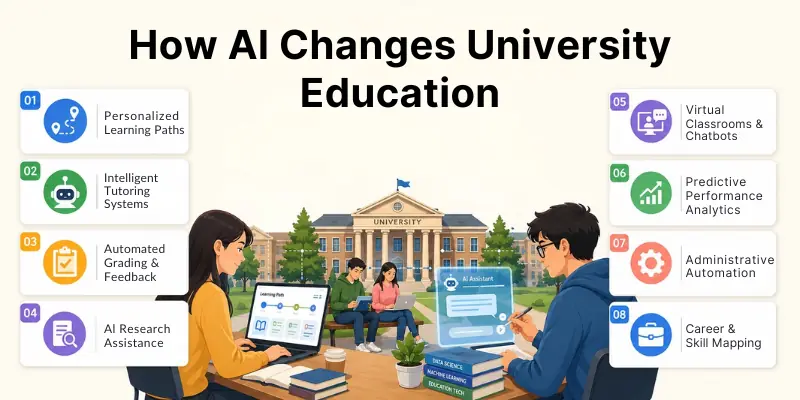
- Personalized Learning Paths
- Intelligent Tutoring Systems
- Automated Grading and Feedback
- AI-Powered Research Assistance
- Smart Content Creation
- Virtual Classrooms and AI Chatbots
- Predictive Student Performance Analytics
- Administrative Automation
- AI-Enhanced STEM Learning
- Academic Integrity Monitoring
- Career Guidance and Skill Mapping
- Data-Driven Curriculum Development
So guys, let us explore each transformation in detail.
1. Personalized Learning Paths
AI enables universities to provide personalized learning experiences based on each student’s performance, interests, and learning speed. Instead of one-size-fits-all lectures, AI systems analyze data and suggest tailored resources. This improves engagement and retention.
How It Works:
- Tracks student performance and behavior
- Recommends custom study materials
- Adjusts difficulty level automatically
- Suggests extra practice where needed
- Identifies strengths and weaknesses
2. Intelligent Tutoring Systems
AI tutoring systems provide 24/7 academic support. These virtual tutors answer questions, explain difficult concepts, and guide students step by step. They are especially useful for large universities where professors cannot provide individual attention to every student.
How It Works:
- Uses natural language processing to answer questions
- Breaks complex topics into simple explanations
- Provides interactive exercises
- Offers instant feedback
- Learns from student interactions
3. Automated Grading and Feedback
AI significantly reduces the grading workload for professors. It can automatically evaluate multiple-choice tests, short answers, and even essays in some cases. More importantly, it provides immediate feedback to students.
How It Works:
- Scans assignments digitally
- Evaluates answers using trained models
- Provides instant score reports
- Suggests improvement areas
- Saves faculty time
4. AI-Powered Research Assistance
University research has been transformed by AI tools that analyze large datasets, summarize academic papers, and generate research insights. Graduate and PhD students especially benefit from AI-powered literature reviews and data modeling.
How It Works:
- Summarizes long research papers
- Identifies research gaps
- Analyzes datasets quickly
- Suggests hypotheses
- Automates repetitive analysis tasks
5. Smart Content Creation
Professors use AI to create lecture slides, quizzes, study guides, and course materials faster. AI tools can generate outlines, simplify complex topics, and even create practice questions automatically.
How It Works:
- Generates lecture drafts
- Creates quiz questions
- Simplifies technical explanations
- Converts notes into structured lessons
- Updates content with latest information
6. Virtual Classrooms and AI Chatbots
AI chatbots integrated into university portals answer student queries related to admissions, schedules, deadlines, and course details. Virtual classroom systems also use AI for attendance tracking and engagement monitoring.
How It Works:
- Provides 24/7 student support
- Automates FAQ responses
- Tracks participation
- Sends reminders
- Assists with administrative queries
7. Predictive Student Performance Analytics
In order to forecast students’ academic performance, AI systems examine student data. Students who are at risk can be identified early on by universities, and they can receive support before the problems become more serious.
How It Works:
- Monitors attendance and grades
- Detects performance trends
- Flags risk indicators
- Suggests academic interventions
- Improves retention rates
8. Administrative Automation
AI is being used by educational institutions to automate administrative tasks such as the processing of enrollment, scheduling, budgeting, and human resource management. In this way, the amount of manual labor is reduced, and operational efficiency is increased.
How It Works:
- Automates student registration
- Optimizes timetables
- Manages resource allocation
- Processes applications faster
- Reduces paperwork
9. AI-Enhanced STEM Learning
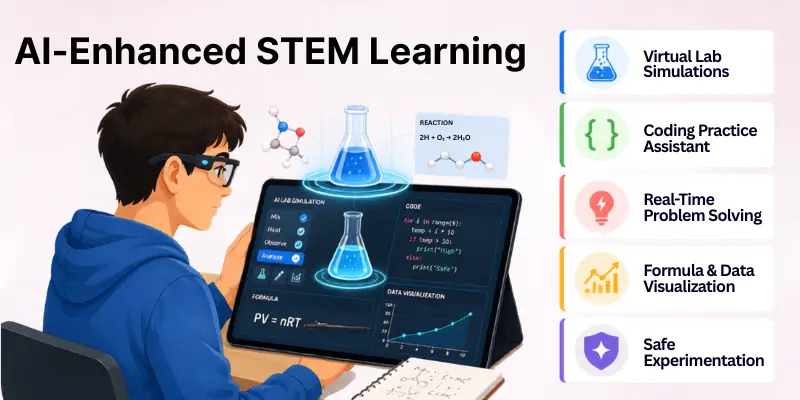
The STEM fields are made more interactive through the use of AI simulations and adaptive systems. Students have the opportunity to practice in secure virtual environments by utilizing artificial intelligence labs, coding assistants, and data simulators.
How It Works:
- Provides virtual lab simulations
- Assists with coding practice
- Offers real-time problem solving
- Visualizes complex formulas
- Encourages experimentation
10. Academic Integrity Monitoring
AI tools assist educational institutions in identifying instances of academic dishonesty, plagiarism, and cheating. These systems examine various submissions in comparison to extensive databases in order to recognize unusual patterns.
How It Works:
- Scans assignments for plagiarism
- Detects copied content
- Identifies unusual writing patterns
- Ensures fair assessment
- Protects academic standards
11. Career Guidance and Skill Mapping
AI utilizes a student’s academic performance, interests, and skills to make recommendations regarding potential career paths. Students can find internships, job opportunities, and programs that help them build their skills through this program.
How It Works:
- Evaluates academic profile
- Suggests career options
- Identifies skill gaps
- Recommends training courses
- Connects students to opportunities
12. Data-Driven Curriculum Development
Artificial intelligence assists educational institutions in updating their course offerings in response to changes in industry trends and the demands of the labor market. Keeping programs relevant requires it to conduct an analysis of job data and employer requirements.
How It Works:
- Tracks industry trends
- Analyzes skill demand
- Suggests curriculum updates
- Supports strategic planning
- Aligns courses with real-world needs
Future of AI in University Education
AI’s role in higher education will continue to expand in the coming years. Universities are expected to integrate deeper automation and smarter systems.
Future Trends:
- Fully adaptive degree programs
- AI-powered virtual professors
- Immersive AR/VR learning with AI guidance
- Advanced research automation
- Real-time global collaboration tools
- Personalized academic advisors powered by AI
AI will not replace professors but will enhance their capabilities and improve learning outcomes.
Final Note
In this guide, we have covered how AI changes university education by transforming teaching methods, research processes, assessment systems, and student experiences. As an expert perspective, AI should be used as a support system, not a replacement for human creativity and critical thinking. Universities must balance innovation with ethical use, ensuring fairness, privacy, and quality education standards.
Now, let us move to the FAQs to answer common questions about AI in university education.
FAQs
Here are some of the most commonly asked questions related to how AI changes university education:
No, AI does not replace professors. It helps by automating tasks and supporting teaching. Human knowledge, experience, and mentorship are still very important.
AI studies student performance and learning patterns. It then suggests study materials and practice exercises based on individual needs. This helps students learn at their own pace.
Yes, AI can help identify students who may be struggling. It uses data to give early warnings. This allows universities to provide support on time.
Yes, AI helps researchers analyze large amounts of data. It can assist with literature reviews, simulations, and complex modeling. This makes research faster and more accurate.
AI can grade quizzes, multiple-choice tests, and some written assignments. It also gives instant feedback to students. This saves time for professors.
The cost depends on the tool and the university’s needs. Many universities invest in AI because it improves efficiency and long-term results. Over time, it can save money and resources.
Some risks include data privacy concerns and possible bias in AI systems. There is also a risk of depending too much on automation. Proper rules and monitoring are important.
Yes, AI tools can check student work against large databases. They detect copied or suspicious content. This helps maintain academic honesty.
AI powers chatbots, adaptive learning platforms, and tracking tools. It helps answer student questions and monitor progress. This improves the online learning experience.
AI will continue to make learning more personalized and efficient. It will support research and automate many administrative tasks. However, human educators will always play a key role.





- Be Respectful
- Stay Relevant
- Stay Positive
- True Feedback
- Encourage Discussion
- Avoid Spamming
- No Fake News
- Don't Copy-Paste
- No Personal Attacks
- Be Respectful
- Stay Relevant
- Stay Positive
- True Feedback
- Encourage Discussion
- Avoid Spamming
- No Fake News
- Don't Copy-Paste
- No Personal Attacks
