How AI Helps in Business Forecasting: Complete Guide
Published: 6 May 2026
Business forecasting is vital for making informed decisions, planning budgets, and predicting future trends. Traditionally, forecasting relied on historical data and manual calculations, which could be slow and prone to errors.
Today, AI improves business forecasting by analyzing large datasets, identifying patterns, and predicting future outcomes with greater accuracy. This guide explains how AI helps in business forecasting, its benefits, and practical methods to implement it for smarter decision-making.
Let us cover everything in detail so your forecasts are accurate and reliable.
How AI Helps in Business Forecasting
Here are the 15 ways AI improves business forecasting and decision-making:
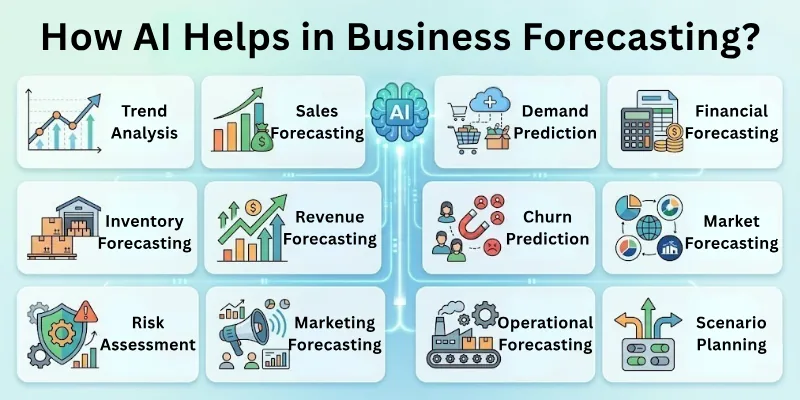
- Trend Analysis
- Sales Forecasting
- Demand Prediction
- Financial Forecasting
- Inventory Forecasting
- Customer Behavior Prediction
- Revenue Forecasting
- Churn Prediction
- Market Forecasting
- Supply Chain Optimization
- Risk Assessment
- Marketing Forecasting
- Operational Forecasting
- Scenario Planning
- Continuous Forecasting and Learning
Let us learn about each method in detail.
1. Trend Analysis
Manual trend analysis was time-consuming and limited to historical patterns. AI analyzes large datasets quickly and identifies trends across markets. Forecasts become data-driven. Decision-making improves. Businesses anticipate changes. Competitive advantage increases.
Prompts you can use:
- Identify emerging market trends
- Track seasonal patterns
- Compare historical and current data
- Predict future behavior
- Optimize strategy based on trends
2. Sales Forecasting
Traditional sales forecasts relied on spreadsheets and past sales only. AI predicts future sales by considering multiple variables like seasonality, customer behavior, and market trends. Forecasts are more accurate. Sales teams plan effectively. Inventory and production align with demand.
Prompts you can use:
- Predict monthly or quarterly sales
- Analyze product-wise sales trends
- Forecast new product performance
- Identify high-demand periods
- Optimize sales strategy
3. Demand Prediction
Manual demand planning was prone to overstock or stockouts. AI predicts demand based on historical sales, market trends, and customer behavior. Inventory levels are optimized. Waste reduces. Customer satisfaction increases. Supply chain is efficient.
Prompts you can use:
- Forecast product demand
- Adjust production schedules
- Prevent overstock and understock
- Identify high-demand regions
- Suggest reorder levels
4. Financial Forecasting
Manual financial forecasting was slow and error-prone. AI predicts revenues, expenses, and cash flow accurately. Financial planning improves. Budgets are realistic. Risk is minimized. Resource allocation becomes efficient.
Prompts you can use:
- Forecast monthly revenues and expenses
- Predict cash flow trends
- Analyze profit margins
- Suggest budget adjustments
- Evaluate financial scenarios
5. Inventory Forecasting
Inventory management relied on manual tracking. AI forecasts stock requirements based on sales trends and seasonality. Stockouts reduce. Overstocking decreases. Operations are smoother. Costs are minimized.
Prompts you can use:
- Predict inventory needs
- Suggest reorder points
- Analyze seasonal demand
- Optimize warehouse storage
- Align supply with demand
6. Customer Behavior Prediction
Manual insights into customer actions were limited. AI predicts purchasing patterns, preferences, and engagement. Segments customers effectively. Marketing and sales become targeted. Customer experience improves. Conversion rates increase.
Prompts you can use:
- Predict repeat purchases
- Identify high-value customers
- Forecast product preferences
- Suggest personalized campaigns
- Analyze engagement trends
7. Revenue Forecasting
Revenue forecasting traditionally used simple projections. AI predicts future revenues using multiple datasets and variables. Accuracy improves. Teams plan budgets effectively. Investors and stakeholders are informed. Business growth is supported.
Prompts you can use:
- Forecast monthly or yearly revenue
- Identify revenue drivers
- Predict impact of new initiatives
- Suggest revenue optimization strategies
- Monitor forecast accuracy
8. Churn Prediction
Manual churn tracking was reactive. AI predicts customers likely to leave. Retention strategies are proactive. Engagement improves. Customer lifetime value increases. Revenue stability strengthens.
Prompts you can use:
- Identify at-risk customers
- Predict churn probability
- Suggest retention campaigns
- Monitor engagement changes
- Improve customer loyalty
9. Market Forecasting
Market predictions were often based on limited historical data. AI analyzes industry trends, competitor activity, and external factors. Market demand is predicted accurately. Strategic decisions are informed. Marketing campaigns align with trends. Growth opportunities increase.
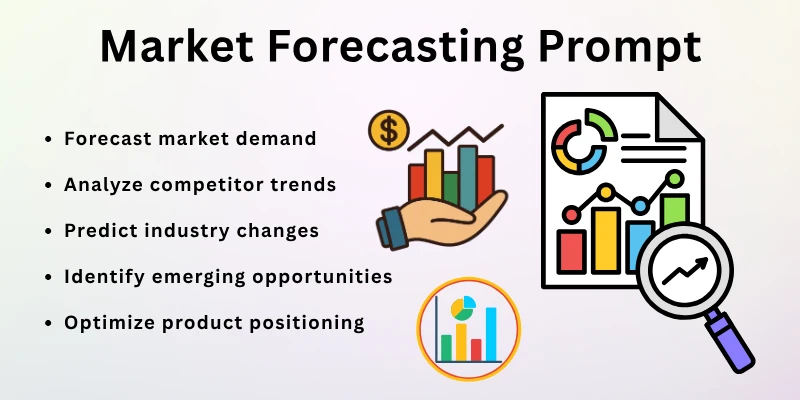
Prompts you can use:
- Forecast market demand
- Analyze competitor trends
- Predict industry changes
- Identify emerging opportunities
- Optimize product positioning
10. Supply Chain Optimization
Supply chain planning manually was complex. AI predicts delays, demand, and logistics needs. Inventory and shipments align with actual demand. Costs reduce. Efficiency improves. Operations are streamlined.
Prompts you can use:
- Forecast supply chain needs
- Identify potential delays
- Optimize delivery schedules
- Reduce transportation costs
- Align supply with demand
11. Risk Assessment
Risk evaluation was time-consuming and incomplete. AI forecasts potential risks in finance, operations, and markets. Businesses prepare proactively. Losses reduce. Decision-making becomes safer. Contingency planning improves.
Prompts you can use:
- Identify financial risks
- Predict operational challenges
- Evaluate market volatility
- Suggest risk mitigation
- Monitor risk trends
12. Marketing Forecasting
Marketing results were often unpredictable. AI forecasts campaign performance, engagement, and ROI. Campaigns are optimized for maximum impact. Marketing spend is efficient. Strategy aligns with predicted outcomes. Performance improves.
Prompts you can use:
- Predict campaign ROI
- Forecast audience engagement
- Adjust marketing channels
- Identify high-performing segments
- Optimize marketing budget
13. Operational Forecasting
Operational planning manually was slow. AI predicts resource requirements, workforce needs, and task durations. Operations become efficient. Delays are minimized. Costs reduce. Planning is data-driven.
Prompts you can use:
- Forecast staffing needs
- Predict resource utilization
- Plan production schedules
- Optimize operational processes
- Track performance metrics
14. Scenario Planning
Scenario analysis was labor-intensive. AI models different business scenarios using variables and predicts outcomes. Decision-makers prepare for multiple possibilities. Strategy becomes flexible. Risk reduces. Outcomes are optimized.
Prompts you can use:
- Model best-case and worst-case scenarios
- Predict financial outcomes
- Evaluate operational impact
- Optimize strategic planning
- Suggest alternative approaches
15. Continuous Forecasting and Learning
Traditional forecasts were static. AI continuously learns from new data to update predictions. Accuracy improves over time. Businesses adapt quickly. Strategies remain relevant. Forecasts are always optimized.
Prompts you can use:
- Update forecasts regularly
- Learn from historical performance
- Adjust predictions with new data
- Monitor forecast accuracy
- Improve over time
Best AI Tools for Business Forecasting
Here are the 10 best AI tools for business forecasting.
- Anaplan – Predictive business planning and forecasting platform.
- Oracle NetSuite – AI-driven financial and operational forecasting.
- IBM Planning Analytics – AI-powered forecasting and planning.
- SAP Analytics Cloud – Predictive analytics and forecasting.
- Adaptive Insights – Business planning and forecasting tool.
- Fathom – Financial forecasting and analysis with AI insights.
- Board – Predictive analytics and scenario planning.
- Prevedere – Market and business forecasting platform.
- Forecast Pro – Statistical and AI forecasting software.
- Planful – AI-assisted financial planning and forecasting.
Final Note
In this guide, we explained how AI helps in business forecasting with practical methods and examples. We covered trend analysis, sales, demand, revenue, and continuous learning. Each method ensures forecasts are more accurate, timely, and data-driven.
My personal advice is to start with high-priority areas like sales or revenue forecasting first, test predictions, and gradually expand to other business functions. Continuous monitoring and AI insights improve decision-making over time.
Thank you for reading. I hope this guide helps you plan smarter and make informed business decisions.
FAQs
Here are some of the most commonly asked questions related to how AI helps in business forecasting:
AI business forecasting uses data and patterns to predict future trends. It analyzes sales, market trends, and customer behavior. Forecasts become more accurate and reliable. Teams make informed decisions quickly. Planning and strategy improve overall performance.
AI studies large amounts of historical data. It identifies trends and patterns humans might miss. Predictions become more precise. Errors are reduced, and outcomes are more reliable. Businesses can plan with confidence.
Yes, AI forecasts sales, revenue, and demand. It considers multiple factors like seasonality and customer behavior. Businesses can adjust production and inventory proactively. Revenue goals are easier to achieve. Planning becomes data-driven.
Yes, many AI tools are affordable and easy to use. Small businesses can forecast without hiring data experts. Predictions help optimize resources and strategy. Decision-making becomes faster and smarter. Teams save time and reduce risks.
Yes, AI analyzes competitor activity, customer behavior, and market changes. Trends are identified early. Businesses can adapt their strategy proactively. Opportunities and threats are easier to spot. Teams stay ahead of the competition.
AI works in real time using available data. Forecasts can be generated instantly or regularly. Teams get timely insights for decisions. Planning becomes faster and more effective. Adjustments are made without delay.
Yes, AI identifies potential risks and market fluctuations. Businesses can act before issues escalate. Decisions are data-driven instead of guesswork. Risk management becomes more proactive. Financial losses are minimized.
Yes, AI processes large volumes of data efficiently. It can analyze multiple sources simultaneously. Businesses can forecast for multiple regions or products. Accuracy stays high even with complex data. Scaling forecasting is simple.
Costs vary depending on tools and scale. Many platforms offer affordable options for small teams. ROI is usually higher than the investment. Forecasting becomes faster and more accurate. Businesses save money by avoiding wrong decisions.
Yes, AI forecasts help shape long-term business strategies. Teams plan budgets, resources, and marketing more effectively. Predictions guide growth and expansion. Decision-making becomes proactive. Companies stay competitive in changing markets.


- Be Respectful
- Stay Relevant
- Stay Positive
- True Feedback
- Encourage Discussion
- Avoid Spamming
- No Fake News
- Don't Copy-Paste
- No Personal Attacks
- Be Respectful
- Stay Relevant
- Stay Positive
- True Feedback
- Encourage Discussion
- Avoid Spamming
- No Fake News
- Don't Copy-Paste
- No Personal Attacks
